Z.ai ZCode vs DeepSeek Harness: Which Open-Source Agent Platform Should You Choose?
A direct, no-fluff architectural comparison between Z.ai ZCode and DeepSeek Harness (dsh): comparing runtime surfaces, plugin philosophy, remote development, and multi-agent coordination.
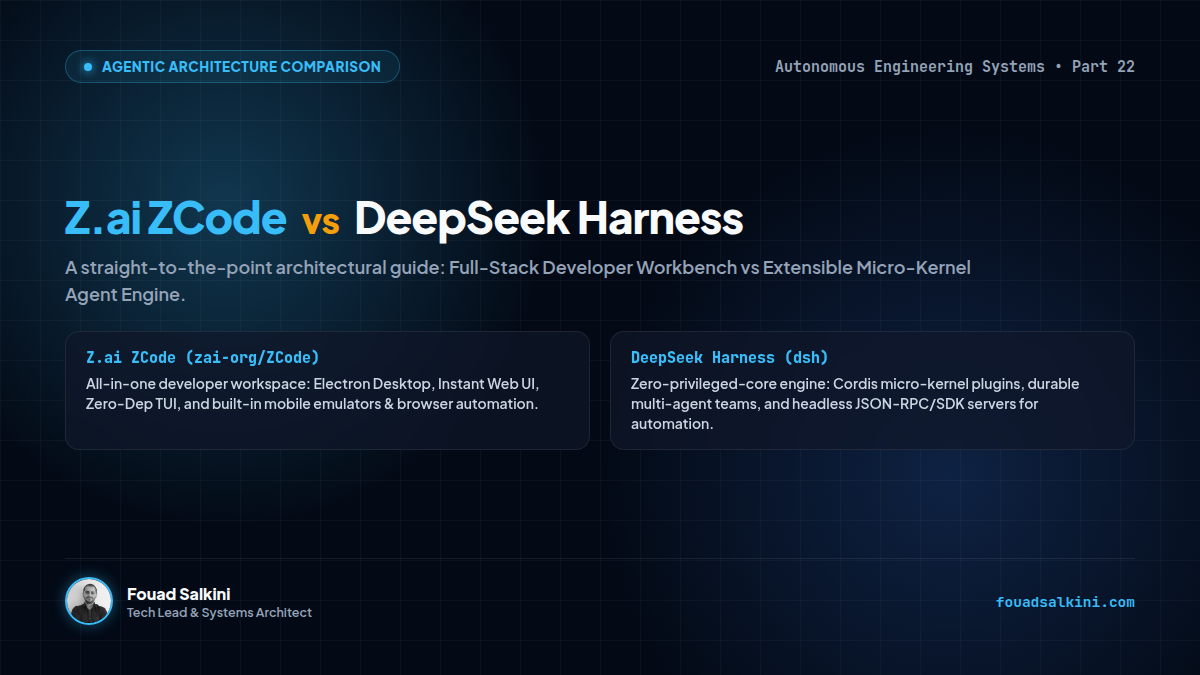
Open-source agentic coding frameworks are evolving at breakneck speed. Within the span of a few weeks, two major AI labs open-sourced their flagship agent platforms:
- Z.ai (Zhipu AI): Open-sourced ZCode (
zai-org/ZCode), a full-stack, multi-surface coding agent workbench. - DeepSeek AI: Open-sourced DeepSeek Harness (
deepseek-ai/deepseek-harness, CLI:dsh), a micro-kernel agent engine built on the principle that “everything is a plugin.”
While both projects aim to liberate developers from closed agent ecosystems like Claude Code or Cursor, their internal architectures, developer ergonomics, and target workloads differ fundamentally.
Here is a straightforward, direct engineering comparison to help you choose the right platform for your stack.
1. Architectural Philosophy: Workbench vs Engine
The difference between ZCode and DeepSeek Harness boils down to where the abstraction boundary sits:
| Dimension | Z.ai ZCode (zai-org/ZCode) |
DeepSeek Harness (deepseek-ai/dsh) |
|---|---|---|
| Core Concept | All-in-one Developer Workbench | Micro-Kernel Agent Engine |
| Underlying Framework | TypeScript / Electron / Zustand / Custom RPC | Cordis (arXiv:2608.25512) |
| Plugin Architecture | Hybrid (Model Context Protocol + CLI Plugins) | Zero-Privileged Core (everything is a replaceable plugin) |
| Primary Interaction | Desktop GUI & Web Browser & Terminal TUI | Headless CLI, Web UI, JSON-RPC SDK & ACP Server |
| Target User | Everyday software engineers and product teams | Platform architects, CI/CD automation, and agent researchers |
ZCode: The Complete Workbench
ZCode is designed to be installed and used immediately as a daily driver. It bundles a desktop interface, a terminal interface, and a browser UI into a coherent monorepo. You don’t build with ZCode; you develop inside ZCode.
DeepSeek Harness: The Composable Engine
DeepSeek Harness (dsh) treats every component—the model provider, the tool registry, the session logger, and even the agent reasoning loop itself—as an unprivileged Cordis plugin. You can literally swap out how the agent plans, or replace the entire prompt assembler, using declarative YAML patches without modifying core source code.
2. Interaction Surfaces (Surfaces Breakdown)
Both platforms provide multiple surfaces, but with distinct ergonomics:
ZCode Surfaces:
- Electron Desktop (
packages/desktop): A sleek GUI with live visual diffs, chat timeline, and execution traces. - Instant Web UI (
zcode --web): Runs an authenticated HTTP/WebSocket server so you can drive and monitor agent tasks from a tablet or phone over your local network (--host 0.0.0.0). - Zero-Dependency Terminal (
apps/zcode-cli): An interactive terminal UI (TUI) written with zero production dependencies, relying strictly on native Node.js primitives and compilable into a Single Executable Application (SEA).
DeepSeek Harness Surfaces:
- Web UI (
dsh web): Browser interface served on port3080. - Headless Runner (
dsh headless): One-shot agent execution without a persistent server, ideal for CI/CD pipelines. - SDK Server (
dsh sdk): Full JSON-RPC server enabling external Python, TypeScript, or Go applications to programmatically control agent sessions. - ACP Automation (
dsh acp): Headless server adhering strictly to the Agent Client Protocol for autonomous tool delegation.
3. Remote Development & Environments
How do the two handle remote servers and cloud workspaces?
- ZCode Remote Workspaces:
ZCode features dedicated remote workspace support over SSH and WSL (pnpm bootstrap:with-remote). Crucially, it uses an internal SFTP streaming pipeline to synchronize runtime assets locally-to-remote, preventing network bottlenecks and eliminating dependencies on external CDNs. - DeepSeek Harness Decoupled Sandboxing:
DeepSeek decouples the filesystem and subprocess execution through swappable capability seams (ctx.fsandctx.sandbox). You can mount a remote container or a microVM sandbox, and the agent’s Bash, PTY, and LSP automatically target the remote environment without changing the agent loop.
4. Extensibility: Plugins vs Cordis Seams
ZCode Built-in Toolkit:
ZCode ships out-of-the-box with high-value plugins located in ~/.zcode/cli/plugins:
browser-use: Visual and headless browser automation for web scraping and QA.document-skills: Extraction and authoring of PDFs, Office documents, and markdown knowledge bases.ios-simulator&android-emulator: Native mobile app testing and emulator control.- Full support for connecting to external Model Context Protocol (MCP) servers.
DeepSeek Harness Cordis Seams:
DeepSeek Harness takes modularity to the extreme:
- Reversible Effects: Plugins mount and unmount cleanly; if an extension fails, its effects are completely unwound.
- Hot Module Replacement (HMR): You can update agent behavior, prompt schemas, and tools live without restarting long-running sessions.
- Native Agent Teams: DeepSeek includes built-in multi-agent orchestration (
ctx.agentTeams), offering durable agent rosters, task dispatch boards, and internal inter-agent mailboxes.
5. Direct Decision Matrix: Which One Should You Pick?
                      Do you need a daily-driver coding environment?
                                       │
                      ┌────────────────┴────────────────┐
                     YES                                NO
                      │                                 │
           Choose Z.ai ZCode                     Do you need to build
      (Electron + Web + TUI + Emulators)      custom agent infrastructure
                                             or CI/CD autonomous pipelines?
                                                        │
                                                        YES
                                                        │
                                            Choose DeepSeek Harness
                                       (Cordis Micro-Kernel + Headless SDK)
Choose Z.ai ZCode if:
- You want an immediate, open-source alternative to Claude Code, Cursor, or Windsurf.
- You develop mobile applications (iOS/Android) and need built-in simulator drivers.
- You frequently work on remote cloud instances over SSH and want an intuitive GUI/TUI interface.
- You want zero-hassle local network access (
zcode --web) to review code and drive agents from your phone or tablet.
Choose DeepSeek Harness if:
- You are building an enterprise agent platform and need complete control over every layer (custom loops, swappable memory, sandboxed runtimes).
- You want to run multi-agent fleets (Agent Teams) that coordinate tasks via internal mailboxes and shared state.
- You need headless integration into CI/CD workflows or backend microservices via JSON-RPC.
- You value mathematical rigor and formal architectural isolation over pre-packaged UI bells and whistles.
Summary
Both frameworks represent a monumental leap for the open-source agent ecosystem:
- Z.ai ZCode wins on developer ergonomics, ready-to-use tooling, and multi-surface polish.
- DeepSeek Harness wins on modular architecture, headless automation, and multi-agent coordination.
Both repositories are freely accessible on GitHub:
- Z.ai ZCode: github.com/zai-org/ZCode
- DeepSeek Harness: github.com/deepseek-ai/deepseek-harness

Written by Fouad Salkini (فؤاد سلقيني)
General Manager & Tech Lead at Tripnologies and Sync Studios. Systems Architect focusing on AI coding agents, DevOps, and quantitative systems.