Unhobbling Claude: The 12 New Rules of Context Engineering for Opus 5.5
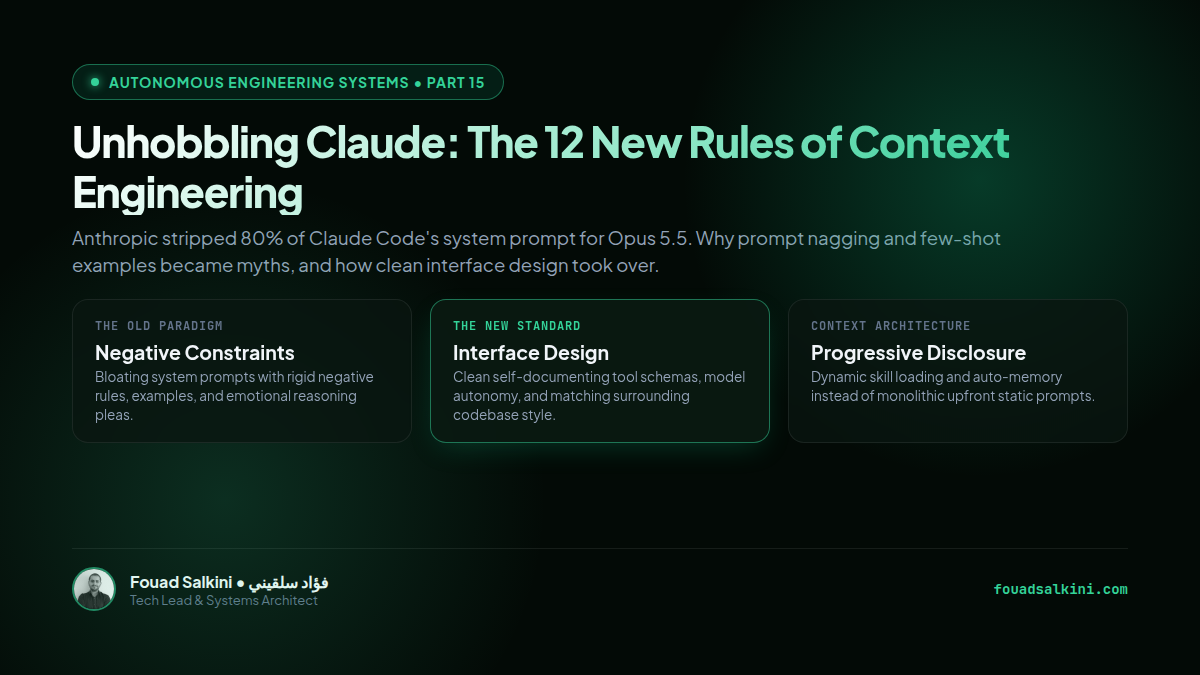
Anthropic stripped over 80% of Claude Code's system prompt for Opus 5.5. An architectural breakdown of why mega-prompts, few-shot examples, and prompt nagging are obsolete, and how progressive disclosure and interface design define the new era of coding agents.
For the past two years, the AI developer community has been operating under an unspoken collective anxiety: the need to overconstrain models.
Engineers spent countless hours crafting monolithic system prompts stuffed with dozens of negative rules: "Never write comments," "Always format outputs in JSON," "Think step-by-step," "Do not invent packages," and endless few-shot examples illustrating every edge case. We treated frontier LLMs like brittle, unruly interns that required constant hovering, repetition, and micro-management.
Anthropic recently published an internal post-mortem and guidelines that shattered these legacy assumptions: "The New Rules of Context Engineering for Claude 5 Generation Models (Unhobbling Claude)."
When benchmarked against real-world software engineering repositories, Anthropic’s team discovered something counterintuitive: their own extensive system prompts were actually degrading Claude Code’s performance. By attempting to guard against every worst-case scenario, the prompt created conflicting directives that paralyzed the model’s emergent problem-solving capabilities.
In response, Anthropic deleted over 80% of Claude Code’s system prompt for Opus 5.5.
Here is an architectural breakdown of what changed, why legacy prompt engineering rules have become engineering anti-patterns, and the 12 principles that define modern context engineering.
1. The Core Paradigm Shift: Then vs. Now
Anthropic contrasted the transition between the Claude 3/4 era and the Claude 5/Opus 5.5 era across four fundamental dimensions:
| Architectural Dimension | Legacy Practice (Then) | Modern Context Engineering (Now) |
|---|---|---|
| Model Behavioral Guidance | Enumerate rigid rules & negative prohibitions | Allow model judgment; instruct it to match surrounding codebase style |
| Tool Usage Guidance | Few-shot examples embedded directly in prompt | Clean, self-documenting interface design & strict parameter schemas |
| Prompt Delivery Structure | Stuff all tools, docs, and rules upfront | Progressive Disclosure: Load skills and files dynamically on demand |
| Instruction Reinforcement | Nagging and repeating instructions multiple times | Single, concise instruction; trust frontier attention mechanisms |
| Context Memory Architecture | Monolithic CLAUDE.md stuffed with project lore |
Dynamic auto-memory and scoped progressive reference links |
Let’s dissect the primary lessons and how you should adapt your coding agent configurations.
2. The 12 New Rules for Frontier Models
Rule 1: Delete "Think Carefully" and Emotional Pleasing
Older prompts frequently used phrases like "Think carefully," "This is critical to my career," or "Take a deep breath." In Opus 5.5 and frontier reasoning architectures, reasoning tokens and chain-of-thought are intrinsic to the model. Emotional pleading consumes precious attention budget without improving benchmark performance.
Rule 2: Hand Over the Entire Task with a Defined Finish Line
Micro-prompting (asking the agent to plan, then stop, then draft, then stop) creates context fragmentation and high round-trip latency. Instead, provide the end-state criteria: the test suite that must pass, the verification command that must return exit code 0, and let the model execute end-to-end.
Rule 3: Stop Micromanaging Comments; Instruct Style Matching
Old system prompts instructed: "Never write comments or docstrings." When an engineer asked Claude to write documentation, this created a direct logical contradiction. The new rule is simple and adaptive:
"Write code that reads like the surrounding codebase: match its comment density, indentation, naming conventions, and architectural idioms."
Rule 4: Design Interfaces Instead of Few-Shot Examples
Providing few-shot examples of tool calls bloats the system prompt and biases the model toward the specific edge cases shown in the example. Instead, spend your engineering effort on Tool Interface Design:
- Use descriptive parameter names and explicit JSON Schema enums (
status: ['pending', 'in_progress', 'completed']). - Return structured, parseable tool outputs.
- A well-designed tool schema eliminates the need for tool-calling examples entirely.
Rule 5: Adopt Progressive Disclosure (Skills & References)
Stuffing a 30,000-token master prompt at the beginning of every turn is wasteful and degrades retrieval accuracy. Frontier context architectures (such as Hermes Agent skills or Claude Code skills) keep the base system prompt under 1,500 tokens. Specialized procedures, database schemas, and deployment recipes are stored as standalone reference files and loaded only when the task triggers them.
Rule 6: Replace Monolithic Static Memory with Dynamic Auto-Memory
Large CLAUDE.md or SYSTEM.md files that accumulate weeks of raw conversation history act as noise. Split memory into high-signal declarative facts (user profile, stable environment parameters) and move operational procedures into version-controlled skills.
Rule 7: Name the Design Patterns You DON’T Want
Vague constraints like "Write clean code" produce generic boilerplate. If you want to avoid specific pitfalls, name them explicitly: "Do not use ORM queries inside tight loops; use batch joins." "Avoid mock-heavy tests; prefer black-box integration tests."
Rule 8: Never Repeat Instructions
If an agent fails to follow an instruction on turn 1, repeating the exact same sentence with exclamation marks in turn 2 rarely fixes the root issue. It indicates that the model is facing conflicting directives in its context window or ambiguous tool outputs. Fix the conflicting constraint rather than shouting at the model.
Rule 9: Maintain a 20-30% Context Headroom Buffer
Filling an agent’s context window to 98% capacity causes severe "context cliff" degradation. Always configure auto-compaction and summarize working state before context utilization exceeds 80%.
Rule 10: Steer Long Runs via Tool Telemetry, Not Interruptions
For multi-turn autonomous runs, verify progress using real tool execution (linters, test runners, git diffs) rather than asking the agent to explain what it plans to do. The ground truth lives in the filesystem.
Rule 11: Decouple Fast Execution from Frontier Reasoning
Do not waste high-compute frontier reasoning models on mechanical file renaming, linting, or grep operations. Delegate deterministic or lightweight work to subagents or smaller models, preserving the primary reasoning engine for architectural synthesis.
Rule 12: The Golden Rule: When in Doubt, Simplify
If an agent begins hallucinating or looping, the solution is almost never to add more rules. Audit the system prompt and delete half of it. Unhobble the model and give it clean tools.
3. Practical Architecture Takeaway
The transition from prompt engineering to context engineering is complete. We are no longer "prompting" models; we are designing operating environments, tool APIs, and progressive disclosure layers for autonomous agents.
Strip the fluff, design clean interfaces, and let the model exercise judgment.
Sources & References: Anthropic Engineering Publications, Claude Code Internal Architecture Review, and Production Agent Orchestration Benchmarks.

Written by Fouad Salkini (فؤاد سلقيني)
General Manager & Tech Lead at Tripnologies and Sync Studios. Systems Architect focusing on AI coding agents, DevOps, and quantitative systems.