The Filesystem Is the Agent Architecture: Why Google OKF and ICM Prove the "Anti-Framework" Thesis
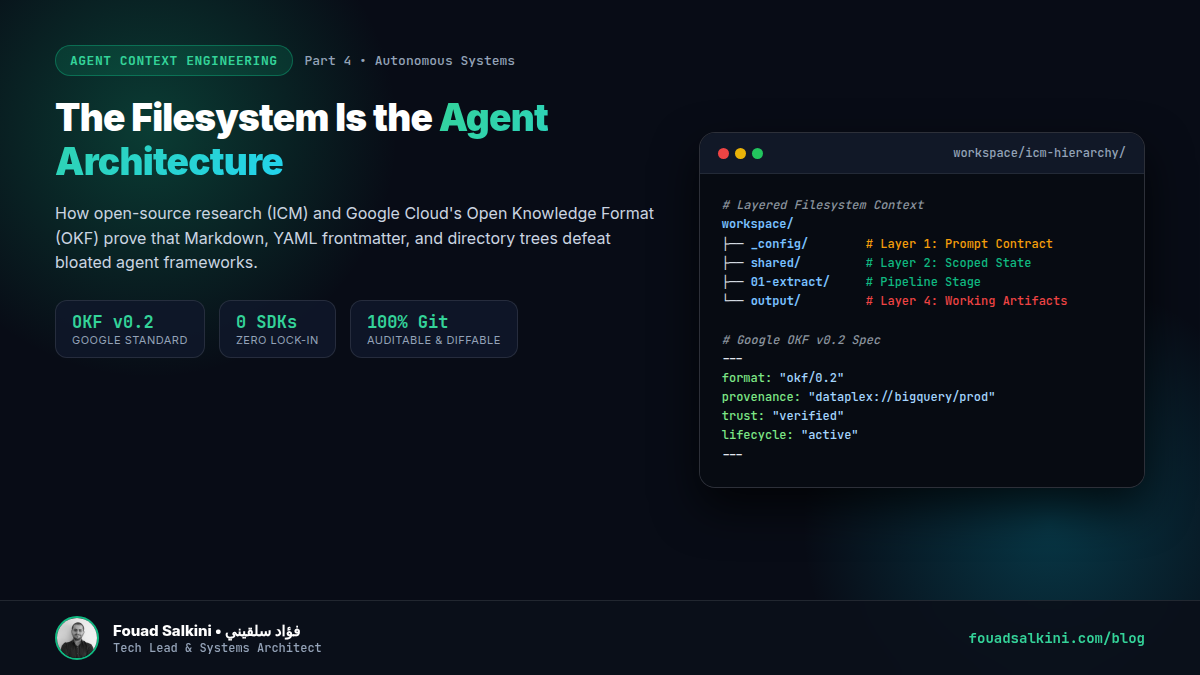
How open-source researcher Jake Van Clief's ICM paper and Google Cloud's Open Knowledge Format (OKF) prove that Markdown, YAML frontmatter, and directory trees outperform bloated multi-agent frameworks.
When open-source researcher Jake Van Clief (@lostandlucky) posted a viral breakdown claiming “Google stole my research—that’s how you know it’s good,” the AI community took it as entertaining social banter.
Beneath the viral humor lies one of the most critical architectural shifts in modern AI engineering: the total vindication of the “Anti-Framework” thesis.
Van Clief’s published paper on arXiv (Interpretable Context Methodology: Folder Structure as Agentic Architecture, arXiv:2603.16021) demonstrated that sequential multi-agent pipelines do not need bloated orchestration frameworks (LangGraph, CrewAI, AutoGen). Instead, the filesystem itself is the orchestrator.
Weeks later, Google Cloud’s Data Cloud team published the Open Knowledge Format (OKF v0.2)—a vendor-neutral standard specifying knowledge not as vector databases or proprietary SDKs, but as plain Markdown files with YAML frontmatter organized in a directory hierarchy.
Why are frontier engineering teams and academic researchers converging on the exact same conclusion?
1. The Multi-Agent Framework Hangover
Over the past two years, enterprise AI teams rushed to adopt multi-agent frameworks that manage context passing, state synchronization, and step coordination entirely in code.
In production, these frameworks introduced fatal failure modes:
- Context Pollution: Frameworks frequently dump sprawling conversation histories into the LLM context, bloating token burn and triggering cognitive drift.
- Opaque State Machines: Debugging a failed 7-agent execution chain buried inside asynchronous Python classes is a developer nightmare.
- Proprietary Vendor Lock-In: Custom state formats make it impossible to audit, diff, or migrate knowledge across tools or model providers.
The Bloated Framework Approach:
[Agent 1] ──(Python Memory Class)──> [Vector DB] ──(Custom SDK)──> [Agent 2] ──(Deadlock/Drift)

The Filesystem-Native Approach (ICM / OKF):
[Layer 1: Prompt Contract] ──> [Layer 2: Scoped Directory] ──> [Layer 4: Diffable Artifacts on Disk]
2. Interpretable Context Methodology (ICM): Folder Hierarchy as Memory
In his arXiv paper, Van Clief formalized what pragmatic engineers call Model Workspace Protocol (MWP) or ICM.
Instead of spawning 7 concurrent agents with complex inter-process communication, you deploy a single agent operating over an explicit, numbered directory hierarchy:
- Layer 1 (System Prompts & Constraints): Stored in
_config/orsetup/questionnaire.md. Defines immutable operational boundaries. - Layer 2 (Control & Scoped State): Dedicated input contracts specifying exactly which files and sections the agent is allowed to read for the current step.
- Layer 3 (Reference Material): Read-only canonical knowledge bases and schemas that do not mutate during runs.
- Layer 4 (Working Artifacts): The
output/directory where the agent writes files that change on every iteration.
As Van Clief concisely stated:
“This is the filesystem doing the work that an orchestrator would otherwise do in code. Stage sequencing is folder numbering. Context scoping is the files on disk.”
By reading only two markdown files and a single folder drawer instead of 10,000 files, the agent operates with deterministic precision, zero framework overhead, and minimal token cost.
3. Google’s Open Knowledge Format (OKF): The Enterprise Standard
Google Cloud’s release of OKF v0.2 (led by BigQuery and Data Cloud engineering leads Sam McVeety and Amir Hormati) validates this exact thesis at hyperscale.
OKF defines knowledge as a portable directory of Markdown documents enriched with lightweight YAML frontmatter:
---
title: "Quarterly Revenue Ledger"
format: "okf/0.2"
provenance: "dataplex://bigquery/prod/financial_ledger"
trust: "verified"
lifecycle: "active"
tags:
  - "fintech"
  - "compliance"
---

## Definition
Recognized revenue sums `amount` over rows booked to the active fiscal period,
computed deterministically by [the revenue computation](../computations/revenue.md).
Why OKF Rejects Complex SDKs:
- Human-Readable: Anyone can open, read, and edit it in Obsidian, VS Code, or plain terminal
cat. - Agent-Friendly: Any agent can parse YAML headers and chunk Markdown sections without custom client libraries.
- Git-Native: Knowledge changes are versioned, reviewed in pull requests, and diffable via standard
git diff. - Zero Runtime Overhead: No server daemons, no vector embeddings required to know where definitions live.
4. The Production Blueprint: How We Implement This
In our production systems at Tripnologies and Sync Studios, we enforce strict filesystem contracts across all autonomous coding harnesses:
// Production Filesystem Contract Checker
import fs from "node:fs/promises";
import path from "node:path";
import yaml from "js-yaml";

interface OKFHeader {
  title: string;
  format: string;
  trust: "unverified" | "curated" | "verified";
  provenance: string;
}

export async function validateAgentScope(workspaceDir: string, stage: number): Promise<boolean> {
  const stageFolder = path.join(workspaceDir, `stage-0${stage}`);
  const contractPath = path.join(stageFolder, "CONTRACT.md");

  const raw = await fs.readFile(contractPath, "utf-8");
  const match = raw.match(/^---\n([\s\S]+?)\n---/);
  if (!match) throw new Error(`Missing OKF contract in stage ${stage}`);

  const header = yaml.load(match[1]) as OKFHeader;
  return header.trust === "verified";
}
The Verdict
The AI industry spent the last two years trying to reinvent databases, operating systems, and memory stores inside complex Python abstractions.
The convergence of open-source research like Jake Van Clief’s ICM and enterprise standards like Google’s OKF sends an unmistakable signal to systems architects:
Stop wrapping your AI agents in thousands of lines of fragile framework boilerplate. The filesystem was the ultimate multi-agent orchestrator all along.

Written by Fouad Salkini (فؤاد سلقيني)
General Manager & Tech Lead at Tripnologies and Sync Studios. Systems Architect focusing on AI coding agents, DevOps, and quantitative systems.