Subscriptions Are Dead: The Future Is Headless Software and Outcome-Based Pricing
An architectural autopsy of software monetization in the agentic era: why AI agents running in terminal harnesses (Claude Code, Hermes) make GUI dashboards obsolete, how the traditional Build vs. Buy calculus is permanently inverted, and why per-seat monthly SaaS is being replaced by Headless Pay-Per-Result pricing.
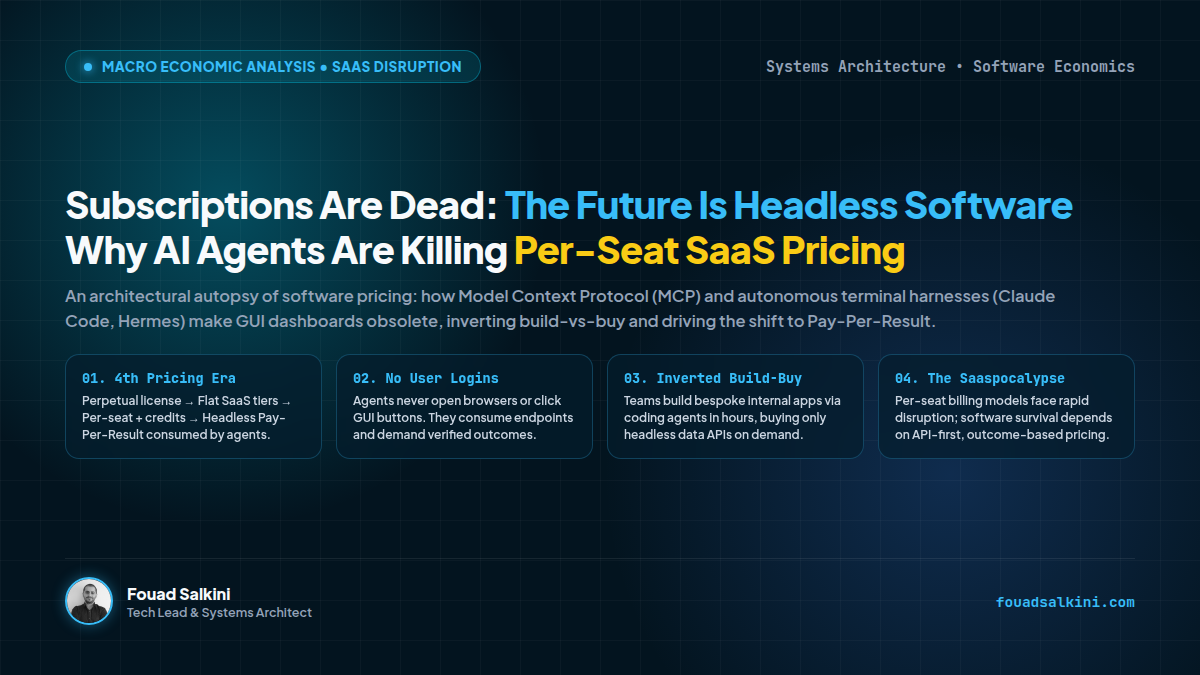
A quiet but devastating tectonic shift is dismantling the economic foundation of the modern software industry.
For twenty years, the enterprise software ecosystem ran on an uncontested formula: Software-as-a-Service (SaaS) priced per user seat, billed monthly or annually. You hired knowledge workers, provisioned them $49/month or $99/month subscriptions to Salesforce, HubSpot, Linear, Jira, and Zendesk, and expected those humans to log in, navigate dashboards, and click buttons.
Recently, tech founder and investor David Arnoux posted a concise reality check on LinkedIn that crystallized what forward-thinking systems architects have been watching unfold:
“Subscriptions are dead. The future is headless… Just look at how a lot of us work. People wire a dozen amazing tools into their Claude, their Claude Code, or their Codex through MCP or API and then they build and run GTM campaigns, dashboards, and apps from the terminal. The future marketer, product person, RevOps, and builder all end up in the same place: a command line and a conversation. The future is headless.”
Why does the arrival of autonomous AI agents spell doom for traditional per-seat subscriptions? How is the software pricing model evolving? And what replaces it?
Here is an architectural and macroeconomic analysis.
1. The Four Eras of Software Monetization
To understand where software pricing is heading, we must look at how we got here:
┌────────────────────────────────────────────────────────────────────────┐
│                    The Evolution of Software Pricing                   │
├────────────────────┬────────────────────┬──────────────────────────────┤
│ Era                │ Pricing Model      │ Underlying Human Dynamic     │
├────────────────────┼────────────────────┼──────────────────────────────┤
│ 1. Perpetual (90s) │ One-time upfront   │ Software shipped on CDs/disk │
│ 2. SaaS 1.0 (2010s)│ Flat monthly tiers │ Hosted multi-tenant web apps │
│ 3. SaaS 2.0 (2020s)│ Per-seat + credits │ Metered human seats & quotas │
│ 4. Headless (2026+)│ Pay-per-Result     │ Autonomous agent invocation  │
└────────────────────┴────────────────────┴──────────────────────────────┘- The Perpetual Era: You purchased a boxed CD with an activation key ($499 upfront). You owned the binary forever, and vendors made money by selling upgrades every three years.
- The Flat SaaS Era: Cloud hosting made continuous delivery possible. Pricing shifted to predictable tiers ($29 / $49 / $99/month).
- The Per-Seat + Usage Era: Sales teams optimized monetization by tying licenses to human employee headcounts, accompanied by obscure “credit” pools that expired at the end of each billing cycle.
- The Headless Agentic Era: Software is no longer operated by human fingers clicking through browser tabs. It is invoked programmatically by autonomous coding agents via the Model Context Protocol (MCP) or REST APIs.
2. The Core Breakdown: Why Agents Break the SaaS Formula
The per-seat subscription model depends on three fundamental assumptions that autonomous agents completely shatter:
[ Traditional SaaS Model ]
Human Employee ──(Logs into Web GUI)──> Clicks Buttons ──> Vendor Bills $99/seat/mo

[ Headless Agentic Model ]
Human Prompt ──> [ Autonomous Agent ] ──(MCP Tool Call)──> Raw API ──> Verified Result
                         │
                         ▼
             No Browser • No GUI • No Seat
             (Paying $99/month makes zero economic sense)
1. Agents Never Log In
A per-seat license assumes an identifiable human sitting in front of a monitor, logging in with SSO, clicking navigation menus, and reading visual charts.
An autonomous agent (whether running inside Hermes Agent, Claude Code, Codex, or Cursor) does none of these things:
- It never views your CSS stylesheets or marketing banners.
- It doesn’t interact with your carefully designed UI modals.
- It requires a structured JSON payload, executes a task, and exits in 400 milliseconds.
Paying a fixed $120/month seat fee for an entity that interacts via curl commands over a terminal connection is an absurd capital misallocation.
2. The Fragmentation of Subscriptions and API Keys
Currently, an engineer wiring tools into an agent runtime faces an administrative nightmare:
- They need a $50/month subscription to Provider A.
- A $100/month subscription to Provider B.
- A credit package on Provider C.
- 15 different API keys stored in
.envfiles with disparate billing dashboards.
When an agent needs to perform an enrichment task, search a company database, or fetch financial records, it doesn’t want an active subscription—it wants a single, verified result, delivered at the lowest latency and cheapest market cost.
3. The Outcome-Based Pricing Inversion (Pay-Per-Result)
Why should an enterprise pay for tool availability when what matters is the outcome?
- In the headless era, pricing shifts from Access to Availability to Settlement on Outcome:
- Did the API verify the customer’s identity? Bill $0.02.
- Did the scraper extract the valid financial statement? Bill $0.005.
- Did the call fail or return empty data? Bill $0.00.
3. The Great Build vs. Buy Inversion
For the last fifteen years, standard engineering doctrine was dogmatic:
“Never build what you can buy as a SaaS subscription.”
Need internal CRM workflows? Buy Salesforce. Need feature flagging? Buy LaunchDarkly. Need form processing? Buy Typeform. Building custom internal software was prohibitively expensive because software engineers cost $200,000/year.
Autonomous coding agents have inverted this equation 180 degrees:
[ Pre-2024 Calculus: Buy > Build ]
Building custom internal tool = 6 months + 3 engineers ($150,000)
Buying SaaS = $150/user/month ($18,000/year) ──> BUY WINS.

[ 2026 Calculus: Build > Buy ]
Building custom internal tool with Claude Code / Hermes = 4 hours + API tokens ($25)
Buying enterprise SaaS = $150/user/month + annual contract lock-in ──> BUILD WINS.
Engineering teams and AI-native startups are no longer buying bloated off-the-shelf SaaS applications. Instead, they prompt their coding agent to scaffold a tailored internal dashboard using Astro, Tailwind, and SQLite in an afternoon.
What do they buy? Only headless data and infrastructure APIs—raw phone validation, vector embeddings, cloud storage, credit card rails, and compute endpoints. The frontend software layer is commoditized; the underlying data layer is all that remains valuable.
4. The Emergence of Unified MCP Tool Gateways
Just as OpenRouter emerged as a unified gateway allowing developers to route prompts across dozens of LLM providers with a single API key, we are seeing the birth of Unified Headless Tool Gateways (such as David Arnoux’s looot and next-generation MCP registries):
┌─────────────────────────────────────────────────────────────┐
│                 Autonomous Agent Terminal                   │
│         (Claude Code • Hermes Agent • Codex CLI)            │
└──────────────────────────────┬──────────────────────────────┘
                               │ One Unified MCP Key
                               ▼
┌─────────────────────────────────────────────────────────────┐
│                 Headless Tool & Data Gateway                │
│    • Dynamic Provider Routing (Cheapest / Fastest / Best)   │
│    • Real-Time Outcome Verification                         │
│    • Unified Settlement & Micro-Billing                     │
└──────────┬───────────────────┬───────────────────┬──────────┘
           │                   │                   │
           ▼                   ▼                   ▼
    [ Data Vendor A ]   [ Data Vendor B ]   [ Data Vendor C ]
      (Pay $0.01)         (Pay $0.004)        (Pay $0.02)
In this architecture:
- Developers maintain one gateway key instead of managing dozens of SaaS credit cards.
- The gateway dynamically routes requests to whichever vendor has the highest reliability and lowest cost at that precise moment.
- Companies pay strictly for verified responses, eliminating shelf-ware and unused license seats.
5. Architectural Implications for SaaS Founders and Engineers
If you are an engineer, architect, or software founder building products today, this transition requires immediate strategic adaptation:
| Traditional SaaS Thinking (Obsolete) | Headless Agentic Thinking (2026+) |
|---|---|
| Focus on beautiful web UI dashboards and complex navigation menus. | Focus on ultra-clean, machine-readable APIs and native Model Context Protocol (MCP) servers. |
| Lock customers into annual contracts with minimum seat thresholds. | Offer zero-commitment, pay-per-result outcome pricing. |
| Assume human employees are your core users. | Assume autonomous AI agents are your primary consumers. |
| Protect proprietary data behind walled-garden login portals. | Expose headless primitives that plug directly into agent workflows. |
The Verdict:
Traditional SaaS will not disappear overnight, but per-seat UI-centric SaaS is on life support.
When marketing managers, DevOps engineers, and financial analysts operate directly through conversational terminal harnesses, the software company that demands a monthly login fee will be bypassed by the headless API that delivers results on demand.
The future of software is not a subscription dashboard. The future is headless, agent-native, and priced on verified outcomes.

Written by Fouad Salkini (فؤاد سلقيني)
General Manager & Tech Lead at Tripnologies and Sync Studios. Systems Architect focusing on AI coding agents, DevOps, and quantitative systems.