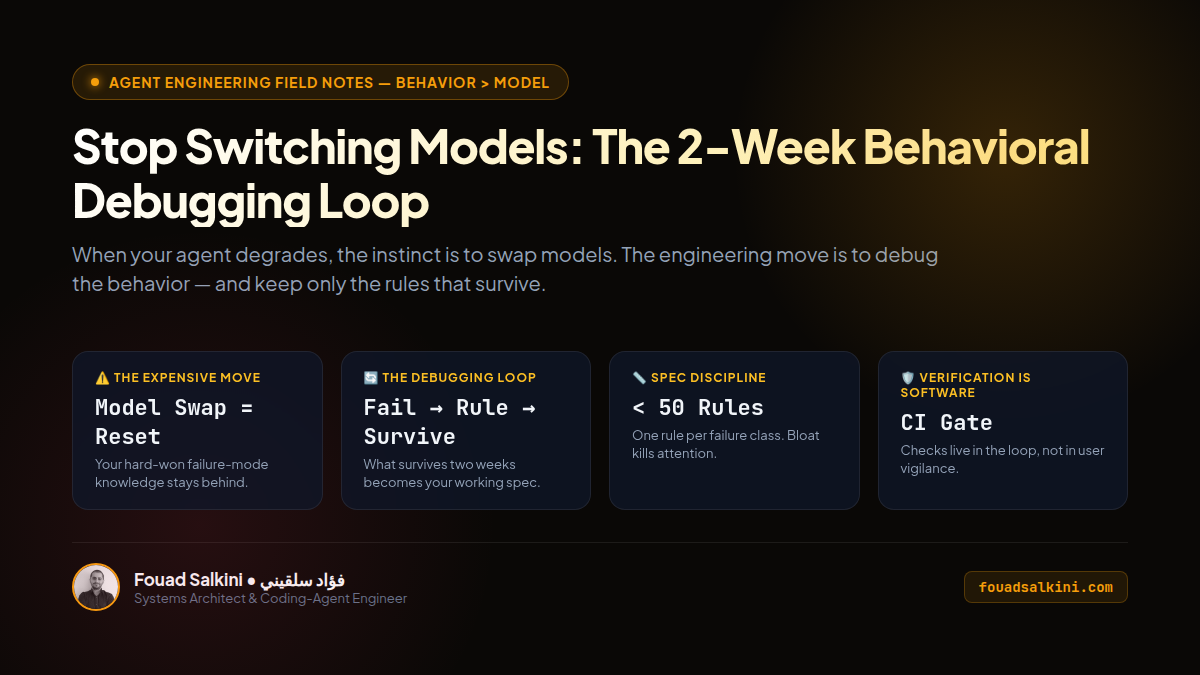
Stop Switching Models: The 2-Week Behavioral Debugging Loop
A viral engineering note landed today: when your AI agent degrades, swapping models is the expensive move. The capability was never the missing piece — the default was. A practical blueprint for turning model behavior into a maintained spec.
An engineering note went quietly viral today from Robert Ta (Human Potential & AI Alignment). The core claim is short and sharp:
“The instinct when a model degrades is to switch. That’s the expensive move, because everything you learned about its failure modes stays behind. What’s happening here instead is a debugging loop pointed at behavior: a failure repeats, you write the rule that kills it, and whatever survives two weeks is a spec of how you actually work. The capability was never the missing piece — the default was.”
It is one of the most important frames I have read this month on running AI in production. The reason it matters: most teams treat model degradation as a model problem when it is almost always a specification problem. This is the engineering breakdown — and the two failure modes the comment section correctly called out.
1. Why “Switch the Model” Is the Expensive Move
Every model swap you perform has a hidden cost that no benchmark shows:
- You discard your failure-mode inventory. Six weeks of observed, documented, and countermeasured behaviors — the edge cases where your team’s specific workload breaks this model — evaporate. You start observability from zero.
- You re-pay the learning curve on a new default. The new model has its own quirks, its own refusal patterns, its own formatting habits. You are not upgrading; you are relocating your bugs.
- You lose the delta signal. When behavior was stable for five weeks and then degraded, that change is information — a version update, a routing change, a prompt drift, a context composition shift. A model swap destroys the control condition you need to find the cause.
The model is a variable you can tune in the field. The spec, the harness, and the verification loop are the system you own. Debug the system first.
2. The Loop, Formalized
Robert Ta’s phrasing is a description. Here is the same idea as a production procedure:
OBSERVE      A failure class repeats in the field.
             (agent skips tests, truncates output,
              rewrites committed code, cites a fake library...)

CLASSIFY     Name the failure class. One class, one rule.
             "fabricates test results" ≠ "stops after first fix"

WRITE RULE   Add the minimal instruction that kills this class.
             Behavioral, not philosophical.
             "Run the test suite and paste the raw output."

OBSERVE      Watch for 2 weeks. Measure: did the class
             stop recurring? Did new failure classes appear?

PRUNE        Anything that never fires, or that caused
             regressions: delete it. The spec shrinks back.

SURVIVORS    What survives two weeks is now part of
             how your team actually works. That is the spec.
Two properties make this loop safe:
- It is falsifiable. Each rule exists to kill a measured failure. No failure, no rule. No evidence the rule works, no rule.
- It is self-pruning. The two-week window is not arbitrary sentiment — it is the window that separates “rule that actually constrains the model” from “rule we hope constrains the model.”
3. The Two Failure Modes the Comment Section Caught
The comments under the original post made two objections that deserve a permanent seat in any spec engineering doc.
Objection 1: “But it ignores your rules too.”
Correct — and precisely why the loop is behavioral verification, not instruction faithfulness. A rule is not in force because the model was told; it is in force because you measure whether the failure class still occurs. If the rule does not hold in two weeks of observation, the rule is the bug, not the model. This is the difference between writing a requirements document and building a test suite: the document describes, the test suite proves.
Objection 2: “Imagine adding 700 lines to CLAUDE.md to fix Opus 5.”
This is the real production danger: spec bloat. Every unpruned rule is a line of attention tax on the model’s context. A 700-line rules file is not a spec — it is a landfill where the model’s ability to weigh what matters has been degraded by the document itself. The pruning step in section 2 is not optional hygiene; it is the mechanism that keeps the spec operable. In our production systems, the working rule is:
If your behavioral spec exceeds roughly 50 active rules, you have stopped maintaining a spec and started writing a novel the model will stop reading.
Split the overflow into scoped, task-level specs (per-repo, per-task) instead of one global monolith.
Objection 3 (the ethical one): “It’s a software failure, not the user’s ‘laziness.’”
The sharpest comment on the thread: the user should not be the model’s verification layer. “The model promised, then claimed done, and now I must double-check” is not a human quality failure — it is a software architecture failure. The answer is the fourth card on today’s cover:
Verification is software. Checks live in the loop — a CI gate that re-runs tests, a lint pass on generated diffs, a schema validation on structured output — not in a human’s vigilance. The model’s claim of “done” is a claim that must be independently verified by a program, the same way an untrusted network input is verified before it touches your database.
4. Where “Switch the Model” Actually Belongs
This is not a “never switch models” manifesto. The model swap is the correct move in exactly two cases:
- The failure class is structural, not behavioral — e.g., the model genuinely cannot hold your context size, its tool-calling format is incompatible with your harness, or its reasoning quality on your task class is measurably below your floor. No rule fixes a capability gap.
- You are early enough that the spec is still cheap — day one of a new project, before failure modes have been observed and codified.
In both cases, the switch is a last resort measured against a documented baseline, not a reflex.
5. The Takeaway
The capability was never the missing piece. The default was.
- Observe failures as a stream, not as a pile of ad-hoc complaints.
- Classify each recurring failure into a named class.
- Write one minimal behavioral rule per class.
- Verify for two weeks — with a program, not a feeling.
- Prune ruthlessly. A spec that grows forever is a spec that stopped working.
- Switch the model only when the failure is structural, not behavioral.
That is the debugging loop. And the teams who run it stop churning their way through the model leaderboard — because their real competitive asset was never the model. It was the spec.
Source reel: @therobertta — “The instinct when a model degrades is to switch…” (247 likes, 23 comments at time of writing). Community objections synthesized from the thread: rule-non-compliance, CLAUDE.md bloat (700-line reports), and the “verification is a software failure, not user laziness” objection.

Written by Fouad Salkini (فؤاد سلقيني)
General Manager & Tech Lead at Tripnologies and Sync Studios. Systems Architect focusing on AI coding agents, DevOps, and quantitative systems.