Ponytail: Less Agent Overengineering, Not a Guaranteed Cost Cut
Ponytail adds reuse-first coding rules, agent hooks and review commands to reduce unnecessary work. A source review of v5.3.2, focused isolated hook tests, the author's benchmark limits, privacy implications and a cautious Claude Code setup guide—without treating shorter code as proof of correctness.
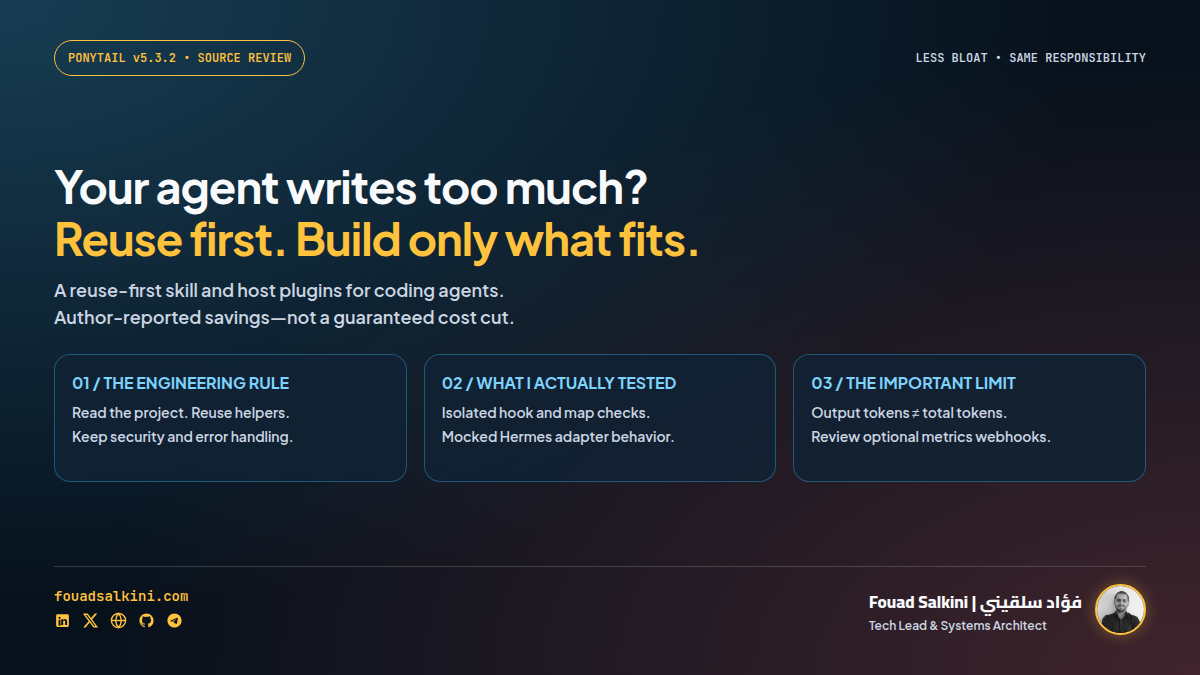
The best coding agent is not necessarily the one that writes the most code. It is the one that understands what does not need to be built.
Ponytail packages that idea into a skill and host-specific plugins: inspect the existing project, reuse what is already there, and make the smallest complete change. It is not a new model, a compiler optimizer, or a replacement for tests. Its core mechanism is instructions and integrations that influence the agent’s behavior. [1][2]
Reviewed 24 October 2026: package version 5.3.2, source snapshot 09c434ab73ca43761c5d8b0c5d341926c2fba710. I inspected the core rules, lifecycle hooks, mapping helper, benchmark report, metrics/webhook path and Hermes adapter. Focused tests ran in isolated containers. I did not install the plugin into my active agent or reproduce its claimed cost savings.
What changes in the agent’s workflow?
The core rules ask the agent to understand the task and affected code before choosing a solution. The preferred order is: [2]
- Does this feature or flexibility need to exist at all?
- Does the project already have the helper, component or pattern?
- Can the standard library or platform do it?
- Does an already-installed dependency solve it?
- Can a reader understand the short solution immediately?
- Only then write the minimum new implementation.
This is not an invitation to remove validation. The rules explicitly preserve trust-boundary checks, error handling that prevents data loss, security and accessibility. They also require a small test or assertion-based self-check for nontrivial logic, and require changes to reach their callers, tests and fixtures. [2]
The useful principle is less unnecessary architecture—not less responsibility.
Three practical use cases
A new feature that could become five services
Suppose an agent is asked to add CSV export to an existing dashboard. It could invent a queue, a plugin framework and a new service before checking the current data-access helper. A reuse-first instruction can steer it toward the existing query path and a focused export implementation.
That is an illustrative use case, not a benchmark result from my review. Large exports, authorization and untrusted data still need appropriate limits and validation.
A bug fix that should reach every caller
A short fix is incomplete if it updates one function while leaving its callers broken. Ponytail tells the agent to trace callers and fix the shared root cause rather than patching only the symptom. [2]
A code review with explicit scope
The bundled review/audit skills ask the agent to examine correctness, security, missing tests and what can be simplified. The commands guide an LLM review; they are not a deterministic vulnerability scanner or a guarantee that all bugs will be found. [1][2]
The benchmark claims—and what they actually measure
The headline reductions come from the author’s benchmark, not my independent reproduction. For Ponytail 5 versus no skill, the report gives: [3]
- 53% fewer delivered source lines.
- 45% fewer output tokens—not 45% fewer total tokens.
- 26% lower cost.
- 41% less time.
The documented setup used Claude Code, Opus 5.5, 39 tasks and five runs per task per arm, comparing no skill, an older Ponytail version and Ponytail 5. It aggregates task ratios using medians and geometric means. These are workload-specific results, not a promised discount on every production repository. The report evaluates Ponytail 5; it is not a fresh independent benchmark of the reviewed 5.3.2 package. [3]
There are important limits:
- Bash was disabled for every arm. The agent wrote code and tests; the harness ran checks afterwards. The author explicitly says this measures what the agent writes, not what it can debug. [3]
- Only 18 surgical tasks had hidden executable correctness checks. The remaining tasks mainly measured size, with additional completeness judging—not an equally broad hidden-test suite. [3]
- The six selected security tasks passed 30 of 30 runs in all three arms, including the baseline. That does not establish that Ponytail improved security or guarantees safe code. [3]
- The privacy task passed only two of five runs in every arm. The benchmark itself therefore supplies a reason to keep independent privacy checks. [3]
- “98% of risky logic ships with a test” is a benchmark test-presence measure. It is not 98% code coverage or a 98% guarantee of correctness. [3]
Treat the numbers as a reason to run your own comparison, not as a production SLA.
What I actually exercised
I ran three selected upstream test files inside a network-disabled Node container, with read-only source, a temporary home/config directory, unprivileged execution and resource limits:
tests/hooks.test.js
tests/map.test.js
tests/activation-map.test.js

Node test-runner result: 7 passed, 0 failed
This checks the selected hook compatibility and code-map behavior, including what happens when the optional map stalls, fails, returns excessive output or is disabled. The count is the Node runner’s reported test units; some files also contain several internal assertions. This is not the full upstream test suite, a performance benchmark, or proof of live compatibility with every advertised agent.
I separately exercised the Hermes adapter with a mocked registration context, in an isolated Python container:
- Six skill registrations and six commands were registered.
- The two declared hooks were registered.
- Default
fullmode produced context. - Already-present context was not duplicated in the fixture.
- Switching to
ultra, thenoff, changed the context as expected.
That validates a focused adapter fixture, not a live Hermes installation, a gateway isolation audit, or an actual LLM coding session. No agent configuration was changed.
More than a Markdown prompt: check the host integration
Ponytail distributes the core behavior across multiple hosts, but the integration depth differs. Some hosts load rule files; others run hooks and commands. Do not assume a copied Markdown file reproduces a full plugin’s behavior. [1][4]
For example, the Claude-style activation hook can inject a small codebase map to encourage reuse. The helper uses regex-based extraction rather than a semantic parser. It has an output budget and a timeout, and can be disabled with PONYTAIL_MAP=0. It should not be treated as an exact call graph. Names and structural information placed in the context may reach the model provider along with the rest of the agent’s context. [5]
The repository also ships a genuine Hermes adapter rather than only listing Hermes in a README. Its mode is held in module-level process state, and its installation guide explicitly warns about restricting slash-command access in shared gateways. Do not assume mode changes are per-user or per-conversation without verifying the host’s isolation. [4][7]
The metrics band: useful visibility, host-specific caveats
The README describes a Claude Code “band” for task cost, tokens, time, reuse and test status, plus a local task board. It states a Claude Code version requirement and says the band does not appear in the VS Code chat panel, cloud sessions or headless claude -p. These are documented product capabilities; I did not run the band UI. [1]
Test-status and reuse counters are useful signals, not substitutes for reading actual test output and the diff. A green indicator should not be promoted into a claim of complete verification.
Local by default is not the same as “cannot send data”
The band stores local ledgers by default, but the source also supports a configured outbound webhook. It can send a task snapshot including project/session metadata, model, usage, cost, counters and a task name. The sendNames: false path removes the task name; it does not remove every other metadata field. HTTPS is required except for supported loopback HTTP targets. [1][6]
Before enabling metrics sharing:
- Leave an external webhook unconfigured unless you need it.
- Review the payload and endpoint ownership.
- Treat webhook tokens and local ledgers as sensitive.
- Do not interpret the plugin’s local defaults as a promise that the coding agent itself runs offline.
I found this documented/configurable data path, not evidence of a hidden exfiltration service. This was a scoped source review, not a comprehensive security certification.
A cautious way to try it
For source review first, retrieve the exact snapshot without enabling it in your agent:
git clone https://github.com/DietrichGebert/ponytail.git
cd ponytail
git checkout --detach 09c434ab73ca43761c5d8b0c5d341926c2fba710
Inspect the skill rules, the host adapter and any hooks you plan to trust. Do not blindly overwrite an existing project AGENTS.md; merge appropriate instructions while preserving the project’s security and testing standards.
For Claude Code, the repository documents these two separate interactive commands: [4]
/plugin marketplace add DietrichGebert/ponytail/plugin install ponytail@ponytailThen test the documented modes in a disposable project:
/ponytail lite
/ponytail full
/ponytail ultra
/ponytail off
lite builds the request and suggests a smaller option; full applies the reuse-first rules by default; ultra also challenges unjustified scope. Choose the level deliberately rather than assuming the most aggressive setting is always best. [2]
These are upstream setup instructions, not commands I executed against your Claude configuration. Marketplace installs can resolve a newer revision than this review. Review what is actually installed, including hook permissions and your agent’s own approval settings.
For a meaningful evaluation, compare the same representative tasks with and without the skill in clean sessions. Keep the model, project revision and permissions consistent. Measure the resulting diff, tests and edge cases alongside total tokens, elapsed time and actual billed cost. Fewer files alone is not success if a requirement disappears.
License and verdict
The reviewed project is MIT-licensed. That does not make the underlying coding model or its API usage free; host availability and billing remain separate. [1]
My verdict: useful engineering discipline packaged for coding agents, especially when they overbuild. Start with a controlled trial. Preserve your own testing, privacy and security rules; treat the benchmark as author-reported evidence; and remember that a shorter solution is valuable only if it still solves the whole problem.
Sources
[1] https://raw.githubusercontent.com/DietrichGebert/ponytail/09c434ab73ca43761c5d8b0c5d341926c2fba710/README.md — Product description, host features and defaults.
[2] https://raw.githubusercontent.com/DietrichGebert/ponytail/09c434ab73ca43761c5d8b0c5d341926c2fba710/skills/ponytail/SKILL.md — Core rules, non-negotiable checks and modes.
[3] https://raw.githubusercontent.com/DietrichGebert/ponytail/09c434ab73ca43761c5d8b0c5d341926c2fba710/benchmarks/results/2026-10-07-agentic.md — Author benchmark, methodology and limits.
[4] https://raw.githubusercontent.com/DietrichGebert/ponytail/09c434ab73ca43761c5d8b0c5d341926c2fba710/INSTALL.md — Host-specific setup and Hermes shared-gateway warning.
[5] https://raw.githubusercontent.com/DietrichGebert/ponytail/09c434ab73ca43761c5d8b0c5d341926c2fba710/hooks/ponytail-activate.js — Context injection and optional map activation.
[6] https://raw.githubusercontent.com/DietrichGebert/ponytail/09c434ab73ca43761c5d8b0c5d341926c2fba710/hooks/band/metrics.ts — Snapshot fields and optional webhook payload.
[7] https://raw.githubusercontent.com/DietrichGebert/ponytail/09c434ab73ca43761c5d8b0c5d341926c2fba710/__init__.py — Hermes adapter and process-local mode state.

Written by Fouad Salkini (فؤاد سلقيني)
General Manager & Tech Lead at Tripnologies and Sync Studios. Systems Architect focusing on AI coding agents, DevOps, and quantitative systems.