Autonomous Agent Harnesses: OpenHuman vs. Hermes Agent and OpenClaw — An Architectural Deep-Dive
A comparative architectural teardown of three leading open-source agent paradigms: OpenHuman (Rust/Tauri, Karpathy-style Memory Trees, digital twin), Hermes Agent by Nous Research (high-agency terminal execution, progressive skills, isolated profiles), and OpenClaw (omnichannel gateway, multi-device nodes). Evaluating memory models, execution engines, and production viability.
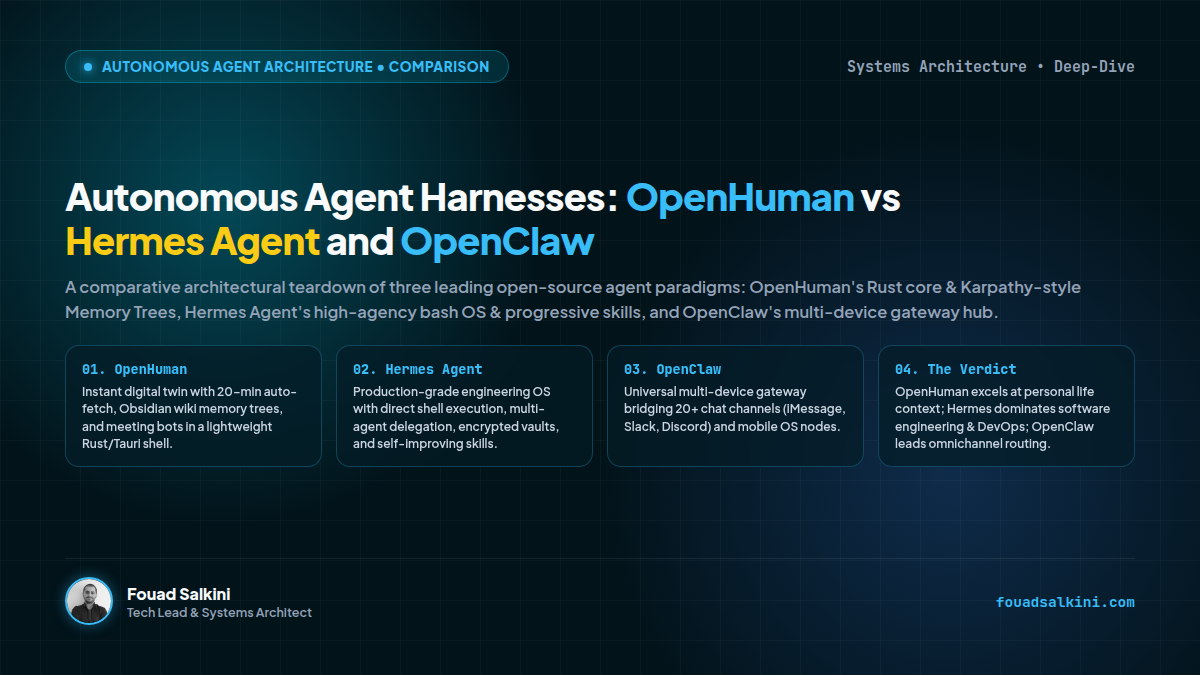
The landscape of autonomous artificial intelligence is experiencing a decisive phase transition. The era of passive chat interfaces and superficial API wrappers has concluded. Today, the frontier belongs to Agent Harnesses—operating runtimes that give Large Language Models persistent memory, local execution authority, multi-channel presence, and the agency to act continuously in the real world.
Recently, OpenHuman (tinyhumansai/openhuman) emerged on GitHub and Product Hunt with a compelling premise: solving the “cold-start problem” of AI agents by ingesting your documents, emails, and repos in minutes using Karpathy-style Memory Trees.
As engineers and systems architects building high-autonomy environments, how does OpenHuman compare to established, production-grade agent runtimes like Hermes Agent (developed by Nous Research) and OpenClaw?
Here is a rigorous architectural dissection of all three platforms, analyzing their core runtimes, memory architectures, execution topologies, and real-world production trade-offs.
1. Architectural Taxonomies: Three Distinct Philosophies
Before comparing benchmarks, we must clarify what each system is fundamentally designed to optimize:
┌────────────────────────────────────────────────────────────────────────┐
│                        The Agent Harness Spectrum                      │
├──────────────────────┬──────────────────────────┬──────────────────────┤
│      OpenHuman       │       Hermes Agent       │       OpenClaw       │
├──────────────────────┼──────────────────────────┼──────────────────────┤
│  The Personal Twin   │   The Autonomous OS      │ The Universal Gateway│
│  (Context-First)     │   (Execution-First)      │ (Channel-First)      │
│                      │                          │                      │
│ • "Becomes you"      │ • High-agency terminal   │ • One control plane  │
│ • Memory Trees       │ • Progressive skills     │ • 20+ chat bridges   │
│ • Meeting bot & GUI  │ • Deterministic CLI & DB │ • Model-agnostic hub │
└──────────────────────┴──────────────────────────┴──────────────────────┘- OpenHuman (
tinyhumansai/openhuman): Designed as a Personal Digital Twin. Its primary goal is minimizing onboarding friction. It connects to your personal services, builds an integrated Obsidian-style knowledge graph, and represents you in daily tasks and meetings. - Hermes Agent (Nous Research): Designed as a High-Agency Systems & Engineering Agent OS. It prioritizes deterministic execution, self-improving procedural skills, terminal autonomy, background daemons, and cryptographic secret isolation.
- OpenClaw (
openclaw/openclaw): Designed as an Omnichannel Gateway Controller. It provides a single trusted daemon running on your hardware that multiplexes AI models across Discord, iMessage, Slack, Teams, and native mobile nodes.
2. Memory Architectures: Memory Trees vs. Progressive Skills
The most striking divergence among these harnesses lies in how they retain, index, and retrieve context over time.
[ OpenHuman: Memory Trees & Auto-Fetch ]
Accounts (Gmail / Slack / Repos) ──(20-min loop)──> [ Memory Tree Compressor ] ──> [ Obsidian Markdown Wiki ]
                                                                                         │
                                                                                         ▼
                                                                                Lossy Flat Markdown

[ Hermes Agent: Multi-Tiered Progressive Skills ]
┌────────────────────────────────────────────────────────────────────────────────────────────────────────┐
│ 1. Compact Working Memory (MEMORY.md / USER.md): Strict char budgets, zero bloat, atomic batch updates  │
│ 2. Progressive Skills Engine: Modular procedures (SKILL.md) loaded on-demand, zero context tax        │
│ 3. Deterministic Local State: SQLite stores + pgvector semantic deduplication                          │
└────────────────────────────────────────────────────────────────────────────────────────────────────────┘
A. OpenHuman’s Memory Trees (Inspired by Karpathy’s LLM Wiki)
- The Mechanism: OpenHuman runs an
auto-fetchbackground daemon on a 20-minute loop. It scrapes connected accounts (Google Workspace, GitHub, Slack, Notion) and passes raw streams into a recursive summarizer. - Storage: The synthesized knowledge is written as Markdown files into an internal Obsidian-style wiki.
- The Architectural Trade-Off: While this eliminates cold start, recursive markdown summarization is inherently lossy. Over time, compressing hundreds of emails and pull requests into hierarchical text summaries leads to semantic drift, hallucinated timelines, and token bloat when loading deep wiki trees into model context.
B. Hermes Agent’s Multi-Tiered Progressive Architecture
- Tier 1: Global Working Memory (
MEMORY.md&USER.md): High-signal, persistent facts governed by strict character budgets (e.g., 2,200 chars). It forces the agent to consolidate and prune stale data atomically rather than accumulating massive conversational debris. - Tier 2: Progressive Skills Engine (
skills/*): Instead of dumping procedural instructions into system prompts, Hermes treats workflows as isolated, modular skill definitions. Skills include scripts, test suites, and references that are only loaded into context when explicitly triggered, keeping the base reasoning window pristine. - Tier 3: Structured Local State: Production artifacts, publication logs, and deduplication vectors are anchored in relational databases (SQLite / PostgreSQL with pgvector), guaranteeing deterministic retrieval.
3. Core Runtime & Execution Topologies
| Architectural Dimension | OpenHuman | Hermes Agent (Nous Research) | OpenClaw |
|---|---|---|---|
| Core Language | Rust (crates/openhuman-core) |
Python (Async Event Loop) | TypeScript (Node.js / pnpm) |
| Desktop / UI Layer | Tauri + React Web App | Headless Daemon, Terminal TUI | Native Desktop / Mobile Nodes |
| Execution Primitives | Checkpointed DAGs (tinyagents) |
Direct Shell, Subagents, Cron | Gateway Event Dispatcher |
| Secret Management | Local configuration files | Encrypted Local Vault (browser_vault) |
Local config / environment |
| Inter-Agent Protocol | E2EE Signal Protocol + x402 | Subagent trees (delegate_task) |
Node-to-Gateway WebSocket |
| Meeting Presence | Native (Google Meet, Zoom, Teams) | Webhooks / API-driven | Audio streaming plugins |
| Channel Ecosystem | 15 Chat Platforms | Telegram, WhatsApp, Slack, CLI | 20+ Channels (iMessage, Discord) |
Rust Core vs. Terminal OS
- OpenHuman’s Rust Advantage: Building the core runtime in Rust (
openhuman-core,openhuman-rpc) provides minimal memory footprint (~40MB idle RAM), instant cold-boot times, and memory safety. Packaging via Tauri yields a snappy cross-platform desktop binary. - Hermes Agent’s Engineering Dominance: While Hermes runs on Python, it treats the operating system terminal as its native limb. Hermes does not just orchestrate APIs; it writes unit tests, compiles binaries, manages PM2 processes, runs Docker containers, and executes CI/CD deployments autonomously. It is an agent built for systems engineers by systems engineers.
- OpenClaw’s Gateway Mastery: OpenClaw excels at being a secure local proxy. Its separation between the trusted Gateway control plane and untrusted model execution creates an exceptionally stable bridge across consumer messaging networks like Apple iMessage.
4. Deep Comparison: Where Each System Shines
                       [ Systems Engineering & DevOps ]
                                      ▲
                                      │
                                [ Hermes Agent ]
                                      │
                                      │
       [ OpenHuman ] ─────────────────┴───────────────── [ OpenClaw ]
[ Personal Digital Twin ]                         [ Universal Chat Gateway ]
1. Choose OpenHuman If:
- You want an executive assistant that sets itself up in 15 minutes by vacuuming your Google Drive, email, and Slack history.
- You need an agent that physically joins Zoom or Google Meet calls to transcribe, summarize, and extract action items in real time.
- You prefer an interactive visual canvas (TinyFlows) to review and approve automated workflows.
2. Choose Hermes Agent If:
- You need uncompromising production agency: building web codebases, managing databases, auditing security policies, and deploying distributed infrastructure.
- You require self-improving procedural memory: an agent that learns from errors, patches its own skill scripts, and executes red-green-refactor testing cycles.
- You operate sensitive environments requiring client-side encrypted vaults where passwords and 2FA secrets are never exposed in conversation contexts.
3. Choose OpenClaw If:
- Your primary requirement is unifying 20+ disparate communication channels (particularly iMessage and Discord) into a single local daemon.
- You want to swap underlying agent runtimes (delegating tasks to Claude Code, Codex, or local Ollama models) without rebuilding chat interfaces.
5. Architectural Synthesis: The Ultimate Hybrid
Each of these three harnesses solves a distinct piece of the agent puzzle. The real insight for systems architects is not choosing one dogmatically, but cross-pollinating their best patterns:
- Adopt OpenHuman’s 20-minute Auto-Fetch: We can implement a lightweight background sync skill that periodically indexes new documents and emails into an interlinked knowledge graph.
- Anchor Execution in Hermes Agent: Keep the core execution engine grounded in high-agency terminal tools, encrypted credential isolation, and progressive skill trees.
- Route via Gateway Bridges: Use open gateway standards to ensure the agent is accessible wherever you communicate.
The future of autonomous computing will not be defined by who builds the largest model, but by who builds the most reliable, context-aware, and execution-resilient agent harness.

Written by Fouad Salkini (فؤاد سلقيني)
General Manager & Tech Lead at Tripnologies and Sync Studios. Systems Architect focusing on AI coding agents, DevOps, and quantitative systems.