OpenAI DevDay: The Autonomous Agent Stack — AgentKit, Sora 2 in the API, Realtime-Mini, and Reinforcement Fine-Tuning
A comprehensive architectural analysis of OpenAI DevDay: AgentKit (visual Agent Builder, ChatKit, MCP Connector Registry), Sora 2 video API with synchronized audio, gpt-realtime-mini, automatic Prompt Caching, and Reinforcement Fine-Tuning (RFT).
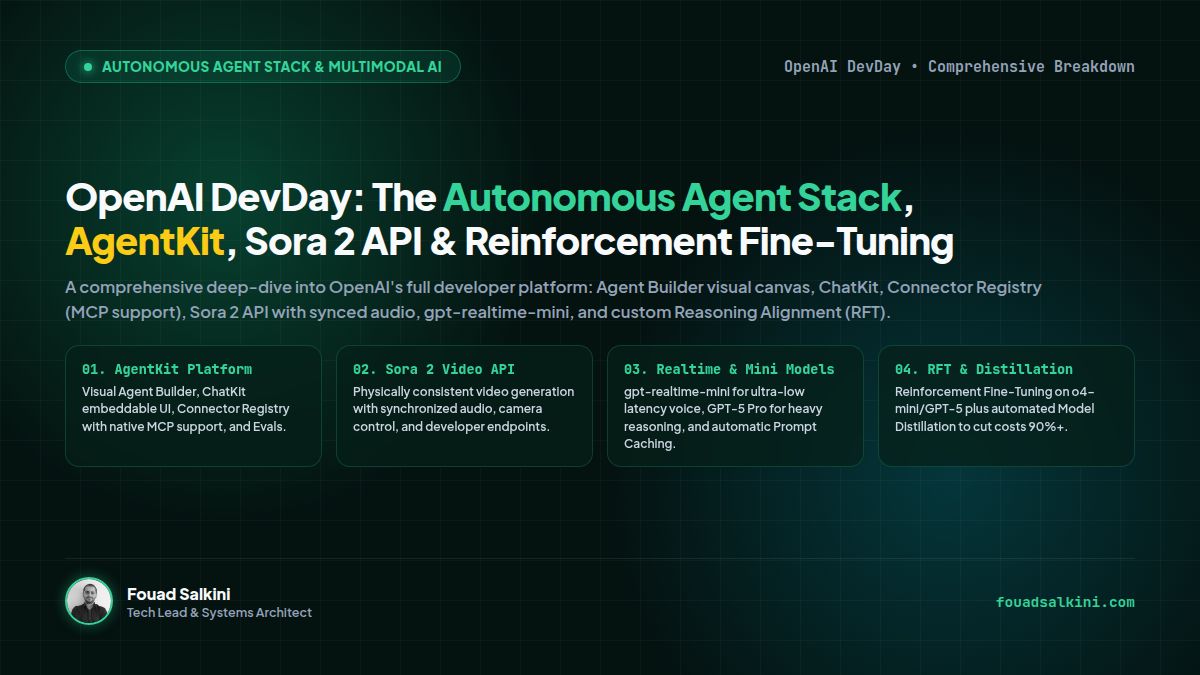
At OpenAI DevDay, the generative AI paradigm completed its historic transition: moving beyond passive chat completions and standalone prompts into a fully integrated, enterprise-grade Autonomous Agent Operating Stack.
The event delivered an expansive suite of developer primitives designed to industrialize agent creation, lower streaming latency to sub-second thresholds, unlock programmable video synthesis with synchronized audio, and allow custom reasoning alignment directly on production models.
Here is a comprehensive systems and architectural breakdown of the announcements, detailing how AgentKit, Sora 2 in the API, gpt-realtime-mini, Prompt Caching, and Reinforcement Fine-Tuning (RFT) work under the hood.
1. AgentKit: The Industrialized Autonomous Agent Platform
Until now, orchestrating multi-agent workflows required stitching together disparate third-party frameworks, manual prompt routers, and fragile bespoke codebases.
AgentKit provides an end-to-end, native platform for designing, deploying, and evaluating production-grade agents:
                           [ Visual Agent Builder ]
                 (Drag-and-Drop Directed Graph of Typed Nodes)
                                       │
                                       ▼
       ┌───────────────────────────────┴───────────────────────────────┐
       │                                                               │
       ▼                                                               ▼
[ ChatKit Embeddable UI ]                                 [ Connector Registry ]
(Drop-in Web / Mobile Chat)                          (Enterprise Data & MCP Servers)
       │                                                               │
       └───────────────────────────────┬───────────────────────────────┘
                                       │
                                       ▼
                         [ Agents SDK (Python & TS) ]
                      (Export & Self-Host Anywhere)
                                       │
                                       ▼
                            [ Evals for Agents ]
                     (Trace Grading & Model Graders)
Core Components of AgentKit:
- Agent Builder (Visual Workflow Canvas): A visual DAG (Directed Acyclic Graph) editor where developers can design agent logic, configure tool nodes, set reasoning effort parameters (
minimal,low,medium,high), and bind structured JSON schemas. Workflows compile directly into runnable Python or TypeScript code via the OpenAI Agents SDK. - ChatKit: An embeddable, customizable frontend chat component that allows developers to integrate agentic interfaces into web and mobile applications with pre-built support for streaming, tool execution states, and human-in-the-loop approvals.
- Connector Registry (Native MCP Support): An organization-wide administrative hub consolidating enterprise data sources (Google Drive, SharePoint, Dropbox) and third-party Model Context Protocol (MCP) servers, allowing agents in both the API and ChatGPT to securely query internal databases.
- Evals for Agents: Built-in trace evaluation, dataset curation, and automated model graders to benchmark agent reliability and optimize prompt instructions before deploying to production.
2. Sora 2 in the API: Programmable Video Generation with Synced Audio
OpenAI made its next-generation video model, Sora 2, available directly through the developer API, introducing physical consistency and audiovisual coherence:
[ Developer Prompt / Keyframes ] ──> [ Sora 2 API Endpoint ] ──> [ 1080p Video + Synced Dialogue / SFX ]- Physical World Consistency: Dramatically improved adherence to real-world physics, lighting reflections, object permanence, and continuous camera movements.
- Synchronized Audio Generation: Sora 2 natively synthesizes matched sound effects, ambient background audio, and spoken dialogue synchronized directly with on-screen lip movements.
- Granular Developer Controls: API parameters allow setting camera trajectories, frame-by-frame guidance, and precise video aspect ratios (9:16, 16:9, 1:1).
3. Realtime API & gpt-realtime-mini: Low-Cost, Sub-500ms Voice
Following the initial preview of the Realtime API, OpenAI expanded the voice stack with gpt-realtime-mini, a lightweight, highly optimized voice model designed for high-concurrency production deployments:
- Bidirectional WebSocket Streaming: Eliminates the traditional cascade (Whisper STT → GPT-4o → TTS) by streaming audio directly into and out of multimodal model weights.
- Sub-500ms Human Latency: Enables natural conversational interruptions (barge-in) and real-time tool execution mid-sentence.
- Structural Cost Reduction:
gpt-realtime-minislashes audio token costs significantly, making autonomous customer service agents and real-time voice translation economically scalable for millions of users.
4. Automatic Prompt Caching: 50% Cost & 80% Latency Reduction
To eliminate the recurring cost of sending long system prompts, documentation, and agent scratchpads:
- Automatic Caching: Prompts with 1,024 tokens or more are automatically cached at the inference router layer using prefix matching.
- 50% Discount: Input tokens retrieved from the KV-cache are billed at half price.
- 80% Lower Latency: Time-to-first-token drops up to 80% because cached prefixes are served directly from GPU memory without re-computation.
5. Reinforcement Fine-Tuning (RFT) & Model Distillation
For enterprises requiring extreme precision and custom reasoning behaviors:
- Reinforcement Fine-Tuning (RFT): Now generally available for
o4-mini(and in private beta forGPT-5). RFT enables developers to reinforce domain-specific reasoning chains, custom tool-calling patterns, and specialized grading criteria using reinforcement learning from task-specific feedback. - Model Distillation Suite: An automated pipeline that logs production outputs from teacher models (GPT-4o / o1), benchmarks them with Evals, and fine-tunes lightweight student models (
gpt-4o-mini), reducing production inference costs by 90% to 95%.
6. Architectural Summary
| Platform Layer | Key Technologies | Core Architectural Benefit |
|---|---|---|
| Agent Orchestration | AgentKit, Agent Builder, ChatKit | Visual DAG workflow design, MCP connector support, and runnable SDK export. |
| Video & Multimodal | Sora 2 API | Physically consistent video synthesis with native synchronized audio. |
| Voice & Streaming | Realtime API, gpt-realtime-mini |
Sub-500ms duplex voice over WebSockets with natural interruption support. |
| Performance & Cost | Prompt Caching & Distillation | Automatic 50% input discount, 80% latency cut, and 90%+ cost reduction via mini models. |
| Reasoning Alignment | Reinforcement Fine-Tuning (RFT) | Custom reasoning optimization for o4-mini and GPT-5 production agents. |
OpenAI DevDay cements 2026 as the year of autonomous, multimodal, low-latency agent infrastructure.

Written by Fouad Salkini (فؤاد سلقيني)
General Manager & Tech Lead at Tripnologies and Sync Studios. Systems Architect focusing on AI coding agents, DevOps, and quantitative systems.