OpenAI DevDay 2026: GPT-6.1 Sol, Always-On Dots Agents, Codex Cloud & CLI, and the Agent Ecosystem
A comprehensive architectural recap of OpenAI DevDay 2026: GPT-6.1 Sol, Astra Ultrafast, always-on autonomous agents (Dots), Codex cloud environments & CLI, Computer Use in the Agents API, Plugin Extensions in ChatGPT, and partner quota sharing across 16 tools.
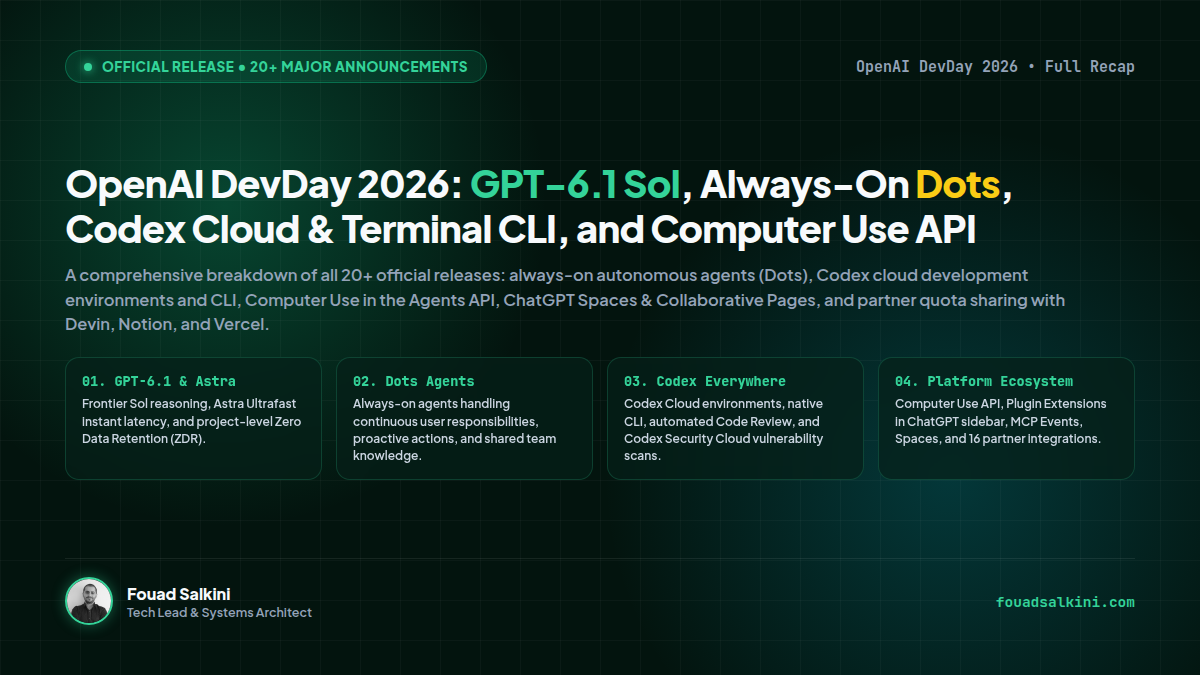
At OpenAI DevDay 2026, OpenAI unveiled over 20 major announcements, marking a pivotal transformation in how humans, developers, and autonomous systems interact.
The platform has expanded beyond conversational interfaces into an always-on agent operating surface for 1.2 billion weekly users. The core architectural updates span four critical layers: frontier models (GPT-6.1 Sol & Astra Ultrafast), persistent autonomous agents (Dots), cloud-native developer infrastructure (Codex Everywhere), and an open collaborative ecosystem (ChatGPT Spaces, Plugin Extensions, and MCP Events).
Here is the complete architectural and operational breakdown of everything announced.
1. Frontier Models & Private Intelligence
┌─────────────────────────────────────────────────────────────┐
│                      GPT-6.1 Sol                            │
│     (Frontier Multimodal Reasoning & World Dynamics)        │
└──────────────────────────────┬──────────────────────────────┘
                               │
                               ▼
┌─────────────────────────────────────────────────────────────┐
│                     Astra Ultrafast                         │
│  (Instant Sub-Second Latency in ChatGPT, Codex & the API)   │
└──────────────────────────────┬──────────────────────────────┘
                               │
                               ▼
┌─────────────────────────────────────────────────────────────┐
│            Zero Data Retention & Private Intelligence       │
│  (Project Policies • Isolated Processing • Validated Cloud) │
└─────────────────────────────────────────────────────────────┘- GPT-6.1 Sol: The flagship next-generation foundation model, delivering unprecedented depth in multi-step deductive reasoning, mathematical proofs, multimodal comprehension, and agentic trajectory planning.
- Astra Ultrafast: A breakthrough low-latency model engineered specifically for interactive coding, instant command execution, and real-time streaming across ChatGPT, Codex, and developer APIs.
- Pro 500 Plan: A premier tier for power users and enterprise developers featuring expanded, prioritized access to Ultrafast capabilities.
- Private Intelligence & Zero Data Retention (ZDR): Enterprise-grade project policies allowing teams to enforce zero data retention, private safety processing, and verified external storage boundaries.
2. Dots: Always-On Autonomous Agents
The most significant workflow shift at DevDay 2026 is the introduction of Dots:
[ User Preferences & Goals ] ──> [ Persistent Context Engine ]
                                            │
                                            ▼
                               [ Always-On Dot Agent ]
                               (Background Execution)
                                            │
             ┌──────────────────────────────┼──────────────────────────────┐
             ▼                              ▼                              ▼
[ Daily Triage ] [ Multi-Step Projects ] [ Proactive Actions ]- Persistent Responsibilities: Unlike ephemeral chat sessions, Dots are persistent background agents that learn individual user priorities, maintain long-term contextual memory, and execute ongoing responsibilities autonomously.
- Proactive Execution: Dots monitor event streams, organize shared team workspaces, synthesize incoming information, and trigger asynchronous actions on the user’s behalf.
- Rollout & Availability: Available immediately on Pro and Business Premium tiers, with an admin-controlled opt-in beta for Enterprise, Education, and Healthcare workspaces.
3. Codex Everywhere: Cloud, CLI, and Security
OpenAI dramatically expanded the Codex developer toolchain into a unified, omni-platform engineering environment:
[ Developer Terminal ] ──> [ Codex CLI ]
                                │
[ Mobile / Remote Device ] ─> [ Codex Cloud Environments ] ──> [ Shared Team Settings & Sandbox ]
                                │
[ GitHub / CI-CD ] ──────────> [ Codex Code Review ]
                                │
[ Security Ops ] ────────────> [ Codex Security Cloud ]- Codex Cloud Environments: Reusable, containerized development environments that run in the cloud with pre-approved dependencies, permissions, and team configurations. Developers can launch, inspect, and guide tasks remotely from a phone or web dashboard.
- Codex CLI: A purpose-built terminal client bringing autonomous code editing, test running, and local repository indexing directly into native shell environments.
- Codex Code Review: An integrated review interface that proactively inspects pull requests, analyzes architectural drift, and conducts contextual threaded discussions directly on code changes.
- Codex Security Cloud: A dedicated vulnerability scanning and compliance dashboard that detects insecure dependencies, secret leaks, and security flaws across entire codebases.
4. Agents API: Computer Use & Decisions API
To empower developers building third-party agents, OpenAI opened the core primitives driving its autonomous workflows:
- Computer Use in the Agents API: Official programmatic endpoints allowing agents to inspect UI screens, control mouse pointers, execute keyboard inputs, and navigate web/desktop software directly.
- Decisions API: A specialized low-latency API designed for high-throughput heuristic branching, safety guardrails, and deterministic routing in complex agent graphs.
- Bedrock Managed Agents on AWS: A strategic partnership enabling organizations to deploy and manage OpenAI autonomous agents natively within their existing AWS Bedrock infrastructure.
5. ChatGPT Surface: Plugin Extensions & MCP Events
OpenAI is turning ChatGPT into an open, extensible operating canvas where third-party developers can build first-class native applications:
- Plugin Extensions: Developers can anchor their applications inside the ChatGPT sidebar, launch interactive side-by-side panels alongside the conversation, and register custom rich file viewers.
- Sites with Connected Plugins: Turnkey website generation integrated directly with active plugins (Shopify, Figma, Canva), enabling instant web storefronts and dynamic web apps.
- MCP Events for Plugin Automations: Native event-driven triggers built on Anthropic’s Model Context Protocol (MCP), connecting external API webhooks directly to background plugin automations.
6. ChatGPT Spaces & Team Collaboration
For enterprise and team workflows, OpenAI introduced a centralized knowledge and collaboration layer:
- ChatGPT Spaces: Persistent team hubs where team members, ChatGPT, and dedicated Dot agents collaborate against a shared knowledge repository.
- Collaborative Pages & Presentations: Multi-user live editing canvases for documents, roadmaps, and presentation slide decks with contextual AI inline comments.
- Team Scheduling & Task Sharing: Native task dispatching interfaces allowing managers to assign work items across human team members and AI agents.
- Deep Workspace Integrations: Native
@ChatGPTintegration directly inside Slack and Microsoft Teams channels, alongside an automated Meetings Plugin for instant action item extraction. - Shareable Profiles: Publicly indexable developer and creator profiles showcasing verified agents, plugins, and custom creations.
7. Open Ecosystem: “Sign In with ChatGPT” & Quota Sharing
┌─────────────────────────────────────────────────────────────┐
│                    Sign In with ChatGPT                     │
│           (Unified Identity & Zero-Password Auth)           │
└──────────────────────────────┬──────────────────────────────┘
                               │
                               ▼
┌─────────────────────────────────────────────────────────────┐
│             ChatGPT Plan Allowance Sharing (16 Partners)    │
│  Devin (Cognition) • Notion • Vercel • T3 • OpenClaw • Dactyl│
└─────────────────────────────────────────────────────────────┘- Sign in with ChatGPT: A global Single Sign-On (SSO) identity standard allowing users to authenticate into external developer tools, eliminate password fatigue, and instantly link plugin permissions.
- Shared Subscription Allowances (16 Partners): Plus and Pro subscribers can now utilize their existing ChatGPT quota across 16 premier partner tools—including Devin (Cognition), Notion, Vercel, T3, OpenClaw, and Dactyl—with granular quota allocation controls.
- OpenAI Marketplace: A consolidated commercial store allowing developers to distribute and monetize native agents, plugin extensions, and automated workflows directly to OpenAI’s 1.2B weekly active users.
Summary Matrix
| Domain | Key Innovations | Architectural Impact |
|---|---|---|
| Frontier Intelligence | GPT-6.1 Sol, Astra Ultrafast, ZDR | Frontier reasoning paired with instant streaming latency and zero-retention compliance. |
| Autonomous Systems | Dots Always-On Agents, Computer Use API | Shift from conversational turn-taking to persistent, background responsibility execution. |
| Developer Stack | Codex Cloud, Codex CLI, Security Cloud | Omni-platform engineering from terminal to phone with automated reviews and security audits. |
| Shared Platform | Plugin Extensions, MCP Events, Spaces | Interactive UI panels in ChatGPT, event-driven webhooks, and multi-user live canvases. |
| Partner Economy | Sign in with ChatGPT, 16 Tool Allowances | Unified developer identity and portable subscription quotas across the modern AI ecosystem. |
OpenAI DevDay 2026 establishes the foundational architecture for the next decade of autonomous software engineering.

Written by Fouad Salkini (فؤاد سلقيني)
General Manager & Tech Lead at Tripnologies and Sync Studios. Systems Architect focusing on AI coding agents, DevOps, and quantitative systems.