Codex GPT-6 Sol and Luna: Why OpenAI Embraced the Dual-Engine Architecture
OpenAI's launch of Codex GPT-6 Sol and Luna marks the formal death of the monolithic coding model in production. An engineering reality check on why deep sequential reasoning and sub-100ms streaming execution require a dual-engine fleet orchestration pattern.
For the past two years, the AI developer landscape was dominated by an unspoken dogma: chase the single, monolithic frontier model. Whether solving a subtle distributed concurrency deadlock or formatting an indentation fix in a markdown table, developers were funneling every token through the largest, heaviest model available.
OpenAI’s launch of Codex GPT-6 Sol and Codex GPT-6 Luna puts an end to that illusion.
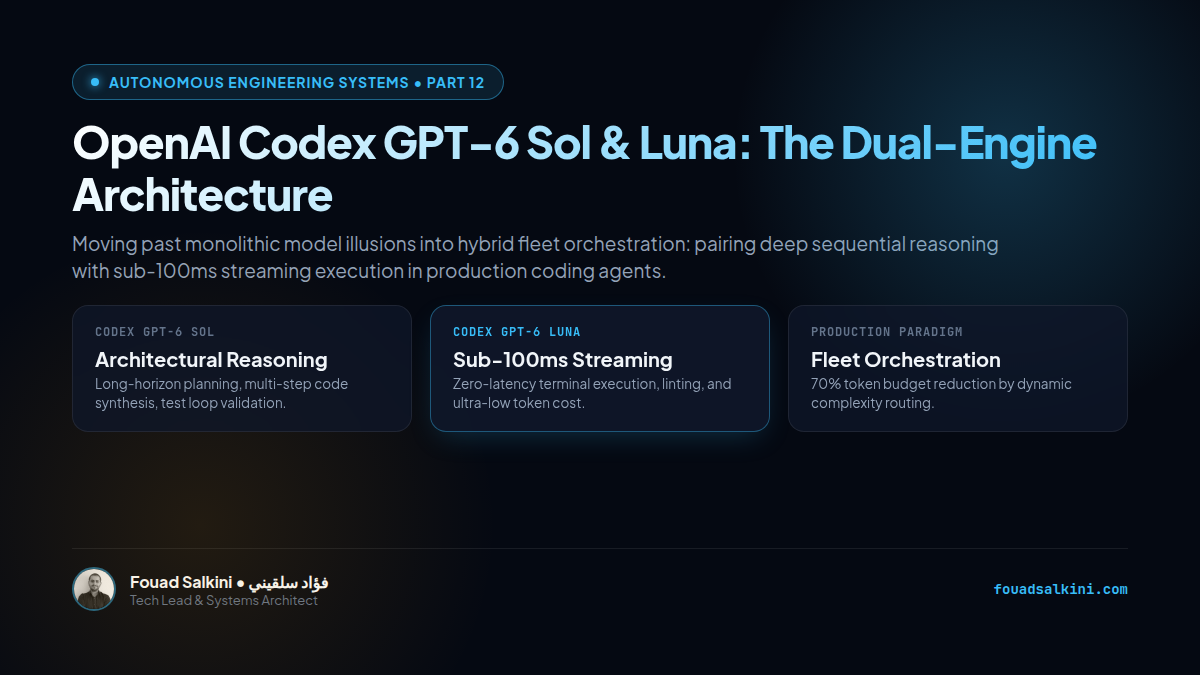
Rather than shipping a solitary monolithic endpoint, OpenAI has bifurcated the developer tier into two specialized engines: Sol, a high-compute sequential reasoning engine designed for deep architectural synthesis, and Luna, a sub-100ms streaming executor engineered for zero-latency terminal operations and high-throughput mechanical edits.
For production systems architects and agent engineers, this is not merely a model release. It is an industry-level validation of the Fleet Orchestration Pattern.
1. The Dual Engine Breakdown
In real-world coding agent operations, task complexity is fundamentally non-uniform. Allocating heavy reasoning tokens to deterministic file navigation burns budget and slows iteration loops. Conversely, delegating complex multi-file architectural refactoring to lightweight models guarantees hallucinations and broken dependency graphs.
OpenAI’s split directly codifies this asymmetry:
| Dimension | Codex GPT-6 Sol | Codex GPT-6 Luna |
|---|---|---|
| Role | Chief Architect & Verifier | Real-Time Operator & Executor |
| Cognitive Profile | Deep sequential reasoning, branch exploration | Fast forward-pass, constrained generation |
| Latency Profile | High time-to-first-token (TTFT), deliberate pacing | Sub-100ms TTFT, real-time code streaming |
| Ideal Workloads | Architecture design, test generation, security audit | CLI execution, linting, syntax completion, diff patching |
| Token Cost Profile | Premium frontier tier | High-volume commodity tier (90%+ savings) |
| Error Recovery Mode | Self-correcting test loops & constraint solvers | Immediate restart / fail-fast streaming |
2. The Architectural Reality: Why One Model Never Worked
Anyone who has run autonomous coding agents in production (whether on Claude Code, Hermes, or custom internal loops) knows the three core failure modes of monolithic routing:
- Context Drift & Latency Fatigue: When an agent invokes a 100B+ reasoning model to run
git statusor parse directory trees, the developer experiences a 15-to-30-second freeze for an operation that takes 5 milliseconds locally. - Economic Exhaustion: In multi-turn debugging sessions, token counts compound exponentially. Using a heavy reasoning model for 50 iterative CLI tool calls can burn $10 to $20 on a single bug fix.
- Over-Engineering Trivial Edits: Heavy models often exhibit "reasoning inertia"—pondering philosophical edge cases when asked to simply rename a function or append a configuration key.
By decoupling Sol (deliberate planning) from Luna (rapid execution), the development workflow mirrors human engineering teams: you don’t ask the principal systems architect to type out boilerplate getters and setters, and you don’t ask an intern to redesign your database replication topology.
3. The Fleet Orchestration Blueprint
How do you implement this in a real autonomous agent pipeline? At Tripnologies and Sync Studios, we standardize on a three-tier execution loop:
[User Prompt / Issue]
       │
       ▼
┌─────────────────────────────────┐
│       Codex GPT-6 Sol           │
│  • Requirements Decomposition   │
│  • Architecture Decision (ADR)  │
│  • Test-Driven Specification    │
└─────────────────────────────────┘
       │
       ▼ (Execution Task Graph)
┌─────────────────────────────────┐
│       Codex GPT-6 Luna          │ ◄── [Tool Feedback / Lint Errors]
│  • Terminal Tool Calling        │      (Fast Local Fixes < 100ms)
│  • File Search & Read Loops     │
│  • Targeted Code Patching       │
└─────────────────────────────────┘
       │
       ▼ (Working Artifact)
┌─────────────────────────────────┐
│       Codex GPT-6 Sol           │
│  • Independent Code Review      │
│  • Security Verification Gates  │
│  • Production Sign-Off          │
└─────────────────────────────────┘
The Rules of the Fleet:
- Sol owns the boundaries: Sol writes the acceptance criteria, defines database schemas, and runs the final adversarial verification.
- Luna owns the terminal: Luna drives the filesystem, executes test commands, applies unified diffs, and streams output. If a compiler error occurs, Luna attempts up to three rapid in-place patches before escalating back to Sol.
- Escalation Protocol: Only when architectural assumptions fail does Luna yield control back to Sol for replanning.
4. Grounded Takeaways for Engineering Leaders
- Stop looking for the "God Model": Benchmark leaderboards that evaluate models on a single aggregated score are misleading for production work. The highest-performing engineering teams in 2026 evaluate systems, not isolated weights.
- Dynamic Routing is Table Stakes: If your agent harness does not route between deep thinkers and fast executors dynamically, you are overpaying by at least 60% on your AI infrastructure bill.
- The Human Engineer Remains the Director: Models like Sol and Luna do not eliminate the necessity of sound engineering fundamentals; they amplify it. Clear system specifications, comprehensive test suites, and strict security sandboxing are more vital now than ever.
Sources & References: OpenAI Platform Model Documentation, LMSYS Chatbot Arena Evals, and Production Agent Benchmark Traces.

Written by Fouad Salkini (فؤاد سلقيني)
General Manager & Tech Lead at Tripnologies and Sync Studios. Systems Architect focusing on AI coding agents, DevOps, and quantitative systems.