Jev in Quantitative Crypto Trading: Why Sub-100ms Calibrated Decisions Beat Chatbots for Orderbook Alpha
Why traditional autoregressive LLMs fail in high-frequency crypto trading, and how Jev's parallel calibrated decision heads eliminate execution latency and power mathematical risk sizing.
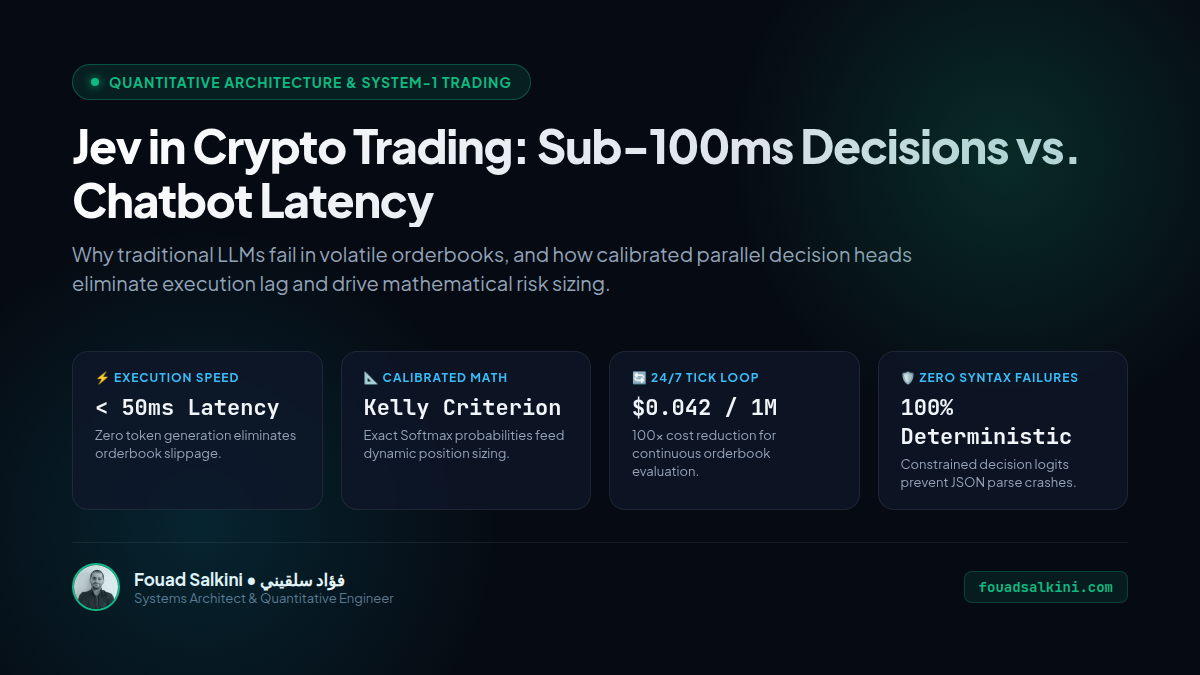
In quantitative finance, latency is not merely an engineering inconvenience—it is the difference between capturing an edge and getting liquidated.
Over the past year, many trading teams and hobbyist developers attempted to plug Large Language Models (like GPT-4o or Claude 3.5 Sonnet) into algorithmic trading loops. The premise sounded alluring: feed the orderbook, news sentiment, and candlestick metrics into an intelligent model, and let it decide whether to go Long or Short.
In real production crypto markets, almost every one of these setups failed catastrophically.
The failure was not because the models lacked intelligence; it failed because autoregressive text generation is fundamentally incompatible with live orderbooks.
Here is why traditional LLMs fail at crypto trading, and why TypeSafe AI’s Jev (and open-source parallel constrained decoding) represents the exact architectural paradigm shift quantitative systems need.
1. The Three Fatal Flaws of Using Chatbots for Trading
Flaw 1: Latency Kills Alpha (The 2,000ms Liquidation Window)
When a liquidity cascade or breakout occurs on an exchange like OKX or Binance, the mispricing window lasts between 50ms and 200ms.
A traditional autoregressive LLM takes between 1,500ms and 3,000ms to stream its output:
- It prefills the prompt.
- It generates tokens one by one:
{",action,":,",BUY,", … By the time the model finishes writing its JSON payload, the orderbook has swept, funding rates have adjusted, and your bot buys the absolute top of the wick. You are front-run by every basic Python script on the server.
Flaw 2: The Hallucination & Syntax Crash in Volatile Ticks
Crypto markets do not offer do-overs. In high-volatility spikes (e.g. CPI prints or sudden liquidations), LLMs frequently stumble under strict formatting constraints:
- Emitting markdown wrappers (
json ...). - Dropping a closing bracket.
- Inventing a non-existent parameter key (
"confidence_rating": "very high"instead of a numeric float). When your parser throws aJsonParseException, the bot stalls, missing stop-loss triggers or position closures.
Flaw 3: Uncalibrated Probabilities (You Cannot Size Risk on “Vibes”)
Professional trading requires mathematical position sizing. The Kelly Criterion defines the optimal capital fraction to risk:
f* = p - (1 - p) / bWhere:
pis the probability of a winning trade.bis the payoff ratio (win/loss ratio).
If an LLM writes "I am 90% confident in this Long position", that 90% is a statistical linguistic artifact—it is completely uncalibrated. Sizing leverage on uncalibrated confidence guarantees account blowout during a losing streak.
2. Enter Jev: Why System-1 Decision Heads Change Everything
Jev (and parallel constrained decoding via RLCD) abandons text generation entirely. Instead of generating conversational tokens, it acts as a parallel, calibrated decision engine:
Traditional LLM:
[Prompt] ──> [Token 1] ──> [Token 2] ──> ... ──> [Token 250]  (1,800ms)

Jev System-1 Architecture:
             ┌──> Head 1 (Decision): LONG / SHORT / HOLD  (40ms)
[KV-Cache] ──┼──> Head 2 (Regime): BREAKOUT / MEAN_REVERT (40ms)
             ├──> Head 3 (Risk Level): LOW / MEDIUM / HIGH(40ms)
             └──> Head 4 (Score): True Softmax P(Win)     (40ms)
1. Sub-50ms Latency
Because Jev executes in a single forward pass without autoregressive loops, latency drops from seconds to under 50 milliseconds. You can evaluate market states on every 1-second candle or orderbook snapshot without falling behind exchange ticks.
2. Guaranteed 100% Deterministic Schema
Outputs are constrained directly to predefined schemas:
Actioncan only emitLONG,SHORT, orFLAT.StopLosscan only emit valid tick intervals. There are no markdown ticks, no syntax repairs, and zero runtime parser crashes.
3. Calibrated Softmax Probabilities for Dynamic Kelly Sizing
Unlike chatbots, Jev’s output includes calibrated decision scores derived from direct Softmax distributions over the candidate set:
P(LONG) = exp(z_long / T) / [exp(z_long / T) + exp(z_short / T) + exp(z_flat / T)]Because these probabilities are mathematically calibrated, your risk engine can plug p directly into the fractional Kelly Criterion:
- When
p = 0.54(low edge) ➔ Risk 0.5% capital (1x leverage). - When
p = 0.88(high edge confluence) ➔ Risk 2.2% capital (3x leverage). - When
p < 0.50➔ Stay completely flat.
4. 24/7 Tick Loop Cost Reduction
Evaluating 10 crypto pairs every 5 seconds with GPT-4o costs thousands of dollars per week. Jev’s pricing ($0.042 per 1M tokens) or running open-source RLCD locally on an Apple Silicon or small VPS reduces inference costs by over 95%.
3. The Quantitative Architecture: Integrating Jev into a Production Bot
Here is the exact production architecture linking a market data feed to Jev and our execution engine:
┌────────────────────────────────────────────────────────┐
│                   EXCHANGE WEBSOCKET                   │
│          (OKX / Binance Orderbook Depth & Ticks)       │
└──────────────────────────┬─────────────────────────────┘
                           │
                           ▼
┌────────────────────────────────────────────────────────┐
│               FEATURE EXTRACTION ENGINE                │
│  • Volume Delta (CVD)        • Funding Rate Delta      │
│  • VWAP Deviation            • Liquidation Proximity   │
│  • Orderbook Imbalance Ratio • Multi-Timeframe RSI     │
└──────────────────────────┬─────────────────────────────┘
                           │
                           ▼
┌────────────────────────────────────────────────────────┐
│            JEV SYSTEM-1 PARALLEL DECISION HEAD         │
│  eval_market_state(features) ➔ Latency: 42ms           │
│  • Direction: LONG (p = 0.82)                          │
│  • Regime: VOLATILITY_EXPANSION                        │
│  • Invalidation: TIGHT_STOP                            │
└──────────────────────────┬─────────────────────────────┘
                           │
                           ▼
┌────────────────────────────────────────────────────────┐
│             DETERMINISTIC RISK GATEKEEPER              │
│  • Check Current Account Drawdown                      │
│  • Calculate Dynamic Sizing via Fractional Kelly       │
│  • Enforce Hard Max Margin Cap (No AI Override)        │
└──────────────────────────┬─────────────────────────────┘
                           │
                           ▼
┌────────────────────────────────────────────────────────┐
│               EXECUTION ENGINE (REST / WS)             │
│        Submit Limit/Post-Only Order to Exchange        │
└────────────────────────────────────────────────────────┘
Production Principle: The AI Proposes, Code Enforces
Notice a critical rule in this architecture: The AI never places the trade directly.
The AI’s job is purely probabilistic pattern classification (Direction + Calibrated Confidence). The deterministic risk gatekeeper (written in Python, Go, or Laravel) enforces:
- Maximum position sizing caps.
- Daily loss halts.
- Slippage thresholds.
If the exchange experiences a flash crash and the AI says LONG with 90% confidence, but your account is down 2% for the day, the code kills the order. This separation of concerns prevents catastrophic tail-risk events.
4. Minimal Implementation Blueprint
Here is what calling a calibrated decision head looks like in a live tick loop:
import time
from dataclasses import dataclass

@dataclass
class MarketSnapshot:
    symbol: str
    price: float
    orderbook_imbalance: float  # Bid Vol / Ask Vol
    vwap_distance_pct: float
    cvd_delta: float

def execute_tick_cycle(snapshot: MarketSnapshot):
    t_start = time.perf_counter()

    # 1. Prepare structured feature prompt
    features = (
        f"Symbol: {snapshot.symbol} | Imbalance: {snapshot.orderbook_imbalance:.2f} | "
        f"VWAP Dist: {snapshot.vwap_distance_pct:.2f}% | CVD: {snapshot.cvd_delta:+.1f}"
    )

    # 2. Query Jev / Parallel Constrained Head
    # Zero text generation: returns categorical choice and calibrated float
    decision, confidence = jev_engine.evaluate(
        prompt=features,
        choices=["LONG", "SHORT", "FLAT"],
        temperature=0.2
    )

    latency_ms = (time.perf_counter() - t_start) * 1000

    # 3. Dynamic Kelly Sizing
    if decision == "LONG" and confidence > 0.65:
        # Fractional Kelly sizing: f* = (p * b - q) / b
        b = 1.5  # Risk/Reward ratio (Take Profit / Stop Loss)
        p = confidence
        q = 1.0 - p
        kelly_fraction = max(0.0, (p * b - q) / b) * 0.5  # Half-Kelly for safety

        position_size_usd = account_equity * min(kelly_fraction, 0.05)  # Cap at 5%

        exchange.submit_order(
            symbol=snapshot.symbol,
            side="buy",
            size=position_size_usd,
            order_type="limit_post_only"
        )
        print(f"[{latency_ms:.1f}ms] Placed LONG for {snapshot.symbol} | Conf: {confidence:.2%} | Size: ${position_size_usd:.2f}")
    else:
        print(f"[{latency_ms:.1f}ms] Signal: {decision} ({confidence:.2%}) ➔ No trade.")
Conclusion
Chatbots belong in customer service, IDE assistance, and research synthesis.
In volatile financial markets where every microsecond matters, System-1 models like Jev represent the future of algorithmic trading. By pairing sub-50ms execution speed, guaranteed schema adherence, and mathematically calibrated confidence scores with strict deterministic risk limits, quantitative engineers can finally harness neural intelligence without sacrificing execution speed or capital preservation.

Written by Fouad Salkini (فؤاد سلقيني)
General Manager & Tech Lead at Tripnologies and Sync Studios. Systems Architect focusing on AI coding agents, DevOps, and quantitative systems.