Grok 4.7 Arrives: Reading the Benchmarks Past the Hype (and the 200k Context Cliff)
SpaceXAI shipped Grok 4.7 on September 21, 2026: a larger base, multi-hour RL runs, and the same $2/$6 price. A verified engineering reading of the benchmarks, the cross-effort comparison trap, and the pricing cliff that bills your whole request.
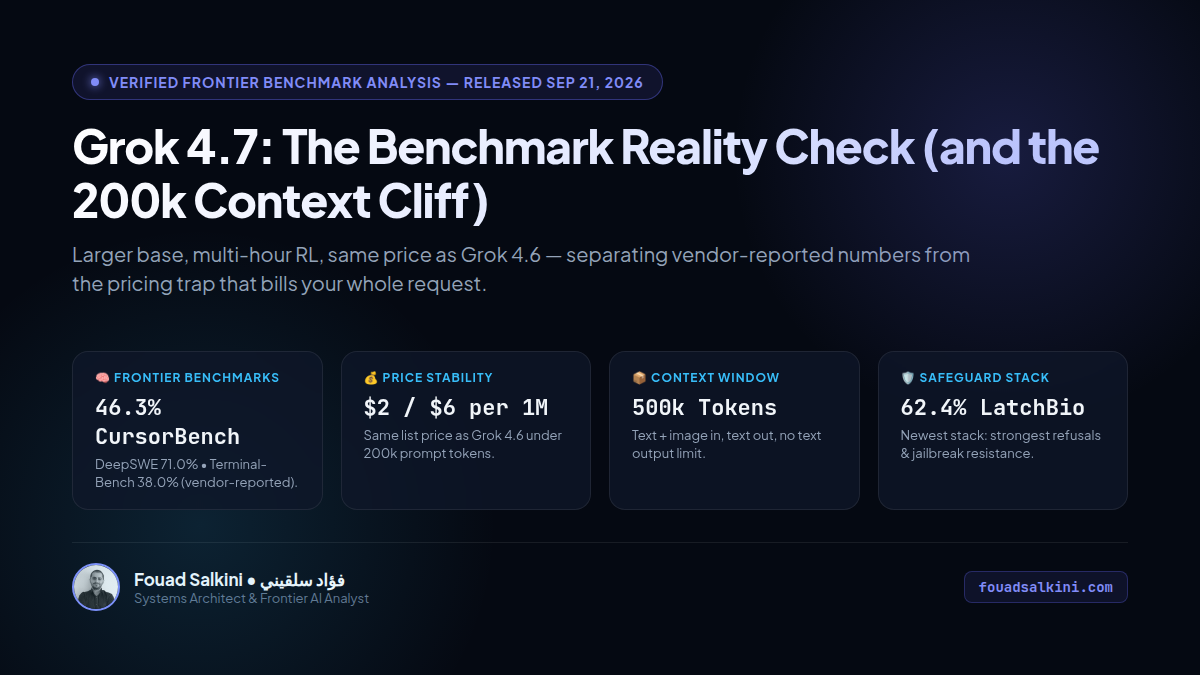
On September 21, 2026, SpaceXAI (the rebranded xAI) released Grok 4.7 on the API as grok-4.7, alongside Cursor and Grok Build. The launch copy is confident: “Twice as fast, at half the price of comparable models.”
As usual, the launch post and the production reality sit at different altitudes. This is a verified engineering reading of what actually shipped, what the benchmark numbers do and do not prove, and the pricing trap most teams will hit on their first long-context bill.
Everything below is verified against primary sources: the official x.ai announcement, the docs.x.ai model page, and the API release notes.
1. The Verified Spec Sheet
| Property | Value (official docs) |
|---|---|
| Model ID | grok-4.7 |
| Context window | 500,000 tokens |
| Knowledge cutoff | May 2026 |
| Modalities | Text + image in, text out |
| Output limit | None |
| Pricing | $2 input / $0.50 cached / $6 output per 1M — under 200k prompt tokens |
| Pricing ≥ 200k | $4 / $1 / $12 per 1M — the entire request bills at this tier |
| Reasoning effort | low / medium / high (default) / xhigh |
| Availability | Grok API, Cursor, Grok Build, third-party harnesses, routers, clouds; US regional endpoint |
| Rate limits (reported) | 150 rps, 50M tokens/min |
Three details stand out before any benchmark talk:
- No text output limit. The previous per-response output caps are gone. For agentic loops that emit long patch sets or full report documents, that is a real architectural simplification — no more chunked continuation requests.
reasoning.effortnow has anxhightier. The default remainshigh. This matters for benchmark reading (section 3), because xAI’s own launch comparisons mix effort levels.Grok 4.7 Fastis not on the public API. The “twice as fast” variant ships only through Cursor and Grok Build. Anyone planning a two-latency-lane agent on the open API gets one model, not two.
2. What Actually Changed Under the Hood
The announcement is unusually specific about the training recipe:
- A new, larger base model — not just more fine-tuning on top of Grok 4.6. Community telemetry (Hacker News) puts the parameter delta around 40% more weights than 4.6, while the list price stays identical.
- A longer reinforcement learning run on a harder task mix, explicitly weighted toward problems that take many hours to complete. This is the clearest signal yet that xAI is optimizing for long-horizon agent work rather than short benchmark answers.
- Better self-verification. The model was trained to check its own work more carefully — the same direction Claude’s “thinking trace” and OpenAI’s o-series have pushed.
- Native understanding of the Grok Bot harness. The model was co-trained with the harness it will most often run inside. That is a genuine capability for in-harness conversational and knowledge work — and a known bias for third-party agents, which do not get that alignment for free.
The practical translation: this is not a “smarter chatbot” release. It is a long-horizon reliability release — the model is being pushed to stay coherent and self-checking across multi-hour task executions.
3. The Benchmark Reading (and the Comparison Trap)
Vendor-reported deltas from the launch material and model card:
| Benchmark | Grok 4.6 | Grok 4.7 | Effort noted |
|---|---|---|---|
| CursorBench 4.0 | 40.4% (high) | 46.3% (xhigh) | cross-effort |
| DeepSWE v1.1 | 65.2% (high) | 71.0% (high) | same effort |
| Terminal-Bench 4.0 | 20.3% (high) | 38.0% (xhigh, Grok Build) | cross-effort + in-harness |
| SWE-Marathon v1.1 | 31.9% (high) | 46.0% (high) | same effort |
| HealthBench Professional | 48.5% (high) | 56.7% (xhigh) | cross-effort |
Read that table with the two caveats the launch does not make loud enough:
Caveat 1 — the headline is a cross-effort comparison. The 46.3% CursorBench number was produced at xhigh reasoning effort, against a 4.6 baseline at high. Higher test-time compute buys higher scores on every model in this class. The +5.9 point headline is partly model improvement and partly more thinking budget. The same criticism landed on the launch chart within hours of release on Hacker News — the “same price, same speed” story quietly swapped in a harder gear for the new model.
Caveat 2 — nothing here is independently verified yet. Every number above is vendor-reported. Independent trackers (Artificial Analysis, LMSYS-style arenas) need a few days to publish reproducible runs before the frontier positioning is settled.
Where the signal is cleaner: DeepSWE (+5.8) and SWE-Marathon (+14.1) are same-effort comparisons, and SWE-Marathon specifically measures exactly what the RL recipe targeted — long, multi-hour software tasks. That is the most honest number in the table, and it is a large jump.
The safety section deserves a line as well: a brand-new safeguard stack reportedly tops LatchBio’s biosafety benchmark at 62.4% and passes only 3.3% of risky dual-use prompts on xAI’s own HackerBench v0.3, while keeping low refusal rates for legitimate security work. Whether those dual-use claims hold up under adversarial testing is for the security community to verify.
4. The 200k Context Cliff (The Real News for Production Teams)
This is the detail most launch recaps skip, and it is where the bill will actually bite.
Grok 4.7’s pricing is two-tier at the prompt level:
- Under 200k prompt tokens: $2 input / $0.50 cached / $6 output per 1M.
- At or above 200k prompt tokens: the entire request — input, cached, and output — bills at $4 / $1 / $12.
That last sentence is a cliff, not a slope. Cross the line by a single token and your whole request — including the 199k tokens that were under the limit and everything the model generates — doubles. Concretely:
Request A: 150k input + 20k output (all under cliff)
  = 0.15 × $2 + 0.02 × $6 = $0.42

Request B: 205k input + 20k output (crosses cliff — everything re-priced)
  = 0.205 × $4 + 0.02 × $12 = $1.04
A 37% increase in input tokens produces a 148% increase in cost. If you are piping entire codebases, long transcripts, or full document repositories into a 500k context window, your unit economics are not the sticker price — they are the cliff price.
The engineering response is the same pattern we use for every tiered-cost system:
- Instrument prompt token counts per request before you flip traffic. Most production agent stacks log output tokens but not prefill size.
- Set a soft ceiling at ~180k with an alert, not at 200k. The headroom covers cache-churn and retry drift.
- Use
prompt_cache_keyaggressively (the docs explicitly recommend it) so repeated agent scaffolding hits the $0.50 cached tier under the cliff — and $1 above it. - Decide deliberately when 500k is worth 2x. For most agent loops, a 120k window with better retrieval beats a 300k window at double billing. The long-context window is a capability; the cliff is a tax on using it.
5. Community Reaction (Hacker News, 522 points)
The HN front page gives a useful ground-truth check, roughly 24 hours post-release:
- Praise for cadence: the monthly-ish frontier cadence (4.5 in July, 4.6 in August, 4.7 in September) and the same-price capability gains are the most repeated positive.
- Chart skepticism: the launch chart’s exclusion of a competitor model and the xhigh-vs-high effort mixing drew the sharpest criticism — “deceptive graph on top” was the recurring paraphrase.
- Harness fit complaints: a minority of users report looping behavior in third-party harnesses (thinking loops enumerating “Fix 1… Fix 81”) and ignored agent instructions — consistent with the model being co-trained for the Grok Bot harness, where it is reported to be solid.
- Margin math: several commenters noted that ~40% more weights at an unchanged price is a margin giveaway that buys ecosystem goodwill — a reasonable read, and exactly why “same price” is doing real work in the launch narrative.
6. The Production Verdict
For teams running agent fleets, the switching calculus on day one:
Switch if:
- Your bottleneck is long-horizon reliability (multi-hour tasks, self-verification, large refactors) — the RL recipe targets exactly that, and SWE-Marathon is the cleanest proof.
- You are already inside the xAI ecosystem (Grok Build, Cursor, Agent Tools API) — the harness-native training and server-side tools compound.
Hold if:
- Your workloads live above 200k prompt tokens — run the cliff math on your actual traffic before migrating.
- You depend on independent benchmark verification for model selection — wait for Artificial Analysis / arena data to land before making the call permanent.
- Your agent runs in a third-party harness where 4.7’s training-time alignment does not apply — pilot it against your current model on your own task set first.
The honest one-line summary: Grok 4.7 is a real, same-price step forward for long-horizon agent work — with a headline benchmark that mixes reasoning efforts, and a context window that quietly doubles in price at 200k tokens. Buy the capability, meter the context.
Sources: x.ai/news/grok-4-7 (official announcement, Sep 21 2026) · docs.x.ai/developers/grok-4-7 (model spec) · docs.x.ai/developers/release-notes · llm-stats.com launch analysis · Hacker News (522 pts, 55 comments).

Written by Fouad Salkini (فؤاد سلقيني)
General Manager & Tech Lead at Tripnologies and Sync Studios. Systems Architect focusing on AI coding agents, DevOps, and quantitative systems.