Frontier Deployed Engineer: The Role Between AI Models and Production Outcomes
What Frontier Deployed Engineer means, how it relates to the older Forward Deployed Engineer role, what Anthropic's residency actually offers, and how to prepare through real deployment skills rather than title hype.
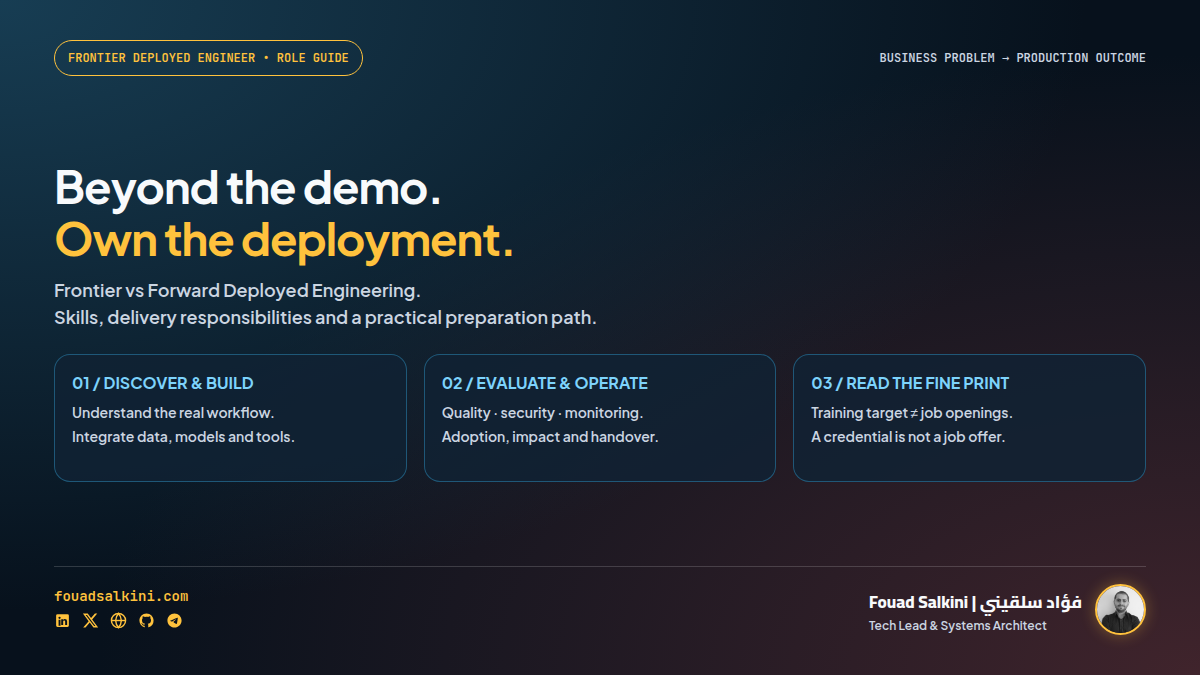
A company does not need another impressive AI demo. It needs a system that can use its data safely, fit into an existing workflow, survive failures and be adopted by the people doing the work.
The engineer who owns that gap is increasingly visible under the FDE label. But the wording matters: Frontier Deployed Engineer is a real name in Anthropic’s training program; Forward Deployed Engineer is the older, more widely used job title. They overlap, but they should not be silently treated as identical credentials or universal job descriptions. [1][2][3][4]
I reviewed Anthropic’s official academy announcement and program page, an actual OpenAI FDE vacancy, an Anthropic applied-engineering role and Palantir’s earlier description of deployed engineering. This article explains what the work involves, what is genuinely new and how a developer can prepare.
1. Frontier or Forward? Both appear—but in different contexts
Frontier Deployed Engineer
Anthropic uses Frontier Deployed Engineer for its Claude Frontier Academy residency and final credential. The program aims to develop engineers who can take Claude into real business systems, work through security review and lead adoption inside their organizations. [1][2]
That is not simply a misspelling of “Forward.” It is the wording the provider uses. However, the official material does not establish an industry-wide, regulated profession with one mandatory credential.
Forward Deployed Engineer
OpenAI’s job listing uses Forward Deployed Engineer and describes ownership of discovery, technical scoping, system design, implementation and production rollout with customers. Success includes production adoption, measurable workflow impact and feedback that informs product and model development. [3]
The underlying delivery model is not new. In a November 2, 2020 article, Palantir described a Forward Deployed Software Engineer as a software engineer embedded with customers to solve problems using its platforms. That is evidence of an established role—not a claim that Palantir invented every version of it. [4]
My reading: the new academy naming focuses attention on deploying frontier AI. The durable professional skill is still turning uncertain requirements and capable technology into a working, maintainable customer outcome.
When searching for opportunities, look beyond one label: Forward Deployed Engineer, Applied AI Engineer, AI Solutions Engineer and related titles can contain overlapping work. Read the responsibilities rather than assuming the acronym defines the job.
2. What does an FDE actually do?
Across the official descriptions, the work extends well beyond prompting. OpenAI explicitly places its team between customer delivery and core platform development. Anthropic’s life-sciences applied-engineering role similarly describes building alongside partner teams, integrating into their workflows and creating reusable infrastructure. [3][5]
A practical delivery cycle looks like this:
- Discover the real problem. Observe how work happens, who owns it and which failure or delay is worth addressing.
- Scope the intervention. Decide what AI should do, what should remain deterministic and what requires human approval.
- Integrate the system. Connect the relevant data, APIs, identity, tools and interfaces—not just a standalone chat box.
- Build and evaluate. Write production code, test representative cases and measure failures as well as attractive examples.
- Launch responsibly. Work through security, rollout, monitoring and operational ownership.
- Drive adoption and handover. Help users change the workflow, document the system and turn lessons into reusable components.
This sequence is my synthesis of those responsibilities, not a mandatory six-step framework published by every employer. [2][3][5]
The “deployed” part is important: the job is not complete when the model responds once. Someone has to own what happens when access is denied, data is stale, the answer is unsupported or the workflow changes.
3. How it differs from adjacent roles
These are useful emphases, not hard boundaries. Companies organize teams differently.
- Software engineer: often owns a product component or platform capability used across customers. An FDE’s scope is often shaped by a particular customer’s workflow and deployment. Both can write substantial production code. Palantir makes a version of this distinction explicitly. [4]
- Solutions architect or sales engineer: can overlap in discovery, design and demonstrations. In the FDE descriptions reviewed here, hands-on implementation, rollout and adoption are explicit responsibilities—not merely explaining what a product could do. That does not mean architects or sales engineers never build. [3]
- ML researcher or model engineer: may focus on developing models, training methods or inference infrastructure. The reviewed FDE roles primarily apply models within real systems and feed deployment findings back to product/research. Training a foundation model is not their defining responsibility. [3][5]
- Prompt specialist: may improve instructions and model behavior. An FDE also needs data integration, software quality, operational controls and stakeholder judgment. Prompting is one technique inside a larger engineering job. [2][3]
It is equally misleading to say this is “just consulting.” The cited roles emphasize implementation and sustained delivery. But the label alone does not tell you the employment arrangement, travel burden or balance between bespoke work and reusable product engineering.
4. A concrete example: an internal support assistant
Consider a fictional company that wants an AI assistant to help support staff find policies and draft responses. This example is a portfolio exercise, not a deployment I ran for this article.
A demo might upload documents and generate an answer. An FDE-style project would ask:
- Which documents are authoritative, and who may access each one?
- How are new policies indexed and retired policies excluded?
- Can every material answer be traced to a source?
- What should happen when the evidence is missing or conflicting?
- May the assistant only draft, or can it send a response or update a ticket?
- Who approves a consequential action, and where is that decision recorded?
- What are the latency, operating-cost and reliability constraints?
- Who maintains the system after handover?
The implementation might require a permission-aware retrieval layer, a model, tool interfaces, a review UI, evaluations and monitoring. It might also reveal that an ordinary search or rules-based workflow is sufficient for part of the task.
The distinction is not “more agents.” It is appropriate engineering around the model.
5. The skill stack worth building
Software and integration fundamentals
Be able to build and debug APIs, work with authentication and authorization, query databases, read unfamiliar code, write tests and operate a service. OpenAI’s example asks for production-grade frontend/backend coding using Python, JavaScript or comparable stacks. A particular language is not the profession. [3]
Applied model judgment
Understand context limits, structured outputs, retrieval, tool use and failure behavior. Be able to explain why a model-backed step is appropriate—and when a simpler method is preferable. Anthropic’s applied role explicitly lists prompting, context engineering, agent architectures and evaluation frameworks. [5]
Evaluation and operational discipline
Move from “looks good” to a representative case set, explicit acceptance criteria and observable failures. Tie evaluation to a business workflow rather than one generic benchmark. OpenAI’s listing makes measurable workflow impact and eval-driven feedback part of the role. [3]
For the support example, measure grounded answers, access-control violations, correct abstentions and human review burden. Fewer tokens alone would not prove that the system is better.
Security and data governance
Know where data travels, what credentials the system holds, which actions need approval and how failures are contained. Anthropic’s academy explicitly includes security review in its simulated enterprise deployment. That is a sign that safety and governance belong inside delivery, not as a final slide. [2]
Domain fluency and communication
An engineer must turn vague requests into a bounded scope, explain trade-offs and earn the confidence of users and technical stakeholders. Specialized deployments may demand deep domain experience: the cited Anthropic life-sciences role asks for research or scientific-computing expertise as well as production engineering. That is a requirement of that role, not every FDE job. [3][5]
6. What Anthropic’s academy actually offers
The official announcement states a $100 million commitment and a goal of training 10,000 Frontier Deployed Engineers by the end of 2027. These are announced program commitments and targets—not evidence that 10,000 people have graduated or that 10,000 vacancies exist. [1]
The published structure is:
- Four-day intensive: three days building a Claude system for a simulated enterprise, followed by a graded new scenario on day four. Passing earns the Claude Resident Engineer badge.
- Twelve-week residency: participants lead a real Claude deployment at their own organization, with cohort mentorship and support.
- Final assessment: successful participants earn the Claude Frontier Deployed Engineer badge. Anthropic expects the first final badges in early 2027. [2]
As checked for this article, participation is nomination-only, initially for selected enterprise customers and partners. Organizations are directed to their Anthropic account team or partner manager to ask about eligibility. This is not a public, self-serve course registration or an Anthropic job application. [1][2]
The intended participants already have strong software fundamentals, a record of building with LLMs and experience helping others adopt AI. The announcement says prior experience building AI agents is not required; that does not mean no engineering experience is required. [1]
I have not enrolled, assessed the curriculum firsthand or verified graduate outcomes. A vendor credential may demonstrate the capabilities its assessment measures; it is not an employment guarantee or a universal license to deploy AI safely.
7. Is it a beginner role? What about salary and demand?
Not every employer has the same level expectations. However, the OpenAI Paris listing reviewed here asks for 5+ years of relevant engineering or technical-deployment experience including customer-facing work. It also specifies a hybrid Paris arrangement and travel up to 50%. Those are details of that vacancy, not global rules for every FDE. [3]
For a junior developer, the practical response is not to abandon the path. Build toward its component skills and demonstrate ownership of a small deployment before claiming broad enterprise-delivery expertise.
I am not giving a universal salary range, a count of available jobs or a forecast of guaranteed demand. A training announcement and a few vacancies cannot establish those market-wide figures. Compensation depends on employer, seniority, location, employment terms and the actual work.
Also, embedded/customer-facing work does not automatically mean remote work. Check location, travel, time-zone, data-access and security requirements in each listing.
8. A practical preparation path
This is my suggested project sequence, not Anthropic’s curriculum or a guaranteed hiring timeline. Progress when you can show the evidence, not when a calendar says the stage is over.
Stage A: understand one workflow
Interview a real user or carefully document a fictional workflow. Record inputs, decisions, permissions, the current baseline and a measurable acceptance target. Explain why a model helps and which parts should not use one.
Artifact: a short deployment brief and workflow map.
Stage B: build the smallest end-to-end path
Connect approved data, a model interface and one constrained user action. Add source traceability, explicit error handling and a testable fallback. Use synthetic or appropriately authorized data; do not upload confidential documents to a public demo.
Artifact: a runnable repository with setup instructions and a clear data-flow diagram.
Stage C: try to break it
Build a held-out evaluation set covering wrong permissions, absent evidence, stale documents, hostile document instructions and normal cases. Record expected versus observed behavior. Include latency and cost measurements from actual runs; mark anything unmeasured as unknown.
Artifact: an evaluation report, failure log and a list of unresolved limits.
Stage D: make it operable and transferable
Write a rollout/rollback plan, monitoring and incident instructions. Identify the service owner. Have another person follow the setup and handover instructions, and record where they get stuck.
Artifact: a runbook and handover record—not just a demo video.
Download the deployment-brief template to structure that project. It is an original worksheet accompanying this article, not an official credential application or an executed deployment.
Questions to ask before accepting an FDE position
- Will I build and ship code, or mostly demonstrate and advise?
- Who owns production incidents and maintenance after handover?
- How much customer embedding, travel and on-site work is expected?
- Which outcomes define success: adoption, quality, revenue, workflow time or something else?
- What authority do I have over data access, architecture and release decisions?
- How are reusable platform improvements separated from one-off customer requests?
- What training, domain support and review processes are provided?
These questions reveal more than the title alone.
Our coding-agent workflow guide covers the execution loop underneath this work: explicit scope, constrained tools, verification and honest measurement. FDE work adds customer discovery, domain integration, adoption and operational responsibility around that loop.
The useful career signal is not a fashionable acronym. It is evidence that you can move from a real problem to a system people can responsibly depend on.
Sources
[1] https://www.anthropic.com/news/claude-frontier-academy — Anthropic official Claude Frontier Academy announcement [2] https://claude.com/programs/frontier-academy — Claude Frontier Academy eligibility and residency structure [3] https://openai.com/careers/forward-deployed-engineer-paris-paris-france — OpenAI Forward Deployed Engineer job description, Paris [4] https://blog.palantir.com/a-day-in-the-life-of-a-palantir-forward-deployed-software-engineer-45ef2de257b1?source=rss — Palantir Forward Deployed Software Engineer, November 2020 [5] https://www.anthropic.com/careers/jobs/5437172008 — Anthropic Applied AI Engineer, Beneficial Deployments, Life Sciences

Written by Fouad Salkini (فؤاد سلقيني)
General Manager & Tech Lead at Tripnologies and Sync Studios. Systems Architect focusing on AI coding agents, DevOps, and quantitative systems.