From Prompt Chatter to AI Operator: The 20 Architectural Rules of Autonomous Agent Workflows
Deconstructing Cooper Simson's viral playbook: how real-world AI operators manage context window saturation at 75%, plan mode isolation, tiered compute execution, and self-updating lesson memory loops.
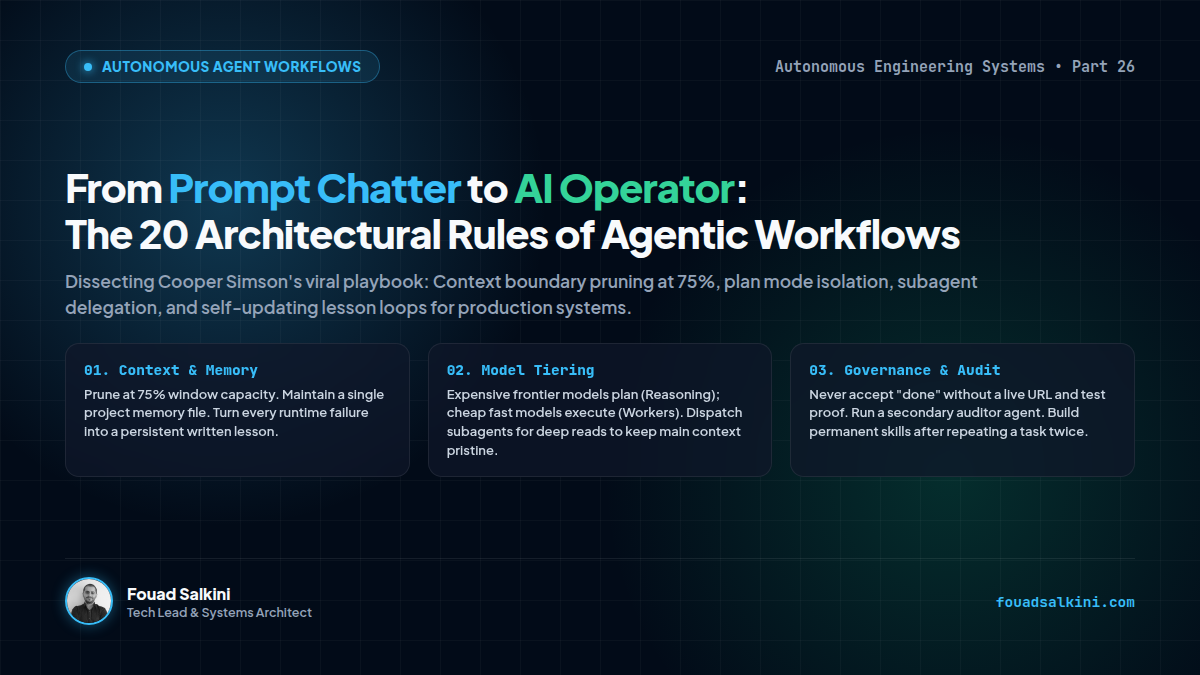
A 60-second video by Cooper Simson (@cooper.simson), founder of Actionable AI, recently struck a chord across the engineering and entrepreneurship communities under the title: “$2M of AI Advice in 60 Seconds”.
Behind the punchy social media delivery lies an operational reality that separates naive “Prompt Chatters” (who treat LLMs as conversational chatbots) from true “AI Operators” (who architect self-correcting, autonomous agent systems).
At Tripnologies and Sync Studios, where we operate production agent fleets across server orchestration, financial trading pipelines, and full-stack software deployments, these principles are not marketing tips. They are hard architectural laws.
Here is an architectural deconstruction of the 20 golden rules, organized into four foundational engineering pillars.
Pillar 1: Context Window Hygiene & Memory Tiering
The single greatest mistake made by developers using agentic CLI tools (like Claude Code, Hermes Agent, or Codex) is treating the LLM context window as an infinite dumpster.
Context Degradation Curve:
[0% - 50%]  ──▶ Peak Attention, Deterministic Tool Calls, Flawless Reasoning
[50% - 75%] ──▶ Latency Rises, Minor Hallucinations on Edge Constraints
[75% - 100%]──▶ Context Saturation: Prompt Forgetting, Silent File Corruptions, Repetitive Loops- Cut sessions at 75% context: Once a context window fills past 75%, attention degradation sets in. High-performing operators force a session compression or start a fresh session with an injected artifact summary.
- Give every project a memory file (
MEMORY.md): Never allow an agent to discover your system from scratch. A declarative memory file briefs the agent before the first tool call runs. - Every failure becomes a written lesson: When an agent misinterprets a command or breaks a build, write the root cause and imperative rule into a persistent skill or lesson file. If it loads in the next session, the mistake never recurs.
- Correct it twice? Make it update its own instructions: If you have to steer an agent twice on the same formatting or architectural error, stop steering manually: command the agent to patch its own system prompt or tool directives immediately.
Pillar 2: Task Partitioning & Model Tiering
The naive approach gives every task to the most expensive flagship model (Claude 3.5 Sonnet, OpenAI o1, GPT-4o). The engineered approach applies Compute Tiering.
| Workflow Stage | Assigned Model Tier | Operational Purpose |
|---|---|---|
| Architectural Planning | High-Cost Reasoning Models (o1, Sonnet 3.5) | Dependency mapping, risk mitigation, interface contracts |
| Worker Subagents | Lightweight Fast Models (Haiku 3.5, Mini, Local) | Reading 10,000-line logs, scraping docs, formatting schemas |
| Mechanical Code Edits | Deterministic Tooling / Fast Code Models | Running tests, git branching, file linting |
- Expensive models plan, cheap models execute: Reserve high-FLOP reasoning models for the plan mode. Once the steps are locked, delegate mechanical execution to cheap, high-speed models.
- Big project? Plan mode first, always: Never allow an agent to write code on a multi-file task before emitting an explicit, numbered execution plan with roll-back triggers.
- Send worker agents to read the long stuff: Do not dump a 500KB server log or a 20-page PDF into your primary supervisor context. Spawn an isolated subagent, let it extract the relevant three lines, and return only the structured payload.
- Give instructions one at a time: Autoregressive models suffer compounding drift when handed 10 instructions simultaneously. Enforce linear or dependency-graph execution.
Pillar 3: Governance, Proof-of-Work, & Verification
Agents are optimistic by design; they will happily report that a feature is complete and working when the server is throwing 500 errors behind the scenes.
     The Iron Rule of Agent Governance:

     Agent Claims "Done" ──▶ [REJECTED]
                                 │
     Must Supply Verifiable Proof:
     ├── Automated Unit Tests Passing (7/7)
     ├── HTTP Status 200 from Live Production Endpoint
└── Secondary Auditor Agent Sign-Off- Never accept “done” without a live link and proof: Prohibit self-reporting. Require real tool output: a passing test suite, a zero-error type check (
npm run check), or a live HTTP 200 verification. - Run a second agent to audit the first: Never trust a single agent to review its own pull request. Spawn an adversarial auditor agent with instructions to find edge-case failures and security regressions.
- Don’t describe errors; screenshot them: Describing a visual UI misalignment or a complex terminal stack trace in English wastes tokens and invites ambiguity. Use multimodal vision tools (
vision_analyze) to pass the raw pixels directly. - Start with the goal, not the instructions: Explicitly define what “done looks like” in verifiable metrics rather than dictating the journey. This allows the model to correct conflicting instructions before executing them.
Pillar 4: Skill Codification & True Autonomy
Chatting with an AI produces disposable answers. Building a system produces compounding enterprise value.
          From Disposable Prompting to Compounding Skills:

          Do a task once    ──▶ Execute via Chat
          Do a task twice   ──▶ Abstract into a Reusable Skill (SKILL.md)
Do a task daily ──▶ Automate via Headless Daemon / Cron- Do a task twice? Build a skill: If an operational procedure is executed more than once, codify it into a version-controlled skill with templates, test scripts, and edge-case guides.
- Don’t download every skill — less is more: Loading dozens of conflicting tool schemas degrades prompt routing. Keep skills modular and load them strictly on-demand.
- Don’t copy-paste responses — connect your tools: Replace copy-pasting text between browser tabs with direct APIs, database connections, and CLI interfaces.
- Don’t prompt AI — make it interview you: On fuzzy, ill-defined strategic tasks, command the AI: “Interview me one question at a time about constraints and objectives before generating anything.”
- Don’t type — use voice: High-bandwidth human intent flows faster through natural speech (transcribed via Whisper or native audio) than manual typing.
- Skip the tool buffet — master the core CLI first: Stop hopping between 50 AI wrappers. Master an extensible, terminal-first agentic harness (Claude Code, Hermes Agent).
- Schedule your agents: True leverage is an inbox that triages itself every hour, a staging server that runs automated regression audits at midnight, and intelligence scouts that monitor competitors automatically.
- The Bottom Line: AI will not replace skilled engineers or operators. A single engineer commanding an autonomous swarm of disciplined, audited agents will effortlessly outperform an entire department of manual workers.

Written by Fouad Salkini (فؤاد سلقيني)
General Manager & Tech Lead at Tripnologies and Sync Studios. Systems Architect focusing on AI coding agents, DevOps, and quantitative systems.