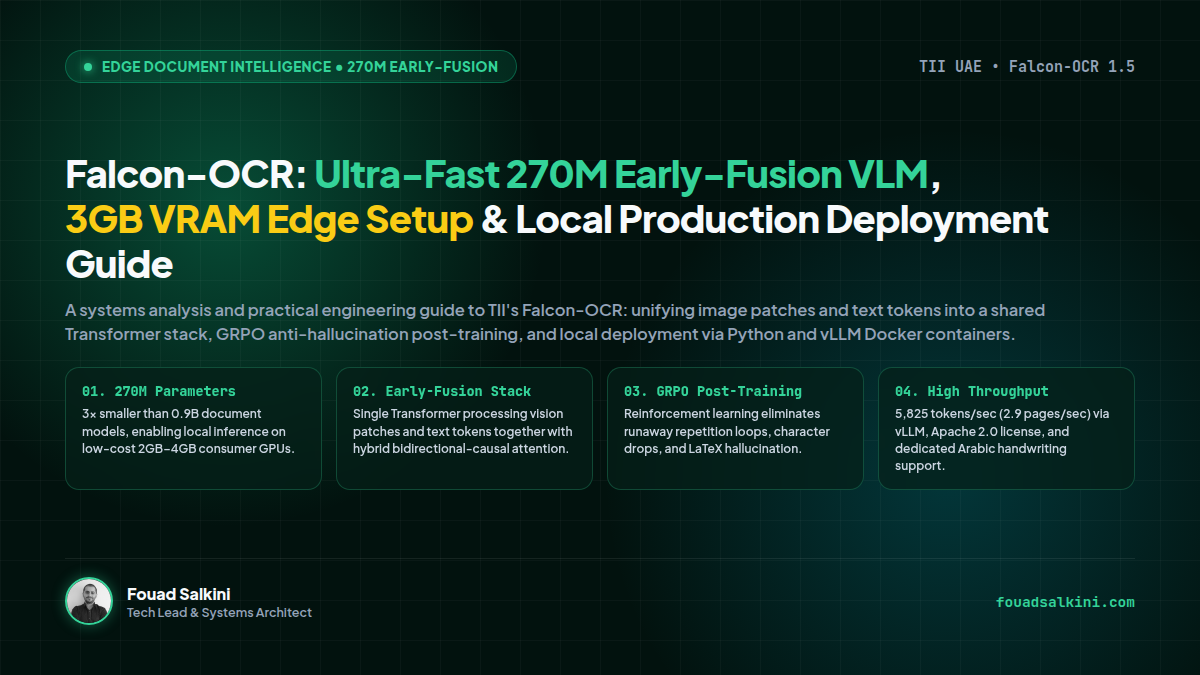
Falcon-OCR: Ultra-Fast 270M Early-Fusion VLM, 3GB VRAM Edge Setup, and Local Production Deployment Guide
A systems analysis and practical engineering guide to TII's Falcon-OCR (270M parameters): how early-fusion architecture unifies image patches and text tokens inside a single Transformer stack, GRPO anti-hallucination post-training, benchmark comparisons against 0.9B models, and step-by-step local setup using Python Transformers and production vLLM Docker containers.
When deploying Vision-Language Models (VLMs) for document extraction in production, systems engineers face an uncomfortable trade-off.
Large models (such as Chandra OCR 2, DeepSeek-OCR, or dots.ocr 1.5) deliver extraordinary recognition fidelity across tables and formulas, but they command 0.9B to 3B parameters, require 16GB to 24GB+ of VRAM, and run up steep cloud GPU bills. Conversely, legacy CPU engines like Tesseract are lightweight and private, but fail catastrophically on modern layouts, multi-column reading orders, and complex typography.
Enter Falcon-OCR (tiiuae/Falcon-OCR), developed by the Technology Innovation Institute (TII) in Abu Dhabi (the creators of the Falcon foundation models).
At only 270 million parameters, Falcon-OCR shatters conventional scaling assumptions. By ditching the traditional dual-encoder pipeline in favor of an Early-Fusion Single-Transformer architecture, Falcon-OCR runs comfortably on 2GB to 4GB of VRAM, achieves up to 5,825 tokens/second (2.9 pages/sec) on production vLLM serving, and scores an impressive 82.4 on the olmOCR benchmark—all under the permissive Apache 2.0 license.
Here is an architectural breakdown of Falcon-OCR, followed by copy-pasteable instructions to run it locally on your own workstation or budget server.
1. Architectural Blueprint: The Early-Fusion Revolution
Most modern OCR VLMs are engineered as multi-stage pipelines: a frozen vision backbone (like SigLIP or ViT) extracts image feature maps, which are projected through adapter cross-attention layers into an autoregressive language decoder.
Falcon-OCR takes an entirely different architectural path: Early Fusion in a Single Transformer Stack.
[ Conventional Two-Stage OCR VLM ]
Document Image ──> [ Vision Encoder (ViT / SigLIP) ] ──> [ Adapter / Cross-Attention ] ──> [ Text Decoder (LLM) ]
(3 Modules • Heavy Latency • Memory Duplication • ~0.9B - 2B Parameters)

[ Falcon-OCR Early-Fusion Architecture ]
Document Image Patches ──┐
                         ├──> [ Unified 270M Transformer Stack ] ──> Streaming Output (Text / LaTeX / HTML)
Prompt Tokens (Task)  ──┘     (Hybrid Attention: Vision Bidirectional + Text Causal)
(Single Model • Shared Parameters • Ultra-Low Latency • 270M Parameters Total)
Why Early Fusion Wins:
- Shared Parameter Space: Image patches and text tokens are processed together from layer one. Visual features directly inform the token embeddings without lossy projection bottlenecks.
- Hybrid Attention Masking: Image tokens attend to each other bidirectionally (allowing the model to understand global two-dimensional layout geometry), while generated text tokens decode causally conditioned on the document canvas.
- Task Switching via Prompts: Rather than needing specialized heads for tables or math, a simple text prompt instructs the model to output Markdown, LaTeX equations, or raw HTML tables.
2. Benchmark Reality: Punishing Efficiency at 270M
How does a 270M model hold up against models three to four times its size?
On the rigorous olmOCR Benchmark, Falcon-OCR 1.5 achieved scores that rival heavyweights while drastically cutting compute requirements:
┌────────────────────────────────────────────────────────────────────────┐
│               olmOCR Benchmark vs. Serving Throughput                  │
├──────────────────────┬─────────────┬──────────────┬────────────────────┤
│ Model                │ Parameters  │ olmOCR Score │ vLLM Speed (H100)  │
├──────────────────────┼─────────────┼──────────────┼────────────────────┤
│ Chandra OCR 2        │ ~0.9B       │ 85.8         │ ~1.4 - 2.0 pgs/sec │
│ dots.ocr 1.5         │ ~1.0B       │ 83.9         │ ~1.2 pgs/sec       │
│ Falcon-OCR 1.5 (TII) │ 270M        │ 82.4         │ 2.9 pgs/sec (5.8k) │
│ DeepSeek-OCR         │ ~1.0B       │ 75.4         │ ~1.1 pgs/sec       │
│ GPT-4o (Vision)      │ Frontier    │ 69.9         │ Cloud API latency  │
│ Tesseract.js         │ Rule/CRNN   │ < 40.0       │ CPU bottleneck     │
└──────────────────────┴─────────────┴──────────────┴────────────────────┘
The Role of GRPO Post-Training:
In version 1.5, TII applied Group Relative Policy Optimization (GRPO)—the same reinforcement learning technique powering frontier reasoning models like DeepSeek-R1.
- The Problem: Small VLMs historically suffer from “runaway repetition loops” (e.g., repeating
|---|---|across thousands of tokens on borderless tables) or dropping math symbols. - The GRPO Solution: The model was rewarded for syntactic correctness (valid LaTeX delimiters, closed HTML table tags) and penalized for repetitive hallucinations, producing clean, bounded generations.
3. How to Run Falcon-OCR Locally
You can run Falcon-OCR locally via two distinct setups: a direct Python script for local experiments, or an official Docker container powered by vLLM for high-throughput production pipelines.
Method A: Local Python Script (Hugging Face Transformers)
This runs on any machine with PyTorch and an NVIDIA GPU (RTX 3060/4060 or Apple Silicon Mac).
Step 1: Install Dependencies
pip install -U "torch>=2.5" transformers pillow einops torchvisionStep 2: Run Inference
Save the following script as run_falcon_ocr.py:
import torch
from PIL import Image
from transformers import AutoModelForCausalLM, AutoProcessor

MODEL_ID = "tiiuae/Falcon-OCR"

# 1. Load processor and model with bfloat16 precision
print("Loading Falcon-OCR (270M)...")
processor = AutoProcessor.from_pretrained(MODEL_ID, trust_remote_code=True)
model = AutoModelForCausalLM.from_pretrained(
    MODEL_ID,
    torch_dtype=torch.bfloat16,
    device_map="auto",
    trust_remote_code=True
)

# 2. Load target document image
image_path = "sample_invoice_or_page.png"
image = Image.open(image_path).convert("RGB")

# 3. Format prompt with system instructions
messages = [
    {
        "role": "user",
        "content": [
            {"type": "image"},
            {"type": "text", "text": "Extract all text, tables as HTML, and math as LaTeX."}
        ]
    }
]

prompt = processor.apply_chat_template(messages, add_generation_prompt=True)
inputs = processor(text=prompt, images=[image], return_tensors="pt").to(model.device)

# 4. Generate structured text
print("Extracting document...")
with torch.no_grad():
    generated_ids = model.generate(
        **inputs,
        max_new_tokens=2048,
        do_sample=False,
        use_cache=True
    )

output_text = processor.decode(
    generated_ids[0][inputs["input_ids"].shape[1]:],
    skip_special_tokens=True
)

print("\n--- Extracted Output ---")
print(output_text)
Run it via:
python3 run_falcon_ocr.pyMethod B: High-Throughput Docker & vLLM Serving (Production)
TII publishes an official, pre-packaged vLLM Docker image that serves the model over a standard REST API and handles image pre-processing out of the box.
Step 1: Run the Official Docker Container
docker run --gpus all \
  -p 8000:8000 \
  -p 5002:5002 \
  --name falcon-ocr-server \
  ghcr.io/tiiuae/falcon-ocr:latest
This exposes:
- Port
8000: OpenAI-compatible vLLM completion endpoint. - Port
5002: Specialized Falcon-OCR HTTP upload service.
Step 2: Send a Document via cURL
curl -X POST http://localhost:5002/falconocr/upload \
  -F "file=@financial_report_page1.png" \
  -F "task=markdown"
The response streams back clean, structured Markdown in milliseconds.
4. Architectural Summary: When to Use Falcon-OCR vs. Chandra 2
| Decision Criteria | Chandra OCR 2 (Datalab) | Falcon-OCR 1.5 (TII) |
|---|---|---|
| Primary Goal | Peak Benchmark Quality (#1 SOTA) | Ultra-Low Cost, Speed & Edge Portability |
| Model Size | ~0.9B Parameters | 270M Parameters |
| VRAM Footprint | 16GB – 24GB VRAM | 2GB – 4GB VRAM |
| Serving Throughput | ~1.4 – 2.0 pages / sec | ~2.9 pages / sec (5,825 tok/s) |
| Arabic & Regional Scripts | High general accuracy | Dedicated Arabic variants available |
| Best Production Fit | Parsing complex academic books & RAG | High-volume invoice backends, edge apps, micro-VPS |
Final Engineering Takeaway:
Falcon-OCR demonstrates that you do not need multi-gigabyte models to solve production document extraction.
With Early-Fusion Transformers and GRPO reinforcement learning, TII delivers a sub-300M model capable of running on edge hardware while outperforming frontier generalist vision models. For developers looking to self-host document parsing with minimal infrastructure overhead, Falcon-OCR is an extraordinary milestone.
Written by Fouad Salkini (فؤاد سلقيني)
General Manager & Tech Lead at Tripnologies and Sync Studios. Systems Architect focusing on AI coding agents, DevOps, and quantitative systems.