EmbeddingGemma 2: Unified 4-Way Multimodal Vector Space, Modular Architecture, and 6x Matryoshka Compression
A comprehensive systems and implementation guide to Google DeepMind's EmbeddingGemma 2 (Apache 2.0): mapping text, code, images, video, and audio into a unified 768-dimensional space, leveraging detachable modular encoders, task-specific instruction prefixes, and Matryoshka Representation Learning (MRL) for production RAG and edge deployment.
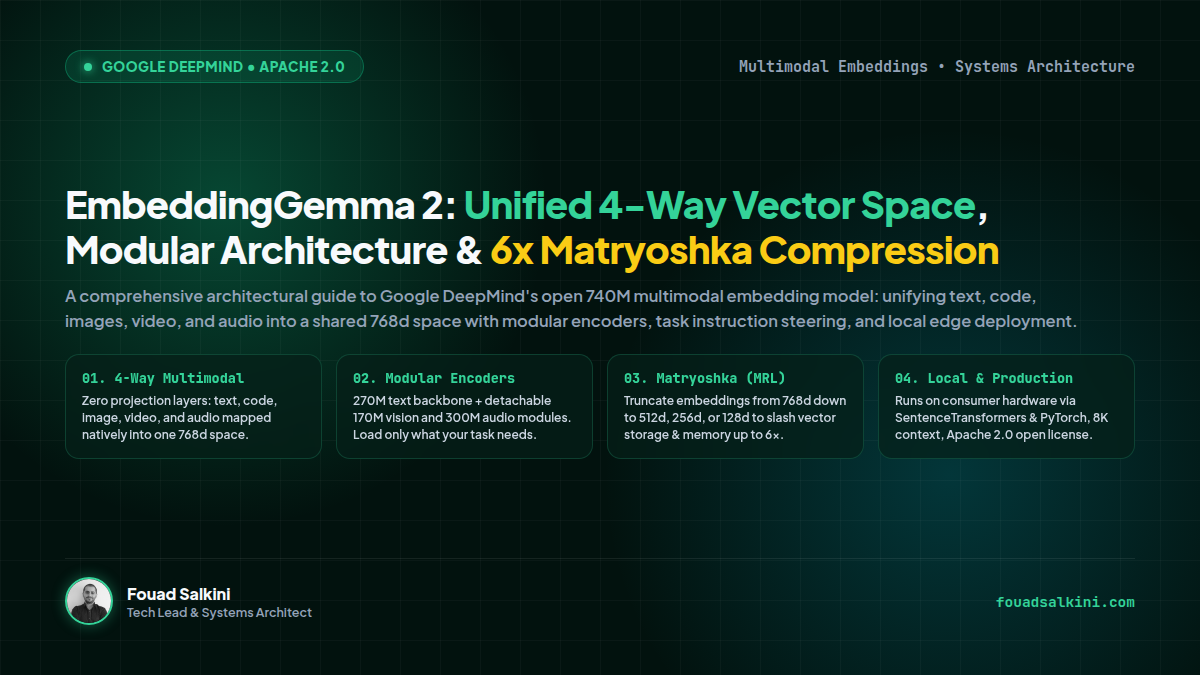
On October 2026, Google DeepMind released EmbeddingGemma 2 under the permissive Apache 2.0 license—a milestone in open vector representation models.
While legacy embedding models remain siloed—requiring separate text embedders (like BGE or text-embedding-3), vision encoders (like CLIP or SigLIP), and specialized audio feature extractors—EmbeddingGemma 2 maps text (including source code), images, video, and audio into a single, unified 768-dimensional vector space.
With a total of 740M parameters structured into an ultra-efficient modular architecture, this model is explicitly designed to run on consumer hardware, laptops, and edge devices.
Here is a comprehensive systems, architectural, and practical implementation guide on how EmbeddingGemma 2 works under the hood, how to integrate it into production pipelines, and where it delivers maximal architectural leverage.
1. Architectural Blueprint: The Unified 4-Way Vector Space
The core breakthrough of EmbeddingGemma 2 is the elimination of cross-modal alignment translation layers:
┌────────────────────────────────────────────────────────────────────────┐
│                        Input Modalities (Raw Data)                     │
│   [ Text & Code ]       [ Images / Video ]           [ Audio Wave ]    │
└──────────┬──────────────────────┬──────────────────────────┬───────────┘
           │                      │                          │
           ▼                      ▼                          ▼
┌────────────────────┐ ┌────────────────────┐ ┌──────────────────────────┐
│  Text Backbone     │ │  Vision Encoder    │ │      Audio Encoder       │
│     (270M)         │ │     (170M)         │ │         (300M)           │
│  Gemma 4 Decoder   │ │  SigLIP-2 Vision   │ │ Conformer Audio Backbone │
└──────────┬─────────┘ └──────────┬─────────┘ └──────────┬───────────────┘
           │                      │                      │
           └──────────────────────┼──────────────────────┘
                                  ▼
┌────────────────────────────────────────────────────────────────────────┐
│                  Unified 768-Dimensional Space                         │
│   (Cosine Similarity natively compares Text ↔ Image ↔ Video ↔ Audio)   │
└─────────────────────────────────┬──────────────────────────────────────┘
                                  │
                                  ▼
┌────────────────────────────────────────────────────────────────────────┐
│             Matryoshka Representation Learning (MRL)                   │
│   Slice Head: [ 768d (100%) │ 512d (99%) │ 256d (96%) │ 128d (92%) ]   │
└────────────────────────────────────────────────────────────────────────┘
The Three Modality Encoders:
- 270M Text & Code Backbone: Derived from the dense Gemma 4 architecture, pre-trained on 100+ natural languages with a ~14% benchmark jump on code retrieval tasks across Python, Go, Rust, and TypeScript.
- 170M Vision Module: A high-throughput vision transformer adapted from SigLIP-2, capable of processing static images, high-resolution diagrams, and sampled temporal video keyframes.
- 300M Audio Encoder: A robust Conformer-based acoustic encoder that captures phonetic nuances, ambient audio events, and multi-speaker speech patterns.
Because all three encoders are joint-trained against a shared contrastive objective, a vector representing an audio snippet of a cat meowing, an image of a cat, the English word “cat”, and the Arabic word “قطة” all land in the exact same neighborhood of the 768d vector sphere.
2. Key Technical Innovations
A. Modular Footprint (Load Only What You Need)
In resource-constrained deployments, loading an entire 740M multimodal model to perform simple text or code retrieval is wasteful. EmbeddingGemma 2 is architecturally partitioned:
- Text-Only Deployment: Load only the 270M parameter core (consuming under 600MB of RAM in FP16/bfloat16).
- Vision-Text Deployment: Attach the 170M vision module (440M total).
- Full Multimodal Suite: Load all 740M parameters across text, vision, and audio.
B. Matryoshka Representation Learning (MRL): 6x Storage Reduction
Dense vector storage is the hidden cost driver in enterprise vector databases (pgvector, Qdrant, Milvus). Storing 768 float32 dimensions for millions of documents quickly saturates RAM.
EmbeddingGemma 2 is trained using Matryoshka Representation Learning (MRL), packing the most salient semantic information into the earliest vector dimensions:
| Dimension Slicing | Vector Size (Bytes / doc) | Relative Accuracy Retained | Storage & Memory Savings |
|---|---|---|---|
| 768d (Full) | 3,072 bytes | 100% | Baseline |
| 512d | 2,048 bytes | 99.2% | 33% Reduction |
| 256d | 1,024 bytes | 96.8% | 66% Reduction |
| 128d | 512 bytes | 92.4% | 83.3% Reduction (~6x) |
In practice, you can index millions of vectors at 128d for fast candidate retrieval (HNSW or IVF-Flat) and rerank the top-50 candidates using full 768d vectors.
C. Task-Specific Instruction Steering
EmbeddingGemma 2 supports asymmetric query-document retrieval via explicit instruction prompts:
- General Semantic Search:
Given a web search query, retrieve relevant passages that answer the query - Code Search:
Given a natural language description, retrieve matching source code implementations - Cross-Modal Retrieval:
Given an audio or image query, retrieve relevant textual documentation
By prepending task instructions to queries while leaving documents un-prefixed, the model separates search intent from document semantics.
3. High-Impact Production Use Cases
1. Cross-Modal Omnisearch (Unified Media Catalogs)
- The Problem: E-commerce and media platforms maintain separate search indices for text tags, image features, and video descriptions.
- The Solution: Embed user voice notes, uploaded screenshot photos, and search keywords into the same table. A single query vector returns matching products regardless of whether the match is in an image, a PDF description, or an audio review.
2. Multi-Tier Codebase & Architecture Search
- With its 14% improvement in code understanding, EmbeddingGemma 2 excels at embedding function definitions, inline docstrings, and system architecture diagrams (SVG/PNG) in a unified repository index.
3. Edge & Local Autonomous Agent Memory
- Because the text core is only 270M parameters, autonomous coding agents and local assistants (running on Raspberry Pi 5, Apple Silicon MacBooks, or low-cost VPS instances) can run local semantic deduplication without sending sensitive embeddings to proprietary cloud APIs.
4. Implementation Guide: Code & Usage Instructions
Step 1: Environment Setup
Ensure you are using the latest sentence-transformers (v3+) and PyTorch with bfloat16 support:
pip install -U sentence-transformers torch torchvision torchaudioStep 2: Text & Code Embeddings with Task Instructions
import torch
from sentence_transformers import SentenceTransformer

# Load the model with automatic device placement (CUDA / MPS / CPU)
model = SentenceTransformer("google/embeddinggemma-2", model_kwargs={"torch_dtype": torch.bfloat16})

# 1. Documents are embedded WITHOUT task instructions
documents = [
    "PostgreSQL 16 introduced substantial performance improvements in pgvector query indexing.",
    "FastAPI utilizes Pydantic v2 to serialize request payloads with native Rust speed.",
    "def calculate_tax(subtotal: float, rate: float = 0.15) -> float: return subtotal * (1 + rate)"
]
doc_embeddings = model.encode(documents, normalize_embeddings=True)

# 2. Queries use asymmetric task instructions for maximum retrieval accuracy
query = "How to compute order totals with sales tax in Python?"
task_prompt = "task: Given a natural language programming question, retrieve relevant code snippets: "

query_embedding = model.encode(task_prompt + query, normalize_embeddings=True)

# 3. Compute cosine similarity
similarities = doc_embeddings @ query_embedding
print("Most relevant document index:", similarities.argmax())
Step 3: Leveraging Matryoshka (MRL) for 6x Vector Compression
# Truncate embeddings to 128 dimensions to save 83% storage in pgvector / Qdrant
truncated_embeddings = doc_embeddings[:, :128]

# Normalize after truncation to maintain unit length for dot-product search
import numpy as np
norms = np.linalg.norm(truncated_embeddings, axis=1, keepdims=True)
normalized_128d = truncated_embeddings / norms

print("Original shape:", doc_embeddings.shape)      # (3, 768)
print("Compressed shape:", normalized_128d.shape)    # (3, 128)
Step 4: Storing in PostgreSQL with pgvector
In your production database:
-- Enable vector extension
CREATE EXTENSION IF NOT EXISTS vector;

-- Use 128 dimensions instead of 768 to save massive RAM & index cache
CREATE TABLE multimodal_knowledge_base (
    id BIGSERIAL PRIMARY KEY,
    content_type VARCHAR(32) NOT NULL, -- 'text', 'code', 'image', 'audio'
    content_ref TEXT NOT NULL,
    embedding vector(128) NOT NULL
);

-- Build high-speed HNSW index
CREATE INDEX idx_multimodal_hnsw ON multimodal_knowledge_base
USING hnsw (embedding vector_cosine_ops)
WITH (m = 16, ef_construction = 64);
5. Architectural Summary
| Dimension | EmbeddingGemma 2 Specification |
|---|---|
| License | Apache 2.0 (Permissive Commercial Use) |
| Total Parameters | 740M (Modular: 270M Text + 170M Vision + 300M Audio) |
| Output Dimension | 768d (MRL-supported: 512d, 256d, 128d) |
| Context Window | 8,192 Tokens (Text) |
| Modalities | Text, Code, Images, Video, Audio |
| Languages | 100+ Natural Languages |
| Target Hardware | Consumer laptops, Edge VPS, Mobile Devices, GPUs |
EmbeddingGemma 2 eliminates the architectural friction of multi-model vector pipelines, establishing a clean, unified standard for next-generation multimodal retrieval systems.

Written by Fouad Salkini (فؤاد سلقيني)
General Manager & Tech Lead at Tripnologies and Sync Studios. Systems Architect focusing on AI coding agents, DevOps, and quantitative systems.