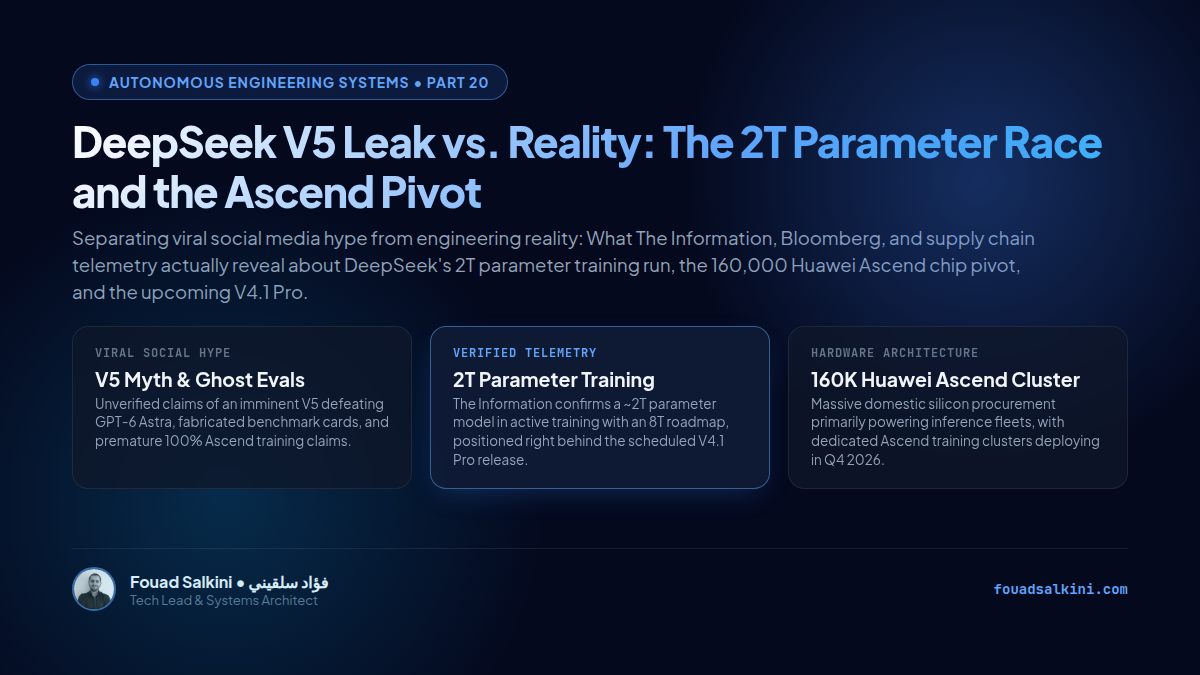
DeepSeek V5 Leak vs. Reality: The 2-Trillion Parameter Race and the Huawei Ascend Shift
Separating viral social media hype from engineering reality: What The Information, Bloomberg, and supply chain telemetry actually reveal about DeepSeek's 2T parameter training run, the 160,000 Huawei Ascend chip pivot, and the upcoming V4.1 Pro.
On September 26, 2026, social media timelines ignited with claims of an "imminent DeepSeek V5 release."
A viral post on X claimed that DeepSeek was preparing to ship a 2-trillion parameter model that "beats GPT-6 Astra," that founder Liang Wenfeng called it the company’s "biggest bet," and that it was "the first DeepSeek model trained fully on Huawei Ascend chips instead of Nvidia."
In an industry driven by engagement farming and speculative leaks, engineers must separate fabricated social graphics from verified infrastructure telemetry.
When you examine the primary reporting from The Information, Bloomberg, TrendForce, and DeepSeek’s own API release pipeline, a much more nuanced—and architecturally fascinating—reality emerges.
Here is an engineering audit of what is genuinely happening inside DeepSeek’s compute clusters, why the Huawei Ascend migration is real (but misunderstood), and what to expect on their model roadmap.
1. Auditing the Claims: The Leak vs. The Record
Let us examine the viral claims against corroborated enterprise reporting:
┌───────────────────────────┬──────────────────────────────────────┬───────────────────────┐
│ Viral Claim on X          │ What Primary Sources Actually Report │ Engineering Verdict   │
├───────────────────────────┼──────────────────────────────────────┼───────────────────────┤
│ Imminent "DeepSeek V5"    │ Bank of America forecast (via 36Kr)  │ Speculative Forecast  │
│ Launch                    │ of H2 2026; no official announcement │ (V4.1 Pro is next)    │
├───────────────────────────┼──────────────────────────────────────┼───────────────────────┤
│ 2-Trillion Parameter      │ The Information (Sep 23): DeepSeek   │ Verified Fact         │
│ Model in Training         │ is training ~2T, with 8T roadmap     │ (Model name unstated) │
├───────────────────────────┼──────────────────────────────────────┼───────────────────────┤
│ Trained 100% on Huawei    │ Bloomberg: 160,000 Ascend chips are  │ False Premise         │
│ Ascend Silicon            │ deployed primarily for INFERENCE     │ (Training in Q4 2026) │
├───────────────────────────┼──────────────────────────────────────┼───────────────────────┤
│ "Beats GPT-6 Astra"       │ Zero evaluation sheets, papers, or   │ Fabricated Metric     │
│ In Benchmarks             │ benchmark runs exist on record       │ (Pure Vaporware)      │
└───────────────────────────┴──────────────────────────────────────┴───────────────────────┘
Claim 1: The “2-Trillion Parameter” Training Run
The Truth: This claim is anchored in legitimate reporting. On September 23, 2026, The Information confirmed that DeepSeek is actively training a massive frontier model with approximately 2 trillion parameters, and that Liang Wenfeng briefed investors that their next computational horizon targets 8 trillion parameters.
However, nowhere in the reporting is this model designated as "V5." DeepSeek’s engineering taxonomy has historically progressed through intermediate architectural refinements.
For scale, Alibaba’s Qwen 3.8 Max sits at 2.4 trillion parameters and Moonshot’s Kimi K3 at 2.8 trillion. A 2T parameter mixture-of-experts (MoE) model is the natural progression of DeepSeek’s sparse architecture.
Claim 2: The “100% Huawei Ascend” Migration
The Truth: The claim that DeepSeek has already completed a frontier model training run exclusively on domestic Huawei silicon conflates two distinct infrastructure timelines:
- The Inference Deployment (Current): Bloomberg reported in early September that DeepSeek placed a massive order for at least 160,000 Huawei Ascend chips. Crucially, supply-chain analysis confirms these accelerators are currently utilized primarily to run inference serving fleets within mainland datacenters, freeing up their existing Nvidia H800/H100 clusters for high-throughput pretraining.
- The Training Cluster Transition (Q4 2026): The Information reported that DeepSeek expects next-generation Huawei Ascend training silicon to arrive in volume during Q4 2026. Because Ascend accelerators exhibit lower compute density and interconnect bandwidth relative to Nvidia’s B200/H100 NVLink fabrics, industry estimates indicate DeepSeek requires approximately 3.5x to 4x more Ascend nodes to achieve equivalent training cluster throughput.
Migrating distributed training code from Nvidia’s CUDA/NCCL to Huawei’s CANN (Compute Architecture for Neural Networks) and MindSpore stack is one of the most complex compiler-engineering undertakings in AI today. Liang Wenfeng’s quote about the company’s "biggest bet" was referring to this software-hardware compiler transition, not a marketing launch.
Claim 3: The “Beats GPT-6 Astra” Benchmark
The Truth: Pure engagement fiction. The viral image consisted solely of DeepSeek’s blue whale emblem placed next to "V5" in a standard sans-serif font. No LMSYS Arena telemetry, no GSM8K metrics, and no SWE-bench numbers have been registered.
2. DeepSeek’s Actual Architectural Trajectory
To understand what DeepSeek is building, one must look at how their codebase has systematically evolved:
┌────────────────────────────────────────────────────────┐
│                   DeepSeek Roadmap                     │
└───────────────────────────┬────────────────────────────┘
                            │
      ┌─────────────────────┼─────────────────────┐
      ▼                     ▼                     ▼
┌──────────────┐      ┌──────────────┐      ┌──────────────┐
│ DeepSeek R1  │ ───► │ DeepSeek V4  │ ───► │ 2T Frontier  │
│  Pure RL &   │      │ 1M Context & │      │ Dense Hybrid │
│   Thinking   │      │  DSA Sparse  │      │ & Ascend HW  │
└──────────────┘ └──────────────┘ └──────────────┘- DeepSeek R1 (January 2026): Proved that pure reinforcement learning (RL) without supervised fine-tuning could induce emergent chain-of-thought reasoning, slashing training compute costs by an order of magnitude.
- DeepSeek V3.2 / V3.2-Speciale (Late 2025): Integrated multi-step reasoning directly into agentic tool execution, capturing gold-medal algorithmic problem-solving in ICPC benchmarks.
- DeepSeek V4.1 Family (September 2026):
- V4.1 Flash (Released September 10, 2026): Introduced DeepSeek Sparse Attention (DSA) to handle 1-million-token contexts economically ($0.14 per million input tokens).
- V4.1 Pro (Queued Next): DeepSeek’s official release schedule explicitly positions V4.1 Pro as the immediate successor, designed for heavy autonomous coding and complex systems synthesis.
3. The Geopolitical Silicon Reality: CUDA vs. CANN
The real story behind DeepSeek is not a speculative version number, but the engineering decoupling of foundation model training from Western hardware monopolies.
Training a 2-trillion parameter model requires solving massive distributed cluster challenges:
- All-to-All Communication Overhead: In Mixture-of-Experts architectures, routing tokens between specialized expert layers across thousands of nodes requires extreme interconnect bandwidth.
- Compiler Optimization on CANN: Replacing Nvidia’s mature Megatron-LM and FlashAttention CUDA kernels with custom Ascend operators requires writing custom kernel assembly from scratch.
- Hardware Fault Tolerance: Operating an Ascend cluster with 100,000+ accelerators demands automated checkpointing that recovers from node degradation in seconds without stalling the entire training run.
4. The Engineering Takeaway
In the era of rapid foundation model iterations, software architects and tech leaders must maintain rigorous epistemic hygiene:
- Verify via Commit Trees & Change Logs: Trust official documentation (
deepseek.com/en/news, Hugging Face model cards, and arXiv preprints), not unverified cards on social feeds. - Respect the Release Pipeline: DeepSeek’s stated pipeline leads with V4.1 Pro before any generational leap to V5.
- Watch the Silicon Shift: The true architectural battleground of 2026 is not parameter counts, but whether open-source teams can achieve frontier pretraining performance on non-CUDA hardware architectures.
Sources & Telemetry: The Information (September 21 & 23, 2026), Bloomberg Supply Chain Reporting, TrendForce Semiconductor Intelligence, DeepSeek Official API Documentation, and CellCog Rumor Tracker.

Written by Fouad Salkini (فؤاد سلقيني)
General Manager & Tech Lead at Tripnologies and Sync Studios. Systems Architect focusing on AI coding agents, DevOps, and quantitative systems.