DeepInfer: DeepSeek Opens Its Inference Engine—Not a Complete Serving Platform
DeepSeek released DeepInfer and deepseek-recipe. Here is what the engine does, which hardware it targets, what a production deployment still needs, and why its benchmarks are not a promise of cheaper AI for every project.
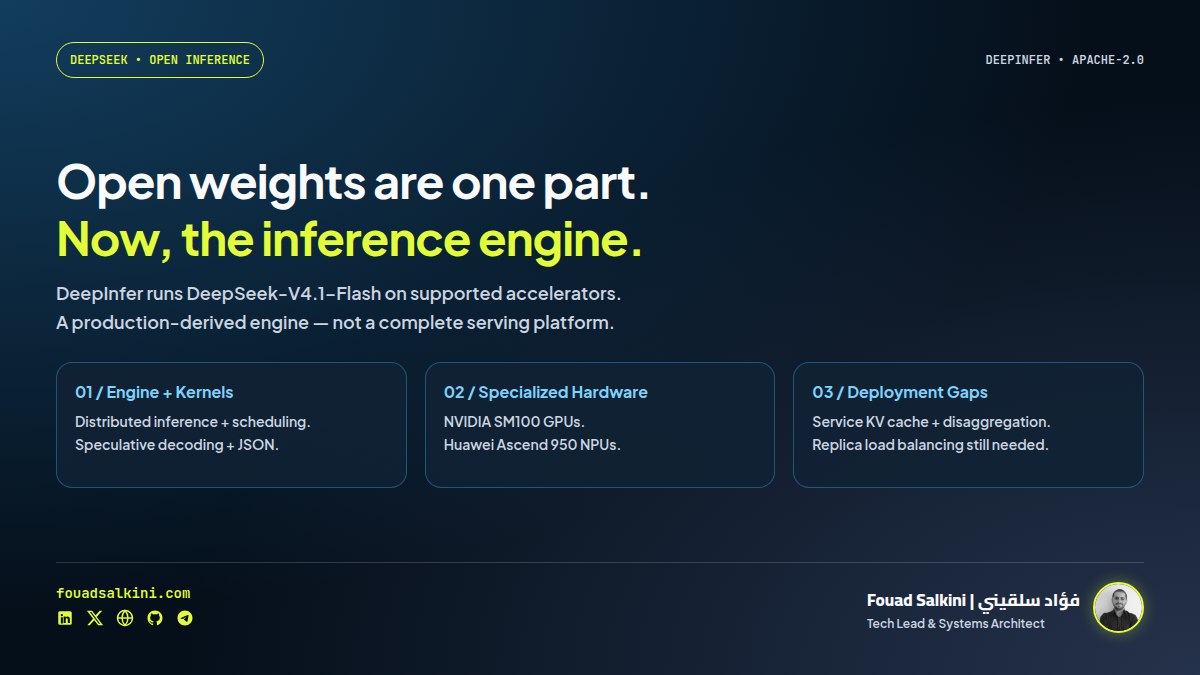
Releasing model weights is one part of making AI deployable. Releasing the engine that runs them is another.
On 20 October, DeepSeek announced DeepInfer, the inference framework it says powers its large-scale production services, including DeepSeek-V4.1-Flash. It also released deepseek-recipe, a companion library for processing requests and model outputs. [1][2][4]
This is useful infrastructure work, but the distinction in the repository matters: the public DeepInfer release provides offline inference, not a complete production serving platform. Several components needed for a full service are explicitly outside this release. [2]
I reviewed the source and documentation. I did not run the model or reproduce its performance charts: this environment has no accessible NVIDIA or Ascend accelerator.
What DeepInfer actually does
Inference is the work a model performs when it processes a request and generates an answer. DeepInfer coordinates that work: how requests are batched, how computation is distributed and how specialized kernels execute the model. [2]
The reviewed release lists DeepSeek-V4.1-Flash as its supported model. It is not presented as a general-purpose runner for every open model. [2]
Its documented features include:
- Optimized kernels: FlashMLA, DeepGEMM, DeepEP, DeepSelect, TileKernels and custom TileLang operations.
- Distributed execution: attention data/context parallelism, MoE expert parallelism and expert load balancing.
- Speculative decoding: DSpark and confidence-scheduled verification use draft tokens and verify them to accelerate generation.
- SWA bounded replay: limits the suffix replayed during decoder prefill rather than repeating all of that work.
- Asynchronous scheduling: overlaps CPU batch scheduling with accelerator execution.
- Structured outputs: constrains generation using a regex, JSON schema or EBNF grammar. [2]
The practical opportunity is to improve how expensive hardware is used. That is an engineering objective—not a measured saving for your application until you test it.
The README also describes deterministic sampling and an optional batch-invariant mode, both documented as NVIDIA-only. These can help investigate reproducibility, but I did not test either behavior. [2]
Why the companion release matters
An inference engine computes tokens. A usable API also needs to turn a conversation into the right input and interpret the generated output correctly.
deepseek-recipe provides Rust libraries and Python bindings for that processing layer: [4]
- Converts Messages, Chat Completions and Responses request formats into a shared conversation representation.
- Renders prompts and encodes them with an attached tokenizer.
- Handles streaming and complete-response parsing, including reasoning content and tool-call representations.
DeepSeek describes the component as aligned with the processing logic behind its official API. That helps community deployments reuse the intended formatting logic rather than recreate it independently. It does not mean installing the library creates the official service. [4]
Its README is explicit: the caller must supply model inference, tool execution and HTTP transport. A parsed tool call is not an executed tool, and an API-format converter is not a hosted API server. [4]
The licenses are separate: DeepInfer is Apache-2.0; deepseek-recipe is MIT. Model weights and third-party dependencies have their own terms; do not assume either code license automatically covers every deployment artifact. [3][5]
The main limitation: the engine is not the whole service
The DeepInfer README lists three missing pieces for a complete inference service: [2]
- A KV cache system at the service level.
- VE/Prefill/Decode disaggregation, while noting that most required engine functionality is already implemented.
- Load balancing across data-parallel replicas, for both prefill and decode.
That does not mean the engine has no internal attention-cache functionality. It means you should not confuse an offline generation engine with the complete service-wide caching and routing system described as missing.
A public or internal business API also needs authentication, quotas, request limits, monitoring, incident handling and a tested deployment/rollback process. Those are responsibilities for the deployment team; open engine code does not remove them.
My assessment: this release is directly useful to inference and infrastructure teams. It is not a one-command substitute for an existing managed API.
Hardware: not a laptop installation story
The reviewed hardware support list is specific: [2]
- NVIDIA SM100 GPUs.
- Huawei Ascend 950 NPUs.
The documented software prerequisites are Linux, GCC 13 or newer, Python 3.12, and CUDA 13 for NVIDIA or CANN 9.2 for Ascend. [2]
Do not read “NVIDIA support” as “any NVIDIA card.” A consumer GPU, an older datacenter GPU or a small CPU-only VPS is not listed as a supported target in this snapshot. I did not establish a minimum working device count or memory configuration, so I am not offering a hardware shopping recommendation.
If you already have compatible infrastructure, start with an isolated evaluation environment. If you do not, assess the workload and total operating cost before renting a cluster simply because the code is free.
Read the performance charts with their setup attached
DeepSeek publishes throughput/latency plots and a reproduction script. The README says its prefill measurements use four SM100 GPUs and its decode measurements use 64, each within one scale-up domain. [2][7]
The chart metrics also differ:
- Prefill: non-cached input throughput per GPU versus latency per prefill step.
- Decode: output throughput per GPU versus per-user generation speed.
They are not interchangeable measures of “how fast the chatbot feels.” The plotted points vary workload/batch settings, and the shown charts do not provide a head-to-head comparison with a different serving engine. [2][7]
I would not turn them into “DeepInfer is X times faster than vLLM” or a promised percentage reduction in your bill. I did not reproduce the charts, and the release does not establish a universal cost or energy saving for arbitrary deployments.
For a useful evaluation, keep model revision, precision, hardware, topology and workload comparable. Measure:
- Time to first token and tail latency, not only peak throughput.
- Per-user generation speed at the concurrency you actually need.
- Output correctness and structured-output validity.
- Memory pressure, failures and recovery behavior.
- Total cost per successfully completed task. If claiming energy savings, measure energy for a comparable workload too.
How to evaluate it without treating your production server as a build machine
The documented installation path is a source build. On compatible hardware, create and activate a clean Python 3.12 environment, install the platform prerequisites, then review the repository’s build scripts before running them. The README’s NVIDIA path is: [2]
git clone https://github.com/deepseek-ai/DeepInfer.git
cd DeepInfer

# Reviewed snapshot; re-evaluate newer revisions before adopting them.
git checkout 9bd9cf243fc53ef9afbf8f04d391d989117d6ab9

export DEEPINFER_ACCELERATOR=nvidia
./build.sh
For Ascend, use the documented ascend platform value and its required software stack. The build installs dependencies and builds vendored operators; run it in a disposable environment rather than replacing packages on a shared production host. [2]
The offline example is:
python examples/offline_inference.pyIts default checkpoint is deepseek-ai/DeepSeek-V4.1-Flash-1017. A first run can download it to the Hugging Face cache. “Offline inference” does not mean the first run needs no network access. For a pre-provisioned checkpoint, the documented local override is: [2][6]
export DEEPINFER_HF_MODEL_DIR=/path/to/DeepSeek-V4.1-Flash-1017
python examples/offline_inference.py
The example supports a local Hugging Face directory with the required configuration and weights. Review model terms, storage needs, checkpoint code and dependencies before downloading or executing anything. These are upstream instructions, not build or generation commands I successfully ran for this review. [6]
Who should pay attention?
If you operate inference infrastructure: inspect the kernels, scheduler and distributed design; evaluate whether they address your real bottleneck. Budget for the missing service components.
If you build applications on an API: this is primarily an infrastructure development, not an instruction to migrate your app today. Watch for integrations and compare service quality, cost and operational burden when a deployable option meets your requirements.
If you run a small server or local assistant: do not assume this release is aimed at your hardware. Check the support list before spending time on a build.
DeepInfer makes more of DeepSeek’s inference implementation available to study and adapt. The value is access to the engineering—not a guarantee that self-hosting will be cheaper, easier or ready for every team.
Review scope
Source snapshot: DeepInfer 9bd9cf243fc53ef9afbf8f04d391d989117d6ab9; deepseek-recipe 935817c66f5d6e64838f419692545f06787e485f, reviewed 21 October 2026. This was a static source/document review and chart inspection. No accelerator build, model generation, upstream test-suite run or production-serving benchmark was performed.
Sources
[2] DeepInfer: scope, supported hardware, features, build and benchmark setup
[3] DeepInfer Apache-2.0 license
[4] deepseek-recipe: supported formats and caller responsibilities
[5] deepseek-recipe MIT license

Written by Fouad Salkini (فؤاد سلقيني)
General Manager & Tech Lead at Tripnologies and Sync Studios. Systems Architect focusing on AI coding agents, DevOps, and quantitative systems.