The Compute Bottleneck Dilemma: Why Claude's Limits Are Expanding While ChatGPT Feels Restrictive
Analyzing the viral critique of OpenAI's compute bottlenecks: why Anthropic's prompt caching and developer-first provisioning allow Claude's limits to expand, while ChatGPT's 300M+ users and o1 test-time reasoning compute trigger silent throttling.
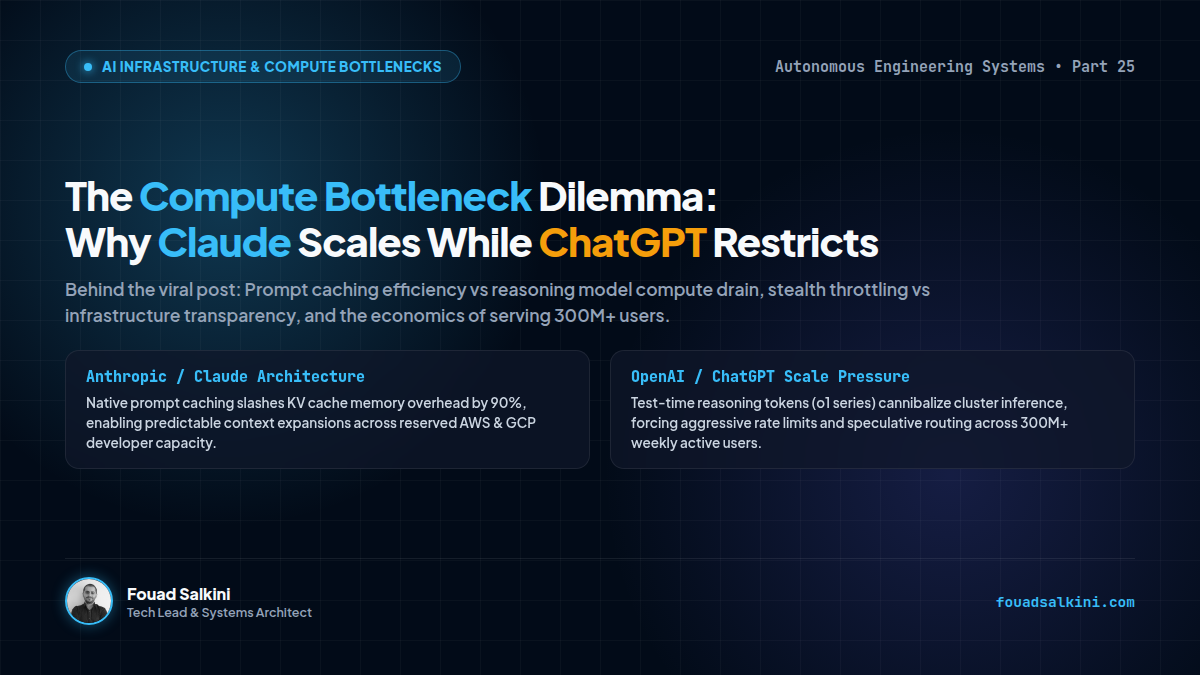
A viral observation recently echoed across technical communities:
“It’s kind of wild watching Claude’s usage limits get better and better while ChatGPT’s feel worse than ever. And honestly, I think OpenAI should just be transparent if compute is the real bottleneck. People can understand infrastructure constraints. What frustrates them is feeling like they’re being kept in the dark while the experience quietly gets worse.”
This sentiment strikes at the heart of modern AI systems engineering. Across developer forums, professional subscribers have noted a paradox: Anthropic has steadily raised rate limits, expanded context windows, and improved concurrency on Claude Pro and Team tiers. Simultaneously, ChatGPT Plus users increasingly report aggressive rate-limit windows, shorter context retention, and apparent speculative downgrades to smaller model checkpoints during peak hours.
As systems architects, this divergence is not a mystery of corporate goodwill or neglect. It is the direct consequence of divergent infrastructure topologies, contrasting memory-tier architectures, and the brutal economics of serving 300+ million active users.
Here is an architectural breakdown of what is actually happening behind the API curtains.
1. The Core Culprit: The Test-Time Compute Cannibalization
The single greatest driver of OpenAI’s internal compute squeeze is the architectural pivot toward Reasoning Models (the OpenAI o1 and o-series).
Traditional Autoregressive Inference (GPT-4o):
Input Prompt ──▶ Fixed Forward Pass ──▶ Direct Token Output (Linear Cost)

Reasoning / Test-Time Compute (OpenAI o1):
Input Prompt ──▶ Hidden Chain-of-Thought (Hundreds/Thousands of Thinking Tokens)
                   ├── Monte Carlo Tree Search / Rollouts
                   ├── Verification & Self-Correction
                   └── Final Pruned Response (10x to 50x Compute Multiplier!)
Unlike traditional autoregressive generation where the token cost scales linearly with user-visible output, reasoning models burn compute at test-time. An innocent 50-word question submitted to an o1 checkpoint can easily generate 3,000 to 8,000 hidden reasoning tokens before emitting a single answer.
Because OpenAI runs its flagship training runs and serving infrastructure on shared supercomputing clusters within Microsoft Azure, this massive test-time compute drain directly competes for H100 and B200 GPU allocations. Every user running an o1 query is effectively consuming the equivalent throughput of 20 standard chat queries.
To prevent systemic cluster meltdowns during peak US and European business hours, OpenAI’s orchestration layer must dynamically squeeze conventional GPT-4o usage limits.
2. Memory Tiering: Why Prompt Caching Saved Anthropic
If OpenAI is battling compute exhaustion, why is Anthropic flourishing with larger context windows and higher message caps?
The answer lies in Prompt Caching and KV Cache Efficiency.
The KV Cache Nightmare
Serving a 200,000-token context window in standard multi-head attention is catastrophic for GPU High-Bandwidth Memory (HBM). Storing the Key and Value matrices across dozens of Transformer layers consumes gigabytes of VRAM per concurrent session, suffocating server concurrency.
Anthropic’s Architectural Counter-Attack
Anthropic made prompt caching a first-class citizen across Claude 3.5 Sonnet and Haiku:
- Up to 90% Cost Reduction on Reused Prefixes: By caching compiled KV cache states across requests, subsequent queries in a conversation or automated coding loop (such as Claude Code) bypass transformer recalculation entirely.
- Deterministic Memory Boundaries: Rather than re-allocating memory dynamically, Anthropic caches persistent segments in fast NVMe/host memory tiers, freeing GPU HBM for new active tokens.
- Capacity Re-investment: Because Anthropic spends vastly fewer GPU FLOPs on repeat context, they can afford to give developers larger rate limits and longer sustained conversations without overwhelming their clusters.
3. Scale Asymmetry: 300M Mass Consumers vs Developer Workloads
The operational realities of the two companies could not be more different:
| Engineering Dimension | OpenAI / ChatGPT | Anthropic / Claude |
|---|---|---|
| User Base Scale | 300+ Million Weekly Active Users | Primarily developer, enterprise, and technical prosumers |
| Traffic Profile | Massive consumer spikes (homework, casual chat, mobile app) | Concentrated API, coding, and structured reasoning pipelines |
| Compute Topology | Azure hyper-scale clusters (High thermal and grid caps) | Multi-cloud: AWS (Trainium / Bedrock) and Google Cloud (TPUs) |
| Serving Strategy | Broad consumer horizontal scaling | Targeted capacity reservation for high-signal developer tiers |
OpenAI operates as the consumer front-door of the entire AI industry. When hundreds of millions of casual users hit the platform concurrently, the infrastructure faces global tail-latency spikes.
Anthropic, by contrast, has deliberately focused its go-to-market on software engineering, enterprise analysis, and agentic workflows. Their multi-cloud reservation strategy across AWS and Google Cloud allows them to guarantee compute envelopes for professional tiers without being swamped by hundreds of millions of free-tier consumer requests.
4. The Engineering Sin: “Stealth Degradation” vs Transparency
The core frustration articulated in the viral post is not that hardware limits exist—engineers understand physical bottlenecks better than anyone. The frustration is the lack of operational transparency.
When an infrastructure platform experiences extreme compute contention, it has two choices:
Option A: The Transparent Route (Explicit Backpressure)
- Inform the user clearly: “Cluster load is at 98%. Message limits are temporarily capped at 15 messages/hour during peak hours.”
- Let developers plan their workflows, save state, and manage queues predictably.
Option B: The Stealth Throttling Route (Silent Shrinkflation)
- Silently compress context windows behind the scenes.
- Speculatively route queries to smaller distilled checkpoints or quantized model replicas.
- Arbitrarily shorten generation token budgets or throw ambiguous “system busy” errors.
When users feel they are being subjected to stealth throttling, trust erodes rapidly. Developers migrate their automated agent loops and production coding workflows to platforms like Claude because predictability and reliability trump raw marketing benchmarks every single time.
5. Architectural Lessons for Systems Designers
What can software architects and systems engineers learn from this compute battle?
    Three Pillars of Resilient AI Infrastructure:

    1. Memory Optimization Over Raw FLOPs
       └── Implement aggressive prompt caching & KV cache offloading before buying more GPUs.

    2. Explicit Backpressure Over Silent Degradation
       └── Expose clear queue depths, rate-limit headers, and status flags. Never lie to clients.

    3. Workload Isolation
       └── Hard-partition developer/agent traffic from generic consumer chat to prevent noisy-neighbor collapse.
The Takeaway:
Compute is a physical resource governed by thermal dissipation, power grids, and silicon yields. Anthropic didn’t bypass the laws of physics; they engineered around them through superior cache architectures and disciplined target workloads.
OpenAI remains an engineering powerhouse, but unless infrastructure bottlenecks are met with radical transparency, developers will continue voting with their API keys.

Written by Fouad Salkini (فؤاد سلقيني)
General Manager & Tech Lead at Tripnologies and Sync Studios. Systems Architect focusing on AI coding agents, DevOps, and quantitative systems.