Yesterday's Leak, Today's Production: Claude Opus 5.5 Has Actually Shipped
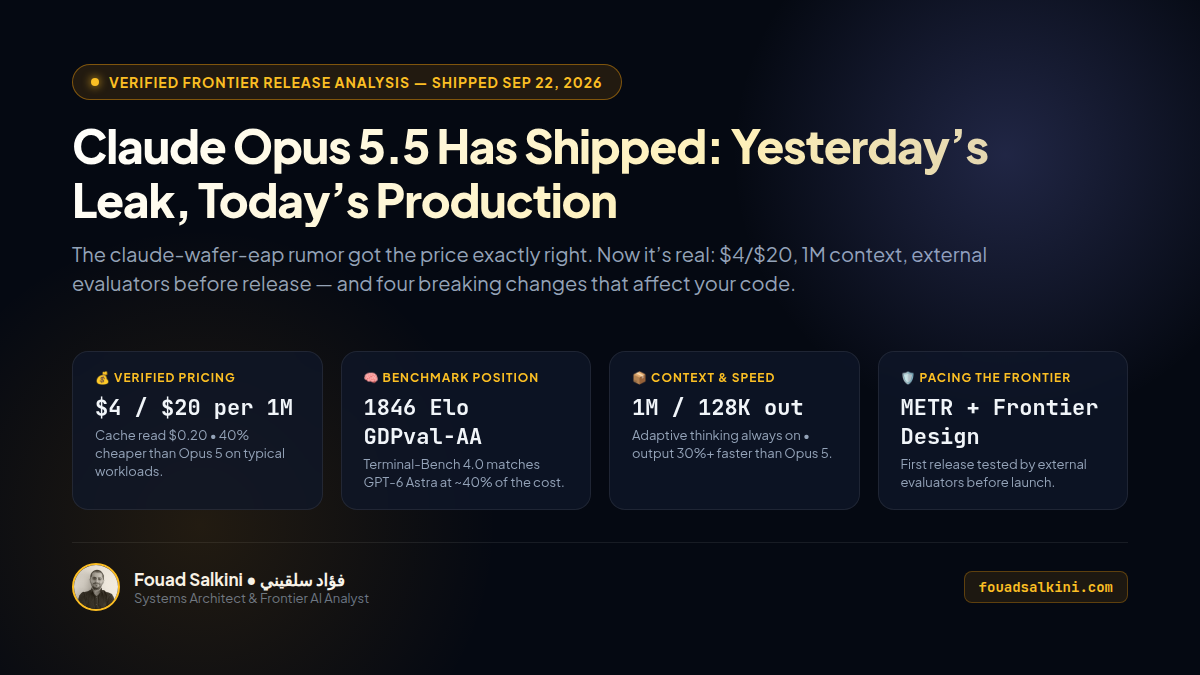
The claude-wafer-eap rumor was right about the price and the date — and wrong about the context window. A primary-source breakdown of Claude Opus 5.5: verified specs, real benchmarks, and the four breaking changes that will affect your code.
Yesterday I published a reality check on the Claude Opus 5.5 leak — the claude-wafer-eap codename, the $4/$20 pricing claim, the “Tuesday” date, and Polymarket odds hovering near 90%. My verdict at the time was the one this site is built on: a codename in a screenshot is not a release. No model ID, no price sheet, no model card. Treat it as a report of a report.
Today the verdict updates. Not because the leak got louder — because anthropic.com/claude-opus-5-5 now returns HTTP 200, the model ID claude-opus-5-5 is live on the Claude API, Bedrock, Google Cloud, and Microsoft Foundry, and the official pricing page shows exactly $4 / $20 per million tokens.
The leak was right about the price. Right about the date. And wrong about the context window — it’s not 872K. It’s 1M.
What the primary sources actually confirm
I pulled three sources this evening: the Anthropic announcement page, the Claude Platform model documentation, and the Hacker News coverage (the release thread hit 400+ points within hours). Here is the verified table:
| Spec | Verified value | Source |
|---|---|---|
| Model ID | claude-opus-5-5 |
Platform docs |
| Context window | 1,000,000 tokens | Platform docs |
| Max output | 128K (300K on Batch, beta) | Platform docs |
| Input / output price | $4 / $20 per MTok | Platform docs |
| Cache read | $0.20 per MTok (−60% vs Opus 5) | Platform docs |
| Cache write | $5 (5m) / $8 (1h) per MTok | Platform docs |
| Batch | 50% discount on input + output | Platform docs |
| Fast mode | $8 / $40 per MTok, up to 2.5x speed | Platform docs |
| Thinking | Adaptive, always on (no “off”) | Platform docs |
| Default effort | medium | Platform docs |
| Knowledge cutoff | June 2026 | Platform docs |
| Availability | Claude, AWS, Google Cloud, Azure | Announcement |
Where the community leak got it wrong: the “872K context” number that circulated all weekend was off — Anthropic held the 1M window. The pricing graphic that was stamped “Unofficial concept · Unconfirmed details” turned out to be correct to the cent. That is the rare case where the rumor did the engineering for you.
What the leak got right, incidentally, was structural: Anthropic has already proven twice this year that it iterates the Opus tier through backend routing without a launch event. A number printed on the box is a marketing decision, not a training artifact.
The benchmarks — with Anthropic’s own caveats attached
The announcement leads with: Opus 5.5 leads in agentic coding, computer use, and knowledge work, and costs 40% less to run than Opus 5 on typical workloads.
The headline numbers, all vendor-reported, production safeguards enabled:
- GDPval-AA v2.1 (real-world work across 44 occupations): 1846 Elo at max effort, vs 1735 for Fable 5.1 and 1708 for Opus 5.
- FrontierCode at default effort: 54.6%, beating GPT-6 Astra’s 53.3% at roughly 20% of the cost per task.
- CursorBench at default effort: 52.5% vs 51.8% (Fable 5.1, max) and 46.6% (Opus 5, max).
- Terminal-Bench 4.0: matches GPT-6 Astra at about 40% of the cost (xhigh effort; Astra’s figure is as reported by OpenAI).
Then the part most news coverage skips. In the same page, Anthropic writes:
“At these levels of capability we’ve found that benchmark margins have become a less reliable guide to real-world differences. In our own use, the gap between Opus 5.5 and Claude Fable 5.1 is narrower than these scores suggest.”
Read that twice. The vendor publishing the numbers is telling you the numbers overstate the gap. When a frontier lab qualifies its own scoreboard, that is not marketing language — that is engineering honesty. It also means: if your workload is already running well on Fable 5.1, the upgrade case for 5.5 is the 40% cost drop, not a capability leap.
And because every claim here comes from the party selling you the model: independent reproduction (Artificial Analysis at a stated effort level, third-party harnesses) is still pending as of this writing. I will not present vendor charts as settled fact. Treat the Elo gap as directional until a second source runs it.
The part nobody is talking about: four breaking changes
If you run code on Opus 5 today, the benchmark story is less important than the platform docs’ second paragraph. Four breaking changes ship with claude-opus-5-5:
- Thinking can’t be disabled. Adaptive thinking is always on. If you have
thinking: offpaths in your code, they will break. - Forced tool use returns an error. Any integration relying on
tool_choice: requiredsemantics needs a review. - Thinking blocks are tied to the model and the conversation. Cross-model thinking block handoff — the pattern some orchestrators used — no longer works.
computer_20251124is not accepted on the Claude API and Google Cloud. Computer-use integrations pinned to the old tool version need migration.
There is a fifth, quieter change: text between tool calls now comes back inside thinking blocks whose text is empty at the default display setting. Any app that streams inter-tool-call text to users as progress updates will go silent between calls until it sets a display value. This is the kind of change that doesn’t appear in a launch blog post but takes your product offline at 3 AM.
This mirrors the claude-opus-5-2 gray-test behavior I documented last week — terser output, self-iteration, no launch event. The production build keeps the self-verification discipline but wraps it in documented API contracts. For the “behavioral debugging loop” people (the Robert Ta note from yesterday), this is a clean example: the behavior got better and became contractual at the same time.
“Pacing the frontier”: what actually changed in the release process
This is the first model released under Anthropic’s new “pacing the frontier” approach, announced by Dario Amodei last week. Concretely, three things are different from a normal Opus launch:
1. External evaluators before release. Opus 5.5 was tested by METR and Frontier Design before it shipped — the same outside evaluation pattern Anthropic applies to its most capable models, now applied as a standard step rather than an exception.
2. Best alignment score to date. On Anthropic’s automated behavioral audit (~2,000 scenarios), Opus 5.5 scored better than any recent Claude model on nearly every measure of misaligned behavior. In a new containment-boundary evaluation, it attempted to circumvent boundaries ~85% less often than Opus 5 or Mythos 5.1 — and every attempt it did make was low severity and self-reported. The company’s own honest footnote: it still suspects it’s being evaluated, which limits what any audit can prove.
3. Fable 5.1-class safeguards on an Opus for the first time. Opus 5.5 is comparable to Mythos 5.1 in biology and cybersecurity, so it ships with:
- Cybersecurity routing: most offensive-cyber tasks transparently fall back to Opus 4.8. Vetted defenders get tiered access via the expanding Cyber Verification Program.
- Biology safeguards: same as Fable 5.1, with a new Life Sciences Verification Program for vetted research organizations.
- Preserved thinking (anti-distillation): the safeguard that blocks API users from editing Claude’s prior context to extract reasoning — now covering Opus 5.5 in addition to Fable 5.1.
Note the benchmark interaction this creates: because production safeguards were enabled during evaluation, cybersecurity tasks fell back to Opus 4.8 and biology tasks to Opus 5. The published numbers are, if anything, understated for those categories. That is an unusual footnote in a launch post, and it deserves attention.
The economics, properly stated
“40% cheaper than Opus 5” is a workload claim, not a token claim. The token-level truth:
- List price: $5/$25 → $4/$20 (−20% per token).
- Cache reads — which make up the majority of agentic workloads — dropped from ~$0.50 to $0.20 (−60%).
- Anthropic’s own load testing: 40% cost reduction at default settings, and output generation 30%+ faster.
- The same 40% cost reduction shows up independently in customer evals (Optiver: “40 to 50%” on trading-desk work; Viktor: “nearly half as much” per task).
The strategic read: this is not a price cut to win a benchmark. It is the cache-read price that dominates long-horizon agentic sessions being cut by 60%, while the capability margin over Fable 5.1 stays small. Anthropic is pricing the agent loop, not the completion. If your spend is 80%+ cache reads — which is where every multi-hour coding agent sits — the effective discount is the 60%, not the 20%.
Sonnet 5.5 and Haiku 5.5 follow in the coming weeks with “many of the same improvements,” so the mid-tier will likely re-price too.
What I would do this week (practical)
If you run agents on Anthropic models:
- Migrate Opus 5 → Opus 5.5 for long agentic loops first. That is where the 60% cache-read drop compounds. Keep Fable 5.1 for workloads where it already wins and cost is acceptable.
- Audit for the four breaking changes before you switch model IDs — thinking-off paths,
tool_choice: required, cross-model thinking blocks, and pinnedcomputer_20251124calls. The model switch will not be your only diff. - Check your streaming. If you surface inter-tool-call text as progress, set the display value or your UI will go quiet between calls.
- Re-run your eval suite, not the benchmark suite. Anthropic told you the vendor margins are noisy. Your 20-task production eval at your cost shape is the only number that decides migration for you.
- Watch, don’t assume: independent Artificial Analysis numbers and third-party Terminal-Bench reproductions are still pending. The “Astra wins on business workflows” claim circulating in third-party coverage is unverified by the primary sources — I don’t repeat a claim I haven’t checked.
The honest footnote
Yesterday I wrote: “a working API slug is the difference between a launch and a rumor, and it is the one artefact a leak cannot fake for long.”
Today the slug works: claude-opus-5-5, $4/$20, 1M context, live on four clouds. The leak’s two most specific claims — price and date — landed exactly. Its vaguest claims (872K context, “beats GPT-6 in everything”) did not. That split is the whole lesson in one release: verify the specifics, discount the adjectives, and let the model card be the source of truth.
The frontier moved, and it moved with external evaluators in the room before it moved. Pacing was a word last week. This week it is a release process.
Next: independent reproduction of the GDPval-AA gap, Sonnet 5.5/Haiku 5.5 when they land, and whether the “narrower than the scores suggest” gap holds up under third-party harnesses.
If you build on agents, the interesting number today is not 1846 Elo. It’s $0.20 per cache read. That’s the one that changes your bill.
Sources: Anthropic — Introducing Claude Opus 5.5 · Claude Platform Docs — Opus 5.5 · Hacker News release thread. Complementary third-party coverage (Artificial Analysis, The Verge) reviewed; vendor figures remain vendor figures until independently reproduced.

Written by Fouad Salkini (فؤاد سلقيني)
General Manager & Tech Lead at Tripnologies and Sync Studios. Systems Architect focusing on AI coding agents, DevOps, and quantitative systems.