Claude Opus 5.5 Leak vs. Opus 5.2 Reality: What's Actually Happening Inside Anthropic?
Separating Silicon Valley hype from production reality: breaking down the 'claude-wafer-eap' rumor, Polymarket prediction bets, and the real gray-test routing behind Opus 5.2.
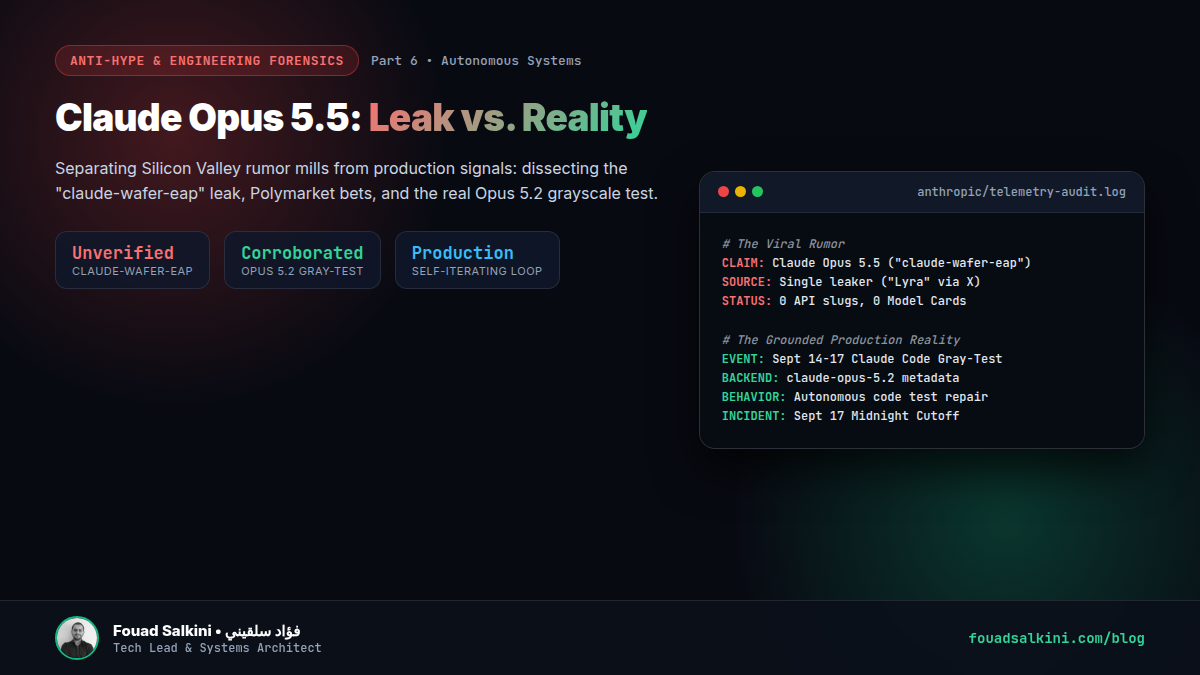
Over the weekend, developer timelines exploded with claims that Anthropic is preparing to stealth-drop Claude Opus 5.5 under the internal codename claude-wafer-eap, with rumors pointing to a launch as early as Tuesday.
In tech media, a single unverified tweet quickly snowballs into full-blown product release speculation.
As systems engineers building production agent harnesses, we do not make architecture decisions based on Twitter rumors or Polymarket odds. We audit network requests, model metadata, and reproducible telemetry.
Here is the objective engineering forensic breakdown: what is demonstrably fake, what is mathematically speculative, and what actually occurred in production.
1. Deconstructing the Leak: Why the Claims Fall Apart
The circulating leak rests on four specific assertions:
- A new checkpoint exists staged for imminent release.
- The version number is 5.5 (jumping over 5.3 and 5.4).
- The codename is
claude-wafer-eap. - Release is slated for Tuesday.
When subjected to basic engineering scrutiny, the chain of custody collapses:
| Claim Element | Verification Status | Source & Evidence |
|---|---|---|
Codename claude-wafer-eap |
Single-Source Unverified | Originates entirely from a single post on X by an anonymous leaker handle (“Lyra”). Zero traces in public GitHub repos, client SDKs, or reverse-engineered API bundles. |
Version Jump to 5.5 |
Marketing Speculation | Anthropic released Claude Opus 5 on July 24, 2026, followed by Claude Fable 5.1 on September 1. “Opus 5.5” gained viral traction because it appeared on Polymarket’s list of qualifying resolution names—not from a leaked model card. |
| Tuesday Launch Window | Prediction Market Cluster | Polymarket betting pools clustered volume between September 21 and September 24. Market probability does not equal an Anthropic press release. |
In short: claude-wafer-eap is an unverified ghost string.
2. The Real Event: What Actually Happened in Production
While the “Opus 5.5” rumor is thin air, it caught fire because it piggybacked on a very real, verified technical anomaly that occurred between September 14 and September 17.
The Grayscale Routing Anomaly (September 14–15)
Developers using Claude Code in high-effort mode noticed that a small, probabilistic slice of requests routed through claude-opus-5 returned radically different telemetry:
- Metadata Leak: Request metadata headers occasionally referenced an internal
claude-opus-5.2identifier. - Behavioral Mutation: Unlike standard Opus 5, this backend exhibited autonomous test-driven self-iteration: writing code, executing terminal tests, analyzing stack traces, and fixing failures in a continuous loop without stopping mid-task.
- The “Tibo Knowledge” Probe: When asked specific real-time questions (with web search and memory explicitly disabled), the test backend possessed knowledge past Opus 5’s documented May 2026 training cutoff.
The “Midnight Shock” (September 17)
Late on the night of September 17, Anthropic abruptly terminated the test routing channel without notice. Requests reverted back to the standard Opus 5 checkpoint. Approximately 24 hours later, the channel was selectively restored.
What Actually Happened in Mid-September:
[Developer Prompt] ──> [Claude Code] ──(Probabilistic 5% Route)──> [Unreleased claude-opus-5.2 Backend]
                                                                        │
                                                                        ▼
                                                         [Self-Iterating Agent Loop]
                                                         (Terminated Sept 17 by Vendor)
3. The 5 Signals to Watch Before Believing Any Launch
If Anthropic does ship an update this week, do not get blinded by vendor charts. Audit these five verifiable criteria:
- The API Slug (
model: "claude-opus-..."): Marketing names mean nothing. A functional API model identifier that accepts completions and returns responses is the only proof of a live model. - Pricing Structure ($/1M Tokens): Opus 5 currently runs at $5.00 input / $25.00 output. If an update arrives at $4.00 / $20.00 (as some rumors claim), it represents an aggressive commoditization move against OpenAI.
- Context & Output Caps: Opus 5 established a floor of 1M context tokens and 128K max output (300K on Batch API). Anything less is a regression.
- Third-Party Evaluation (Artificial Analysis): Ignore first-party marketing benchmarks. Look for independent evaluations conducted at standardized reasoning effort levels.
- Preservation of Self-Iterating Agent Loops: Did the autonomous test-repair loops observed during the September 14 grayscale test survive into the final release, or was it sanitized for safety?
The Verdict
The AI industry is addicted to breathless rumor cycles.
Whether Anthropic calls its next iteration Opus 5.2 (the engineering truth) or slaps a 5.5 badge on the box for marketing leverage against GPT-6, the takeaway for systems architects remains the same:
Never optimize your production architecture for unreleased rumors. Build resilient, vendor-neutral harnesses that can hot-swap backends the minute real API keys and benchmarks arrive.

Written by Fouad Salkini (فؤاد سلقيني)
General Manager & Tech Lead at Tripnologies and Sync Studios. Systems Architect focusing on AI coding agents, DevOps, and quantitative systems.