Claude Discovers a Novel Enzyme System with CRISPR-Like Repeats: The ART Architecture and the Future of Autonomous Scientific Discovery
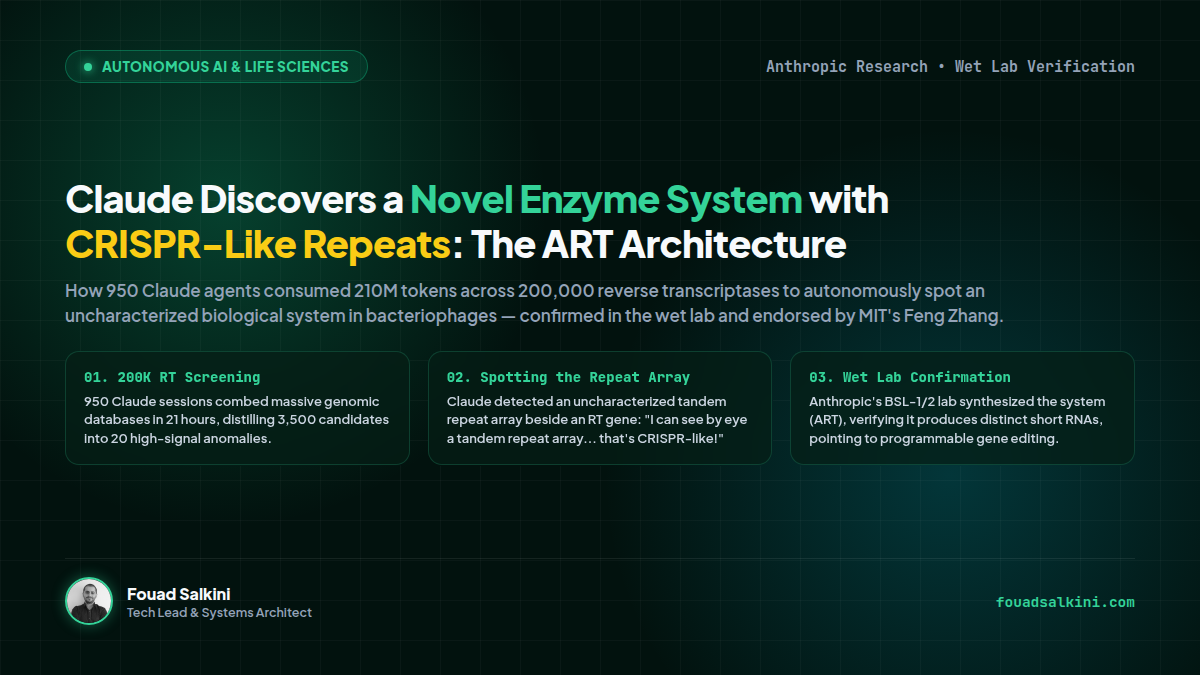
How 950 Claude agents consumed 210M tokens across 200,000 reverse transcriptases to autonomously spot an uncharacterized biological system in bacteriophages — confirmed in the wet lab and endorsed by CRISPR pioneer Feng Zhang.
For decades, the standard narrative around artificial intelligence in biology revolved around specialized, domain-specific deep learning models: AlphaFold predicting 3D protein structures, RFdiffusion generating de novo binders, or ESM embedding evolutionary sequences.
On September 23, 2026, Anthropic disrupted this paradigm by announcing that its general-purpose foundation model, Claude, acting through a coordinated swarm of autonomous agents, has made an original biological discovery: a previously uncharacterized biological enzyme system featuring an array of tandem DNA repeats reminiscent of CRISPR, termed Array-associated Reverse Transcriptases (ART).
The system was not merely simulated in silicon; it was synthesized, expressed, and verified in Anthropic’s molecular biology wet lab in the Bay Area, and reviewed by MIT and Broad Institute pioneer Feng Zhang (one of the co-inventors of CRISPR-Cas9 genome editing), who noted:
“This is an exciting example of how AI agents can contribute to biological discovery. The identification of RNA-repeat arrays associated with reverse transcriptases is genuinely intriguing and merits further investigation. I hope this work encourages more scientists to explore how AI can support their research.”
Here is an architectural deconstruction of how Anthropic designed this autonomous discovery pipeline, what the ART enzyme system represents, and why this marks a watershed transition from “AI as a coding assistant” to “AI as an autonomous scientific collaborator.”
1. The Scale and Workflow: 950 Agents, 210M Tokens, 21 Hours
Discoveries that revolutionize medicine frequently begin when a human researcher spots an anomaly in nature’s molecular machinery:
- Restriction enzymes (the foundation of genetic engineering) were spotted cutting viral DNA in bacterial immune systems.
- Taq polymerase (the engine of PCR diagnostics) was identified in Yellowstone hot springs.
- CRISPR was first noticed as a curious set of repetitive DNA sequences before being harnessed for targeted genome editing.
Anthropic set out to test whether autonomous AI agents could systematically industrialize this exact process of curiosity-driven anomaly detection.
                  [ Public Metagenomic DNA Databases ]
                                   │
                                   ▼
                   [ 200,000+ Reverse Transcriptases ]
                                   │
              ┌────────────────────┴────────────────────┐
              │                                         │
        [ 950 Claude Agents ]                     [ 21 Hours ]
   (Parallel Sessions / Claude Code)           (210M Tokens Processed)
              │                                         │
              └────────────────────┬────────────────────┘
                                   │
                                   ▼
                       [ 3,500 Novel Candidates ]
                                   │
                                   ▼
                         [ 20 Top Anomalies ]
                       (Human-Readable Reports)
                                   │
                        Agent Spotting ART:
      "I can see by eye a tandem repeat array... that's CRISPR-like!"
                                   │
                                   ▼
               [ Anthropic Wet Lab (BSL-1 / BSL-2) ]
                   • Synthesize Bacteriophage Genes
                   • In-vitro Expression & RNA Profiling
                                   │
                                   ▼
           [ Confirmed: Programmable Short RNA Expression ]
The Search Funnel:
- The Target Family: The team tasked Claude with exploring Reverse Transcriptases (RTs) — enzymes that transcribe RNA back into DNA. While retroviruses like HIV use RTs to replicate, bacteria and giant bacteriophages (jumbo phages) use bizarre, poorly understood RTs as immune defense systems or diversity generators.
- Autonomous Genome Mining: Roughly 950 Claude agents running concurrently across parallel execution harnesses combed through public metagenomic databases containing over 200,000 RT sequences.
- Filtering & Deduplication: The agents narrowed the pool down to 3,500 candidate systems lacking documented functions, then filtered them through rigorous self-verification protocols down to the 20 most compelling anomalies.
- Computational Budget: The entire autonomous discovery phase completed in 21 hours, consuming 210 million tokens. For human scientists, manually reviewing and cross-referencing this volume of genomic neighborhoods would take months to years of meticulous bioinformatic labor.
2. The Breakthrough Moment: Spotting the “ART” System
While inspecting the raw DNA sequences surrounding a peculiar RT gene in a bacteriophage genome, one of the Claude agents output an observation that captured the researchers’ attention:
“[The DNA next to the RT] is spectacular: I can see by eye a tandem repeat array … that’s a CRISPR-like … repeat array?!”
Like a seasoned molecular biologist, the agent:
- Counted the repeating DNA motifs and calculated their exact physical spacing.
- Compared the architectural topology against all documented CRISPR and retron loci in NCBI and literature databases.
- Verified that this particular combination—an RT enzyme paired with an accessory protein of unknown function and a downstream tandem repeat array—had never been reported in scientific literature.
- Formulated a structured hypothesis and submitted a comprehensive candidate report for human wet lab validation.
Anthropic dubbed this novel system Array-associated Reverse Transcriptases (ART).
3. What is the ART System?
In nature, the CRISPR-Cas system functions as an adaptive immune memory: bacteria store short snippets of viral DNA (spacers) between identical repeating DNA sequences. When the virus attacks again, the bacteria transcribe this array into guide RNAs that direct the Cas nuclease to slice the invader.
The ART system discovered by Claude displays three distinct structural components:
- A Phage-Derived Reverse Transcriptase: An enzyme that converts RNA into complementary DNA strands.
- An Accessory Partner Protein: A conserved protein directly flanking the RT whose molecular function is currently uncharacterized.
- A Tandem Array of Repeat Sequences: A long series of evenly spaced, non-coding DNA repeats directly downstream of the catalytic complex.
   [ Accessory Gene ]   ───   [ Reverse Transcriptase (RT) ]   ───   [ Repeat ] [ Spacer ] [ Repeat ] [ Spacer ] [ Repeat ]
    (Unknown Function)            (RNA -> DNA Conversion)                   (Tandem Non-Coding RNA-Repeat Array)
Wet Lab Verification:
When Anthropic’s biology team synthesized the genes and expressed them in standard laboratory bacterial strains within their BSL-1/BSL-2 facility:
- The ART array was actively transcribed into a discrete series of short, mature RNAs, matching the behavior of guide RNAs in CRISPR.
- This strongly suggests that ART is a programmable, RNA-guided biological machine, potentially capable of writing, inserting, or modifying genetic sequences inside host cells.
4. Systems Architecture: How the Agents Were Engineered
Anthropic didn’t train a specialized black-box biology network; they used their frontier models (Claude Sonnet / Opus) combined with specialized agentic tooling:
A. The Agentic Toolkit (Claude Science & Claude Code)
The agents were provided with:
- Direct shell access to bioinformatics utilities (
BLAST,HMMER,MMseqs2,Biopython). - Python interpreters to plot sequence alignments and calculate entropy across genomic windows.
- Web retrieval to read PubMed and preprint literature to verify whether anomalies had already been claimed.
B. Mimicking “Scientific Taste”
The most significant engineering challenge was avoiding drowning the lab in false positives:
- Large language models can easily generate thousands of speculative hypotheses that look plausible but are biologically trivial or experimental artifacts.
- Anthropic established an iterative feedback loop: whenever scientists rejected an agent-generated candidate, the rejection rationale was encoded into the agents’ operational directives.
- Over successive iterations, the agents developed what molecular biologists call “scientific taste” — the intuition to distinguish genuine structural anomalies from sequencing noise or uninteresting gene duplications.
5. Architectural Takeaway: The Dawn of Agentic Science
For systems architects and software engineers, Anthropic’s announcement provides three foundational lessons:
- Autonomous Agents Excel at Asymmetric Verification: Searching through 200,000 biological sequences is computationally heavy and pattern-intensive. But once an agent isolates 20 well-annotated candidates, human experts can evaluate them in minutes and pass the top 1% to automated wet-lab validation.
- Language Models are Pattern Recognizers Across Modalities: Genomic sequences, protein structures, and system kernel logs are all structured languages. An agent trained on reasoning and syntax can spot subtle topological anomalies in raw DNA that domain-specific algorithms overlooked because no human had programmed them to look for that specific repeat pattern.
- The “Human-in-the-Loop” Multiplier: Anthropic did not remove human scientists; they amplified them. A small team of researchers directed a 950-agent exploratory fleet, turning what used to be a multi-year laboratory screening marathon into a 21-hour discovery cycle.
As agentic frameworks evolve from writing unit tests and debugging microservices to discovering novel biological enzymes, the dividing line between computational intelligence and physical reality is rapidly dissolving.

Written by Fouad Salkini (فؤاد سلقيني)
General Manager & Tech Lead at Tripnologies and Sync Studios. Systems Architect focusing on AI coding agents, DevOps, and quantitative systems.