Claude Code Templates: The Modular Ecosystem for Agentic Tooling and Remote Monitoring
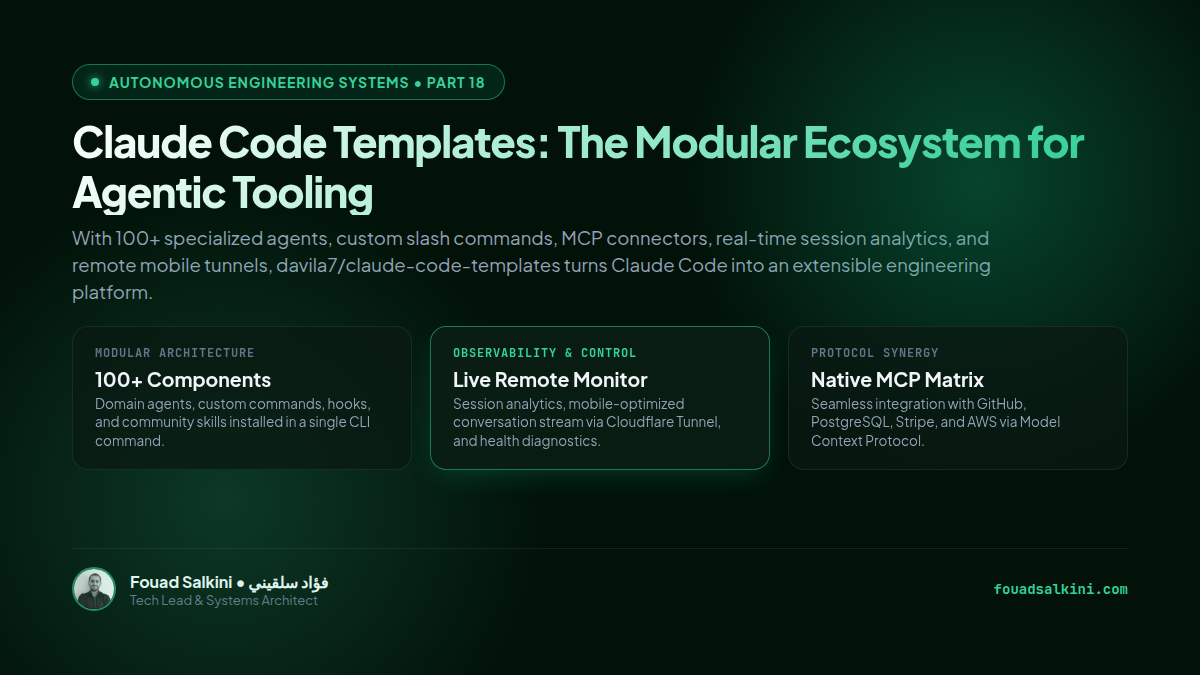
With 100+ specialized agents, custom slash commands, MCP connectors, real-time session analytics, and remote mobile tunnels, davila7/claude-code-templates (aitmpl.com) turns Claude Code into an extensible engineering platform. An architectural breakdown.
When Anthropic released Claude Code, it marked a watershed moment for terminal-based autonomous programming: an agent that lives inside your git repository, executes terminal commands, inspects diffs, and iterates autonomously.
Yet, as software engineering teams integrated Claude Code into production codebases, two operational bottlenecks quickly emerged:
- Configuration Fragmentation: Configuring specialized domain roles, prompt rules, memory parameters, and Model Context Protocol (MCP) integrations manually across multiple developers is tedious and error-prone.
- Terminal Invisibility & Monitoring Friction: When long-running coding agents execute multi-file refactoring runs in the background, developers are either trapped watching scrolling terminal text or blind to what the agent is deciding.
To address this, developer Daniel Avila created Claude Code Templates (davila7/claude-code-templates, accessible at aitmpl.com).
Far more than a simple collection of markdown prompts, the project has evolved into a full-fledged modular distribution engine, CLI manager, and real-time observability suite for Claude Code.
Here is an architectural analysis of how this ecosystem operates, what makes its component model powerful, and how it elevates the developer workflow.
1. The Modular Architecture: 6 Composable Building Blocks
Instead of presenting developers with monolithic "mega-prompts," claude-code-templates decouples the agent environment into six composable primitives:
┌────────────────────────────────────────────────────────┐
│           Claude Code Templates CLI Engine             │
│            (npx claude-code-templates@latest)          │
└───────────────────────────┬────────────────────────────┘
                            │
      ┌───────────┬─────────┴─┬───────────┬───────────┐
      ▼           ▼           ▼           ▼           ▼
┌───────────┐┌───────────┐┌───────────┐┌───────────┐┌───────────┐
│  Agents   ││ Commands  ││   MCPs    ││   Hooks   ││ Analytics │
│Domain Bots││Custom /cmd││Context Bus││ Lifecycle ││ & Tunnels │
└───────────┘└───────────┘└───────────┘└───────────┘└───────────┘- Specialized Agents: Domain-scoped subagents that assume strict role profiles (e.g.
frontend-developer,database-architect,security-auditor). Each agent is configured with distinct tool permissions and behavioral constraints. - Custom Slash Commands: Instant workflow shortcuts that can be invoked within the Claude Code REPL (e.g.
/generate-tests,/optimize-bundle,/check-security). - Model Context Protocol (MCP) Connectors: Pre-wired configurations connecting Claude Code to external data infrastructure: GitHub API, PostgreSQL databases, Stripe, AWS, and local filesystems.
- Lifecycle Hooks: Automation triggers that execute deterministic scripts at critical phase boundaries—such as pre-commit lint validation, secret scanning, or test-suite verification before completing a turn.
- Progressive Disclosure Skills: Domain-specific procedures (PDF processing, Excel data extraction, scientific research skills from K-Dense AI) that load into the context window only when referenced.
- Unified Settings Matrix: Standardized environment profiles governing timeout budgets, memory thresholds, and token output formatting.
2. One-Command Deterministic Bootstrapping
Setting up a complete agentic engineering stack typically requires manual editing of JSON configuration files. The claude-code-templates CLI packages entire multi-component stacks into a single deterministic command:
# Bootstrap a full full-stack web development agent stack
npx claude-code-templates@latest \
  --agent development-team/frontend-developer \
  --command testing/generate-tests \
  --hook git/pre-commit-validation \
  --mcp development/github-integration \
  --yes
This command validates existing local configurations, creates automated rollback snapshots under ~/.claude/, merges the requested components non-destructively, and confirms dependencies before yielding control back to the terminal.
3. Real-Time Observability: Mobile Tunnels & Session Analytics
The most impressive technical innovation in claude-code-templates is its observability layer:
A. Live Conversation Monitor (--chats)
Rather than remaining chained to a terminal emulator, developers can launch a lightweight web server that streams Claude Code’s thought processes, tool invocations, and git diffs in real time:
# Secure remote access via Cloudflare Tunnel
npx claude-code-templates@latest --chats --tunnel
By leveraging an ephemeral Cloudflare Tunnel, the CLI outputs a secure, authenticated URL that allows developers to monitor agent execution, review generated code, and observe progress from their mobile device or a secondary monitor.
B. Session Analytics (--analytics)
A built-in telemetry engine tracks:
- Token consumption rate across turns.
- Tool invocation latency and error frequencies.
- Context window headroom utilization.
- Health diagnostics checking for deprecated config keys, broken MCP sockets, and stale cache files (
--health-check).
4. Why Modular Repositories Win
The rapid rise of davila7/claude-code-templates (attracting sponsorships from Bright Data, Vercel OSS, and Neon) highlights an important reality in the AI engineering landscape:
The competitive advantage is no longer in the raw model weights; it is in the developer ergonomics, modular distribution, and runtime observability of the agentic workflow.
By curating verified community skills (integrating libraries from K-Dense, Jesse Obra’s Superpowers, and Anthropic’s official skills) into a unified CLI, the project solves the fragmentation problem that plagues modern developer tooling.
5. Architectural Takeaway
For software architects building internal agent fleets:
- Deconstruct prompts into components: Stop managing massive system prompt strings. Package capabilities into agents, slash commands, and MCP connectors.
- Prioritize runtime observability: Background agents require live state detection and remote telemetry. If you cannot observe the agent’s tool loop in real time, you cannot trust its output.
- Standardize team configurations: Use deterministic CLI installers to ensure that every developer on your team executes with identical tool permissions, verification hooks, and safety gates.
Sources & References: davila7/claude-code-templates on GitHub, aitmpl.com Catalog, Model Context Protocol Specification, and Production Agent Orchestration Benchmarks.

Written by Fouad Salkini (فؤاد سلقيني)
General Manager & Tech Lead at Tripnologies and Sync Studios. Systems Architect focusing on AI coding agents, DevOps, and quantitative systems.