Building Autonomous Coding Agents in Production: Beyond the Hype
Architectural insights on designing reliable multi-agent workflows, token reduction strategies, and deterministic execution environments.
Most conversations around AI coding agents oscillate between two unproductive extremes: breathless marketing hype claiming software engineers will disappear tomorrow, or dismissive skepticism dismissing agents as unreliable autocomplete gimmicks.
The reality on the production floor is far more nuanced and substantially more interesting.
The Architectural Core: Determinism over Prompt Magic
When building autonomous agents that actually ship production pull requests, prompt engineering accounts for perhaps 10% of overall system reliability. The remaining 90% is traditional, rigorous systems engineering:
- Deterministic State Snapshots: Agents must never guess repository state. Before any turn, our harness compiles a frozen schema snapshot and read-only database state.
- Atomic Verification Gates: Every code modification (
diff) must execute against automated static analysis, linter checks, and containerized test suites before landing. - Bounded Context Windows: Flooding an agent’s context with 50,000 lines of irrelevant codebase files degrades reasoning exponentially. We enforce strict head+tail truncation with on-demand disk paging.
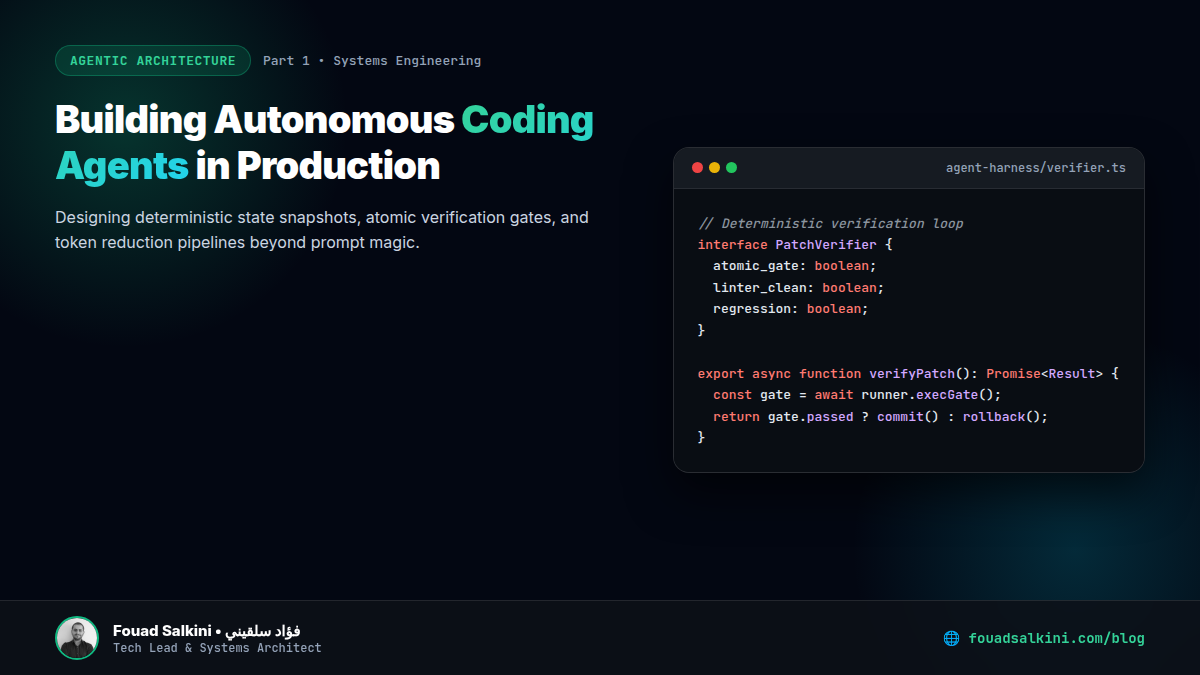
// Architectural verification pipeline
interface VerificationResult {
  passed: boolean;
  lintClean: boolean;
  testExitCode: number;
  regressionDetected: boolean;
}

export async function verifyAgentPatch(patchPath: string): Promise<VerificationResult> {
  const diff = await loadPatch(patchPath);
  const syntaxCheck = await runSyntaxValidation(diff);
  if (!syntaxCheck.valid) return { passed: false, lintClean: false, testExitCode: 1, regressionDetected: false };

  return await executeIsolatedTestHarness();
}
Token Compression: Saving 60% of LLM Overheads
Through our work on OmniRoute—our unified proxy gateway supporting over 1,200 models—we developed the RTK + Caveman token compression protocol. By removing redundant conversational conversational artifacts, whitespace, and repetitive system prompts, we regularly see 15% to 85% reduction in token burn while preserving semantic fidelity.
The future of engineering is not about typing less code; it is about orchestrating distributed cognitive engines with the same discipline we apply to distributed microservices.

Written by Fouad Salkini (فؤاد سلقيني)
General Manager & Tech Lead at Tripnologies and Sync Studios. Systems Architect focusing on AI coding agents, DevOps, and quantitative systems.