Beyond the Chat Window: Nat Friedman, Ambient AI, and the Data Sovereignty Dilemma
Nat Friedman's vision of AI moving beyond chat into real-world sensors (cameras, health telemetry, car GPS, and home devices) signals the rise of Ambient Intelligence. An engineering reality check on why contextual agents require local edge architectures rather than closed cloud surveillance.
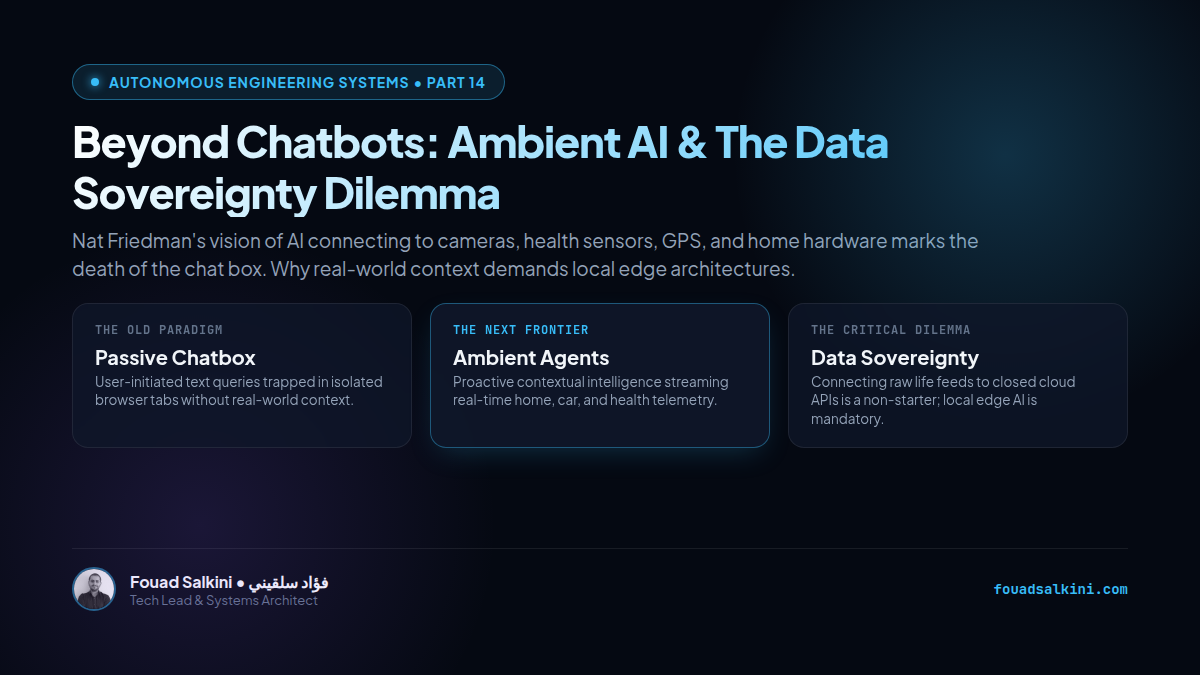
When future historians of computing look back at the 2023–2025 era of artificial intelligence, the "chat window" will appear as quaint and archaic as the command-line prompt did to early Macintosh users.
Typing a 50-word text prompt into an isolated browser tab, waiting for a streaming completion, copying the code into an IDE, and manually feeding the compiler errors back into the chatbox is an unnatural, high-friction bottleneck. It is the definition of passive artificial intelligence.
In a recent interview at Stripe Sessions that circulated widely across developer communities, Nat Friedman (former CEO of GitHub and prominent AI investor) articulated what comes next: the shift from passive chatbots to Ambient Contextual Agents. Friedman detailed how his personal agent stack connects directly to physical reality: home security cameras, biometric health telemetry, car navigation and GPS tracking, calendars, and ambient audio feeds.
Instead of waiting for an explicit command, the agent maintains continuous situational awareness: it knows where you are, what you are building, who you are meeting, and what physical environment surrounds you.
This is a massive leap in human leverage. But as a systems architect, it also raises the single most consequential dilemma in modern computing: The Data Sovereignty Paradox.
1. Deconstructing the Transition: Chatbot vs. Ambient Agent
To understand why this shift is inevitable, we must contrast the operational mechanics of both paradigms:
| Dimension | Legacy Chatbot Interface | Ambient & Contextual Agent |
|---|---|---|
| Trigger Mechanism | Reactive (User manually types a query) | Proactive (Triggered by real-world events and sensor state changes) |
| Context Horizon | Ephemeral, trapped within a single chat session | Persistent, multi-modal, and grounded in real-time environment data |
| Input Modality | Text and manually uploaded file attachments | Video feeds, GPS, biometric wearables, git logs, and audio streams |
| Action Space | Text responses and suggested code snippets | Direct actuation: home automation, fleet dispatch, calendar orchestration |
| Friction Level | High cognitive overhead (prompt drafting and context feeding) | Zero-friction background execution (intelligence as an ambient utility) |
When an agent has access to your calendar, your commit history, and your car’s destination, you no longer need to explain your context. If you are delayed in traffic, the agent does not ask whether it should reschedule a deployment window; it assesses the blast radius, messages the engineering channel, adjusts the calendar, and reschedules the CI/CD pipeline autonomously.
2. The Architectural Trap: Cloud Surveillance vs. Edge Sovereignty
While the convenience of ambient intelligence is undeniable, connecting raw life streams to closed, proprietary cloud APIs creates a critical vulnerability:
- The Closed-Cloud Dystopia: If every room camera, sleep monitor, microphone, and car telemetry stream is piped continuously to a third-party datacenter via closed APIs, users have effectively built their own panopticon. Beyond corporate data harvesting, closed APIs introduce unpredictable latency, vendor lock-in, and catastrophic blast radii if an API token or provider is compromised.
- The Local Edge Imperative: The only architecturally sound way to build ambient intelligence is Local Edge Processing.
In production, ambient systems must be decoupled into a two-tier hybrid architecture:
[ Physical Real-World Sensors ]
 (Cameras, Biometrics, GPS, Smart Home)
                  │
                  ▼
┌──────────────────────────────────────────────┐
│            Local Edge Gateway                │
│  • Local Open-Weight Models (Llama, Qwen)    │
│  • Edge Vector Stores & Semantic Cache       │
│  • Strict Privacy Firewall (Zero Cloud Leak) │
│  • Deterministic Event Filters & Triggers    │
└──────────────────────────────────────────────┘
                  │
       (Redacted / Sanitized Task)
                  ▼
┌──────────────────────────────────────────────┐
│           Frontier Reasoning Tier            │
│  • Ephemeral High-Compute Synthesis          │
│  • Zero Raw Sensory Ingestion                │
└──────────────────────────────────────────────┘
Under this model:
- Raw data never leaves the premises: Video feeds, audio snippets, and real-time coordinates are processed locally on edge hardware (Apple Silicon, local NVIDIA workstations, or on-prem servers).
- Context is abstracted before egress: The local model extracts an anonymized, high-level intent (e.g.
\"User has arrived at the facility; deploy staging build\") rather than streaming video frames to a remote cloud provider. - Control remains sovereign: If the internet connection drops, the local ambient agent continues operating without interruption.
3. What Engineers Should Build Today
For developers and founders looking beyond the saturated "wrapper" market, the opportunities lie in ambient infrastructure:
- Local Agent Runtimes: Tools like Hermes Agent, Home Assistant integrations, and local daemon harnesses that bridge local models with physical sensors.
- Event-Driven Sensory Daemons: Replacing polling loops with native event listeners (file system changes, webhook triggers, Bluetooth beacon detections).
- Privacy-Preserving Abstraction Layers: Middleware that strips PII and sensory artifacts before passing abstract intents to frontier reasoning models.
4. Grounded Takeaway
Nat Friedman is right about the destination: chat windows are an intermediate stepping stone toward ambient intelligence.
The real contest is not who builds the chattiest bot, but who builds the most sovereign, secure, and private architecture to ground artificial intelligence in the physical world.
Sources & References: Nat Friedman Interview (Stripe Sessions), Open-Weight Edge Computing Benchmarks, and Local Ambient Agent Implementations.

Written by Fouad Salkini (فؤاد سلقيني)
General Manager & Tech Lead at Tripnologies and Sync Studios. Systems Architect focusing on AI coding agents, DevOps, and quantitative systems.