The AI Bubble: Real Demand, Fragile Financing and the $1.6 Trillion Question
An independent investigation into AI infrastructure spending, supplier-funded customers and the cash returns behind the boom. What company filings, earnings calls and the IMF actually show, why headline revenue comparisons mislead, and how users and builders can prepare without betting on a crash date.
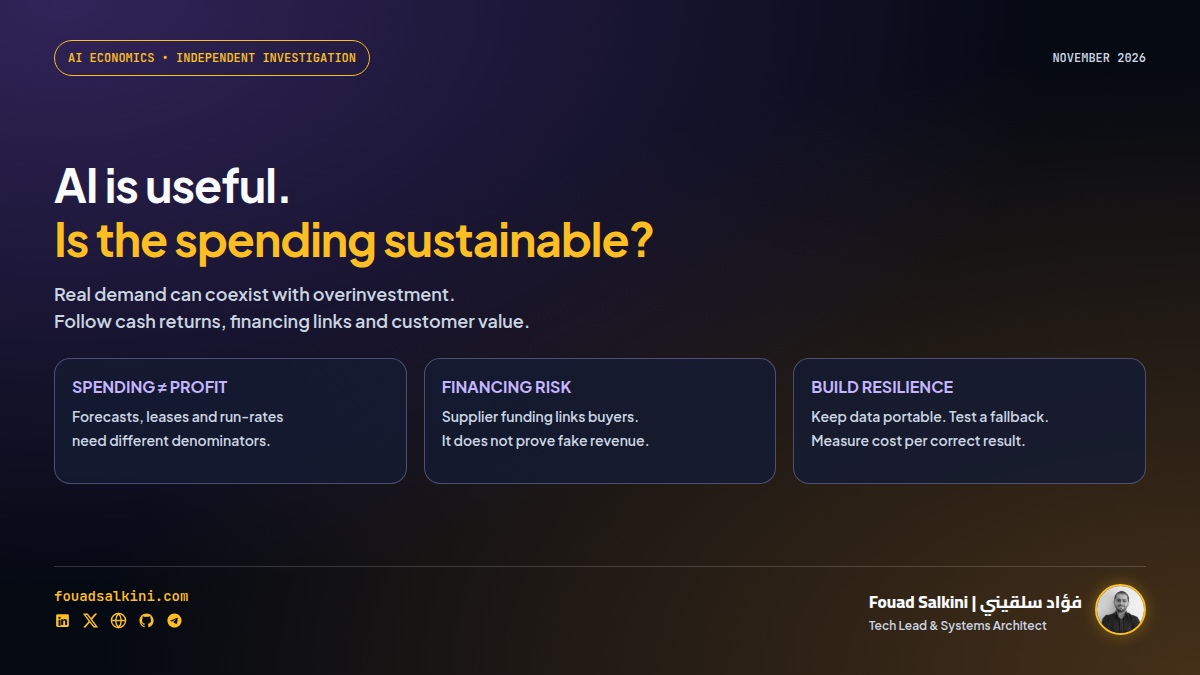
AI can be useful while some of the money invested in it earns disappointing returns. Treating those as contradictory claims makes the bubble debate harder to understand.
My conclusion after reading the underlying reporting, company announcements, quarterly financial statements and the IMF’s financial-stability analysis: the evidence supports serious overinvestment and financing risk in parts of the AI economy. It does not establish that every AI business is a bubble, that sales are fictitious, or that a crash has a known date.
This investigation separates completed results from forecasts and financing announcements. The distinction changes several of the most widely circulated numbers.
The $1.6 trillion figure needs its full definition
Fortune’s October 19 reporting on an October 15 Morgan Stanley note puts hyperscaler and AI-cloud-provider spending at $1.58 trillion in 2027. That is a forecast, not money already spent. It includes about $195 billion of data-center leases, which the bank calls “synthetic capex,” rather than only cash capital expenditure. The same report is bullish on the buildout while discussing financing, power and over-ordering risks. Its spending estimate is not a prediction that the industry will collapse. [1]
The revenue comparison often placed beside that number is narrower and measured differently. Yahoo Finance’s October 8 report, citing the Financial Times, put OpenAI’s September annualized revenue near $50 billion, alongside Anthropic’s $65 billion headline run-rate. Reuters reporting clarifies that Anthropic crossed that level in July, and that the companies use different treatment of cloud-partner sales. These are reported private-company figures, not independently audited annual accounts. [6][24]
An annualized run-rate extrapolates a shorter period across a year. It is neither the year’s revenue already earned nor profit. The revision from an earlier OpenAI estimate near $70 billion does not establish that $20 billion of completed sales disappeared. [6][24]
Subtracting two labs’ current run-rates from next year’s infrastructure investment does not calculate the industry’s loss. The spending covers a broader population, assets serve several years, and the revenue snapshots have different dates and accounting boundaries. A lab’s cloud payment can also be a cloud provider’s revenue; that provider’s chip purchase becomes a supplier’s revenue. Adding every layer’s gross sales would count intermediate transactions repeatedly.
A useful return analysis instead needs matched periods, utilization, operating margins, asset replacement costs and financing costs. Large spending numbers justify scrutiny; an incompatible denominator does not supply the verdict.
Earnings show genuine demand and pressure on cash
Microsoft’s October 28 call lowered its calendar-2026 capex expectation from approximately $175 billion to $170 billion, citing delayed third-party compute-capacity deliveries. Management expected spending to accelerate in January–June 2027. This is a timing-related guidance reduction, not evidence by itself that customers stopped wanting capacity. [13][23]
The completed September quarter’s Azure revenue growth was 48%, not the following quarter’s 49–50% constant-currency guidance. Azure includes core cloud services and AI infrastructure, so neither number is a standalone AI revenue-growth or profit measure. Microsoft also recognizes full finance-lease principal in reported capex at lease commencement; that is not identical to cash spent that quarter. [13]
Alphabet’s cash-flow statement gives a concrete sign of investment pressure. For Q3 2026, it reported $42.290 billion of operating cash flow and $51.355 billion of purchases of property and equipment. The difference is negative $9.065 billion of company-defined free cash flow. [14]
That is a consolidated quarterly cash-flow deficit, not “AI lost $9 billion.” Alphabet’s trailing-twelve-month free cash flow remained positive $19.747 billion. Its CFO also identified inventory buildup for TPU system sales and a $5.2 billion cash payment for an EC fine as pressures on operating cash flow. Omitting those details would overstate what this quarter proves about recurring AI economics. [14][21]
CNBC reported that Alphabet fell about 10% in extended trading after the results, alongside revenue and earnings misses. That is not a verified regular-session closing return, nor a controlled test showing capex alone caused the move. [4]
Meta’s Q3 release likewise reported negative $2.12 billion of free cash flow, despite generating $32.79 billion of operating cash flow. Its free-cash-flow definition subtracts cash principal payments on finance leases as well as purchases of property and equipment. Different companies’ “capex” figures cannot safely be compared without these definitions. [20]
These results support a more specific concern than “there is no demand”: investment can grow faster than internally generated cash, even at companies with substantial businesses and paying customers.
Supplier-funded customers create a shared downside
OpenAI’s February 27, 2026 announcement included $30 billion from NVIDIA in a new investment round and described a substantial NVIDIA compute relationship. It establishes an announced investment and a commercial link. It does not establish that the entire $30 billion arrived that day or provide a dollar-for-dollar trail from invested cash to recognized chip sales. [12]
Meta’s late-October financing illustrates why transaction status matters:
- The original plan combined approximately $35 billion of underwritten equity offerings with a prospective $60 billion at-the-market equity program. It was not a $95 billion loan. The filing said Meta had not entered an agreement for the future ATM program and gave no assurance it would be established or sell shares. [22]
- The common-stock offering was subsequently upsized from $22.5 billion to $25 billion. Together with the $12.5 billion preferred offering and the prospective ATM, that implies a $97.5 billion headline plan before options, not $97.5 billion already received. [17][22]
- Meta’s October 29 SEC filing confirms that the preferred offering closed. It explicitly says Meta would not initially receive proceeds from the forward sellers’ common-stock sale; the forward agreements provide for later settlement on or before November 19, 2027. [16]
- NVIDIA announced $3 billion and AMD $1 billion of participation in Meta’s equity offering. Those amounts belong inside the offering, not on top of the financing plan. The announcements alone do not independently verify each supplier’s final allocation or funded cash. [18][19]
Such relationships can fund real infrastructure and useful services. They can also make buyers’ expansion dependent on their suppliers’ continued financing.
If a buyer becomes distressed, the supplier may face an investment loss at the same time that expected orders weaken. The IMF calls this “wrong-way risk”: investment values and the associated future revenue streams deteriorate together. Its October GFSR examines disclosed financing links rather than assuming each commitment is completed revenue. [15]
Financing dependence is a credible risk channel. It is not, without transaction-level evidence, proof of fake deliveries or fraud. An equity contribution is financing for its recipient; a product sale is a separate accounting event. These announcements do not reveal how much end-customer demand would persist without further capital infusions.
Debt headlines and investor polls are easier to misread than they look
Yahoo Finance’s September 30 reporting on Barclays research says capital raised by hyperscalers, data-center vehicles and neoclouds rose from $172 billion in 2025 to $346 billion in 2026 to that date. The measure includes investment-grade debt, high-yield debt and equity. Calling all $346 billion “borrowing” turns a mixed capital-raising measure into a different statistic. It is also issuance over a period, not the stock of outstanding debt. [7]
The exact Barclays deal table was not available for this investigation, so refinancing exclusions, issuer coverage and potential overlaps cannot be reconstructed from the headline.
The October BofA survey adds evidence of concern, not a crash probability. Yahoo’s reporting says 45% of surveyed managers expected an AI bubble in 2027. The question concerns a bubble, not whether it would burst that year. The Wealth Advisor also reported technology positioning at its highest net overweight since August 2020. That is broad technology exposure and a survey response balance, not a measure of how much money all investors have allocated to AI. [5][25]
Investor anxiety can coexist with continued buying. It cannot identify the month when prices will reverse.
What the IMF warning actually says
The original October 2026 Global Financial Stability Report identifies an AI-driven correction, a sovereign-bond-yield shock and cyber threats as potential catalysts for market turmoil. Its wording is conditional: these risks “by themselves do not necessarily threaten financial stability”, but could become systemic if vulnerabilities amplify them. The chapter also finds aggregate bank capital resilient in its combined stress scenario, while weaker institutions remain exposed. [15]
That is materially different from “the IMF predicts an inevitable AI crash.” Concentration, leverage and connected counterparties determine how a disappointment could spread.
Gartner offers another explicitly conditional assessment. Its October 14 release says more than $3.5 trillion of AI infrastructure spending could be exposed to impairment by the end of 2030 if the investment trajectory continues. Its return model assumes a 12% return-on-invested-capital hurdle. This is a forecast under assumptions, not a loss already booked. Gartner also distinguishes diversified hyperscalers from neoclouds that need their compute businesses to pay for themselves much sooner. [9]
Neither a bullish spending forecast nor a bearish impairment model is a fact about future outcomes. Reading their assumptions is more useful than choosing whichever headline matches a preferred story.
My conclusion: prepare for uneven outcomes, not a single countdown
I see a real risk that some capacity, companies and valuations will fail to earn the returns currently expected of them. The strongest evidence is the combination of heavy investment, pressure on cash generation, greater outside financing and supplier/customer interdependence. Positive cloud growth does not erase those risks; financing risk does not erase the usefulness of AI.
Several paths remain plausible. Customer revenue and efficiency could grow enough to justify much of the investment. A less dramatic outcome is consolidation and write-downs concentrated among weaker operators. A funding shock could instead expose several linked businesses at once. These are scenarios, not assigned probabilities or a prediction of a 2027 crash.
I would become more comfortable with the spending if providers demonstrated sustained utilization, renewals with healthy margins after compute and support costs, stronger cash generation relative to commitments, and less dependence on supplier financing. Falling utilization, deteriorating credit access and more spending backed by the same small set of counterparties would move the assessment the other way.
Cheaper inference can help users while making some infrastructure bets harder to monetize. Stanford’s 2025 AI Index documents a historical fall of more than 280-fold in inference cost at roughly GPT-3.5 performance between November 2022 and October 2024. That is a fixed-performance historical comparison, not a guarantee that today’s frontier agents or complete workflows will get cheaper at the same rate. [10]
Wholesale compute discounts and tighter consumer subscriptions could coexist in a restructuring. They are not assured. Power, utilization and hardware replacement still matter; a discounted accelerator is not free to operate.
What to do if your work depends on AI
You do not need to predict markets to reduce operational exposure:
- Keep exports of important documents, prompts and workflow definitions outside a single provider’s account.
- Test a fallback on your actual tasks. A second API or a local model only counts as a fallback if its quality, privacy, licensing and operating costs are acceptable.
- Budget for retries and human review. Measure cost per correct, accepted result, not just token price or the advertised monthly allowance.
- Avoid a business model that requires a provider to preserve an unlimited promotional plan forever.
- Build customer value you can retain when the underlying model changes: useful workflows, distribution, integrations and domain knowledge. Using another company’s model does not automatically make a product disposable, and owning a model does not automatically make a business sound.
For developers, keep learning systems design, testing, data handling and cost control alongside AI tools. For everyday users, keep your data portable and avoid commitments that only work under today’s subsidized pricing.
The sensible response to an uncertain investment cycle is to make your work useful and portable, rather than make it depend on a crash prediction being right.
Research scope
Sources checked through November 5, 2026. This is a public-source investigation, not an audit of company books or a valuation model. Corporate quarterly statements are unaudited company reports. Private-lab run-rates remain attributed reporting. The full Morgan Stanley and Barclays analyst notes, BofA questionnaire and complete FT article were not accessible; their findings are attributed to the readable original reporting, not presented as independently reconstructed research. This article offers operational analysis, not a recommendation to buy or sell securities.
Sources
[1] https://fortune.com/2026/10/19/nvidia-concentration-hyperscaler-1-6-trillion-92-percent-exposure — Morgan Stanley’s favorite AI stock is 92% exposed to the $1.6 trillion buildout it’s bullish on | Fortune [4] https://www.cnbc.com/2026/10/29/microsoft-google-ai-capex-estimates.html — AI buildout hits snag as Google and Microsoft put off raising capex forecasts [5] https://www.thewealthadvisor.com/article/fund-managers-are-more-exposed-tech-any-time-2020-nearly-half-expect-ai-bubble — Fund Managers Are More Exposed To Tech Than at Any Time Since 2020. Nearly Half Expect An AI Bubble. [6] https://finance.yahoo.com/technology/article/openais-annualized-revenue-20-billion-lower-than-prior-investor-estimates-174058048.html — OpenAI’s annualized revenue $20 billion lower than prior investor estimates [7] https://finance.yahoo.com/markets/stocks/article/debt-is-fueling-the-ai-boom-and-warning-signs-are-flashing-094352460.html — Debt is fueling the AI boom, and warning signs are flashing [9] https://www.gartner.com/en/newsroom/press-releases/2026-10-14-gartner-says-over-us-dollars-three-and-a-half-trillion-of-artificial-intelligence-infrastructure-spending-could-be-exposed-to-impairment-by-the-end-of-2030 — Gartner Says Over $3.5 Trillion of AI Infrastructure Spending Could Be Exposed to Impairment by the End of 2030 [10] https://hai.stanford.edu/ai-index/2025-ai-index-report — The 2025 AI Index Report | Stanford HAI [12] https://openai.com/index/scaling-ai-for-everyone — OpenAI February 27 financing announcement [13] https://www.microsoft.com/en-us/investor/events/fy-2027/earnings-fy-2027-q1 — Microsoft FY27Q1 official earnings transcript [14] https://s206.q4cdn.com/479360582/files/doc_financials/2026/q3/2026q3-alphabet-earnings-release.pdf — Alphabet Q3 2026 unaudited earnings release [15] https://www.elibrary.imf.org/display/book/9798229055673/CH001.xml — IMF October 2026 GFSR Chapter 1 [16] https://www.sec.gov/Archives/edgar/data/1326801/000119312526438017/d183592d8k.htm — Meta October 29 financing 8-K [17] https://investor.atmeta.com/investor-news/press-release-details/2026/Meta-Announces-Pricing-of-Offering-of-Depositary-Shares-Representing-Series-A-Mandatory-Convertible-Preferred-Stock-and-Offering-of-Class-A-Common-Stock-in-Connection-with-Forward-Sale-Agreements/default.aspx — Meta priced equity offering [18] https://ir.amd.com/news-events/press-releases/detail/1302/amd-and-meta-advance-strategic-partnership-to-power-metas-superintelligence-infrastructure — AMD Meta investment announcement [19] https://nvidianews.nvidia.com/news/nvidia-and-meta-to-expand-collaboration-on-muse-and-muse-family-of-models-amid-robust-growth — NVIDIA Meta investment announcement [20] https://investor.atmeta.com/investor-news/press-release-details/2026/Meta-Reports-Third-Quarter-2026-Results/default.aspx — Meta Q3 2026 results [21] https://abc.xyz/investor/events/event-details/2026/2026-Q3-Earnings-Call-2026-Ujou16CTw9/default.aspx — Alphabet Q3 2026 call and cash-flow context [22] https://www.sec.gov/Archives/edgar/data/1326801/000119312526431036/d116268dfwp.htm — Meta initial financing plan and prospective ATM [23] https://www.microsoft.com/en-us/investor/events/fy-2026/earnings-fy-2026-q4 — Microsoft July 2026 calendar capex forecast [24] https://www.channelnewsasia.com/business/openais-september-annualized-revenue-nears-50-billion-less-previously-indicated-source-says-6444566 — Reuters OpenAI run-rate reporting via CNA [25] https://finance.yahoo.com/markets/article/fund-managers-wont-dump-stocks-for-bonds-until-yields-hit-59-bofa-survey-says-chart-of-the-day-161252255.html — Yahoo October 13 BofA survey reporting

Written by Fouad Salkini (فؤاد سلقيني)
General Manager & Tech Lead at Tripnologies and Sync Studios. Systems Architect focusing on AI coding agents, DevOps, and quantitative systems.